Tag Archives: career and college readiness

I Want to Quit (My Career)


Talent Management MagazineThe July 2013 issue of Talent Management Magazine, a respected journal for human resources executives, highlighted some new statistics that reinforce what I’ve been trying to communicate to parents, high school administrators and college and university career centers for some time now – “what you are doing isn’t working!”

Here are excerpts from the article…you be the judge


First there was the Gallup survey that came out in early June 2013, which found the majority of American employees (70 percent) were either not engaged or actively disengaged with their work.

As if that wasn’t enough to raise red flags for employers who care about and are tracking employee engagement, a new Harris survey for the University of Phoenix in Arizona that was released July 8, 2013 showed that more than half of U.S. employees want to change not only their jobs, but their careers.

Apparently, only 14 percent of workers say they’re in their dream careers.

Some of you may not be surprised to learn this feeling is more pronounced among workers in their 20’s (80 percent), but it’s certainly not specific to this demographic alone: Sixty-four percent of those in their 30s want to change careers and 54 percent of those in their 40s reported the same.

Is this the classic “grass is greener on the other side” syndrome? Maybe. Or perhaps it’s the fact that the unstable economic environment coupled with debilitating student loan debt coerced many graduates to scrounge up any kind of employment they could secure just to have a steady cash inflow. Consider that nearly three-fourths of those surveyed (73 percent) said they didn’t end up with a job they had originally anticipated when they were younger.

And before you go on a rant about how flaky millennials are, you may be surprised to learn that those in the upper echelons of corporate America are among those who want to sign up for a different career. Nearly half (43 percent) of C-level executives said they were somewhat interested in switching careers, while 26 percent expressed a stronger desire to do so.

Offering lateral moves and defining a clear career path for employees might not be the silver bullet when it comes to engagement and retention problems, but it’s a start.


Employers can’t fix this. And then there are high schools and colleges continuing to do the same things they’ve been doing for the past 10+ years, only now the high schools have teacher productivity work flow tools in the cloud (Naviance, XAP, etc.) to help track high school student college readiness tasks.

This is a wake up call. Want to decrease student loan debt? Get smarter about planning career and educational strategies. You can delegate career exploration and career matching to an overworked high school counselor with outdated assessments or delay this work until college where students are going in undeclared, changing majors 3 or 4 times and taking 5 years to graduate at a cost of thousands of extra dollars. Or you can take a proactive approach and do something different.

Better Career Planning Better Lifehttp://www.careercoachingforstudents.net

Carl Nielson is Chief Discovery Officer of Success Discoveries and Managing Principal of The Nielson Group, an organizational development consulting firm that provides executive development coaching, team development and assessments for hiring. As creator of the Career Coaching for Students program for high school students and Career and Success Skills Mastery for College Students and Recent Grads, Carl has helped thousands of students find a better way through the career exploration process that works.  Assessment and coaching packages start at $349 – checkout the Summer 2013 special offer – 30-days coaching support with the Home Study student career coaching package.
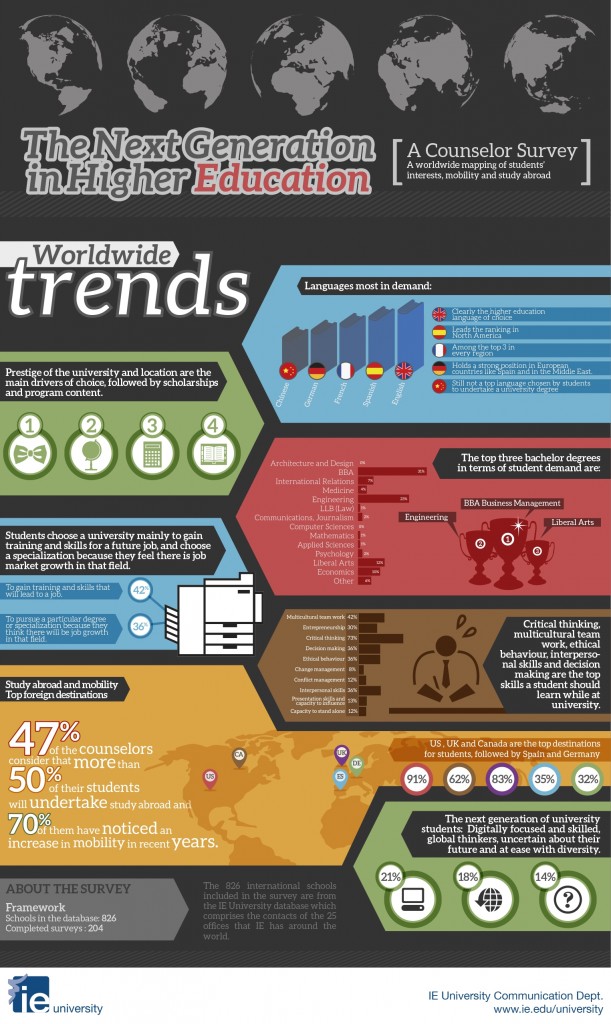

Survey Identifies How Students Choose Their College or University


Infographic_TrendsinHigherEd204 university counselors in 33 countries took part in an IE University survey designed to pinpoint the interests and preferences of the upcoming generation of university students with regard to study abroad and most popular degree programs.

The survey shows students choose a university mainly to gain training and skills for a future job, and choose a specialization because they feel there is job market growth in that field. When asked about the main reasons for choosing a university, counselors cited:

Main drivers

  • Prestige
  • Location

Secondary consideration

  • Scholarships
  • Content

These findings suggest there is either a lack of appropriate guidance at the high school level or students are dismissing better advice for how to choose a college or university.

With the percent of students changing majors 2, 3 or 4 times, taking 5 years to complete a 4-year degree and student retention and graduation rates dropping, students need to take a smarter approach to choosing a college or university.

The fact that students list prestige as the #1 consideration creates immediate risk for the student. By not considering newer institutions, that may actually be way ahead of their more traditional and prestigious counterparts, students are missing out on some possibly better choices. But even if your needs are best served in one of the more traditional universities, the most prestigious option may not have the best program for your area of study. Prestige alone is not a good reason to choose a college or university.

The best order of consideration and prioritizing that has been shown to produce the best choice (high satisfaction with choice, retention, graduation in expected time frame) for the student is:

  • Determine career interest(s)
  • Determine education requirements for the career interest(s)
  • Create an education strategy (choice of majors, field of study)
  • Research and identify colleges/universities or vocational learning institutions that are leading in the chosen field(s) of study (a high level of prestige for the specific subject area)
  • Rank findings to create a short list of institutional choices
  • Conduct on-campus visits to all short-listed choices
  • Make the choice

With the cost of higher education so high, a one-semester course correction costs thousands of dollars. By following a smart strategy for decision-making, students can avoid that unnecessary added expense and be much happier with their choice. But it requires students to change the way they think about school choices.

Carl Nielson is an organizational development consultant, executive development coach, career coach and author of the Career Coaching for Students program for high school students and the  Career and Success Skills Mastery for College Students and Recent Grads. Assessment and coaching packages start at $349 – checkout the Summer 2013 special offer.


7 Myths About Career Exploration in High School


5 Myths about Career Exploration blog picAround 2004, as a parent with kids approaching high school, I found myself curious about the “state-of-the-art” in career exploration and coaching that the students would receive. As a corporate organizational development consultant and executive coach, focusing mainly on adults either in career transition or executive/high-potential development, I had some insight into “talent” and success in life and work.

My adult clients would ask me to coach their “graduating senior in college” who hadn’t figured out what they wanted to do with their life. That was a warning sign to me – not about the person but about the system. How could a student go all through high school, choose a major, complete an undergraduate degree in college and not have a clue about what they wanted to do? What was the root cause of the failure? What was being done to help students and why was it not working?

Fast forward to 2013, and nothing has changed. Students continue to struggle with who they are and how their personal talent design connects to career choices and educational strategy. In some ways, it comes down to something even broader – learning how to make big decisions. But I am finding the same assessments used in 2004 are being used today. And schools are letting technology deliver career coaching.

Based on what I am seeing and hearing from school administrators, parents and students, I’ve put together a list of myths that are in desperate need of being corrected. These myths are prevalent with teachers, counselors, school boards and parents. See if you carry some of these myths as your own beliefs:

  • Myth #1 The high school has this covered. They’d like you to believe they’ve got career exploration covered. Even community colleges and universities want you to think they’ve got it covered. Be wary of the high school’s use of buzz words and descriptions of programs. For example, “all students take one or more career assessments to help them identify careers” may be technically true as a task they have the students complete. Ask your son or daughter what they thought of the assessment results. Ask them to show you the report. Ask them how the results are being used and what are they doing for career exploration. And for the bottom line question, ask them if they feel they are getting appropriate and tangible support for identifying and evaluating personal career options.
  • Myth #2 The assessments used by your high school are valid and insightful. The best way to check this myth is to take the assessments yourself and check your reaction to the report. As for technical information about the validity and reliability of the assessments, the school’s website will point you to the organization’s website that produces the assessments. With a little digging, you’ll find some kind of statement about validity and reliability. Some assessment companies will actually state “this type of assessment does not fit the criteria for validity and reliability studies”.  Taking the assessments yourself will surely enlighten you to the horribly designed assessment that is expected to “tell” your student which careers will be best for them. But even if you were to accept the quality of instrument as credible, what insights has it produced for the student?  What insights has the student learned about themselves after taking the assessment?
  • Myth #3 Counselors and teachers are focused on this. Ask a counselor about the amount of time they focus on coaching students in making career decisions and they will start explaining (after they stop laughing) how their day, week and semester is spent. It isn’t focused on coaching students in career decisions. Some counselors are leaving schools because their job isn’t about helping students, its about pushing paper.
  • Myth #4 The paid-with-tax-dollars school-site subscription to a cloud-based software program (Naviance, XAP, etc.)  is focused on helping the student find their path in life. Actually, many of these site-licensed “portals” are administrative tracking systems to help teachers be more productive. It is possible they also help students to be more productive with the college application process too. However, the primary focus isn’t on helping a student gain insight into who they are and what they want to become (even though the web-based marketing lingo sounds like they do focus on this). These systems are more focused on workflow management, specifically, “the process of getting students into college”. Who cares if the reason they are going to college is faulty or once they get there they change majors 3 times and graduate in 5 years. Put the ladder on the wrong building and you get to the top of a building with no purpose for being there.
  • Myth #5 High school students are too young and immature to focus much on career exploration or make any kind of career choice. This one is mostly on the parents. All I can tell you is if you think this, you are wrong. I am consistently amazed at the level of engagement and deep thinking that students put into developing a future direction, career exploration, choosing a major, choosing the right college for what they want to do and setting goals for themselves. Even those students that start the Career Coaching for Students program with less maturity quickly shed that cover and engage effectively. Watch for the colleges and universities to  empathize with the “high school is too early to know what you want to do with the rest of your life” thinking. The standard language at on-campus college visit presentations is to tell the student and parents it is perfectly fine to come in “undeclared” and take a year or two to decide what to study. Sure, you can start taking the “required Freshman classes” and a few electives to see what floats your boat. In the meantime, some students are figuring out a lot while still in high school and walking into college with a clear plan that may include double majoring, targeting specific companies for internships and obtaining summer jobs that will give them experience that makes them a top prospect upon graduation. In the meantime, being undeclared seems like a slow path to nowhere, and let’s not to mention the extra expense (thousands of dollars) for changing majors and extending the college stay by just one semester. Oops, I guess I did.
  • Myth #6 High achieving students don’t need as much career exploration support. One of the most challenging (and exciting) situations in coaching students is when the student is “All American” (or “All Canadian” for my Canadian readers). You know the type – very high GPA, active in sports, band, club officer, outside activities, loved by the teachers, respected by the administration, etc.).  The fact that these special individuals have so many capabilities, they have the most choices available to them. Many of these report feeling that they are expected to just know some how what they are going to do. The pressure to have a career direction figured out “on their own” is tremendous. From where I sit, there is no class of students that holds some special psychic ability to know what they want to do. All groups of students from under-achievers to over-achievers need professional career coaching.
  • Myth #7 Career exploration and planning is a “nice to have” but not the primary purpose of high school so it doesn’t deserve the funding or attention in high school. Many research studies have shown a clear connection between a student’s clarity about their future and their level of engagement in school. The result – higher academic achievement. If a student is under-performing academically, there is a good chance it is because they don’t see the potential in themselves and how that potential relates to a future. Many parents have reported back to me that their son/daughter raised their GPA the very next semester after going through the Career Coaching for Students program. But it doesn’t stop there. Students who were never on the academic honor roll in high school, and went through the Career Coaching for Students program their senior year were found two years later to have been on the Dean’s list at college every semester. The studies say this happens with credible career coaching at the high school level. Our experience is saying the same thing.

Carl Nielson is an organizational development consultant, executive development coach, career coach and author of the Career Coaching for Students program for high school students. For information about career direction and job search coaching for college students, check out Career and Success Skills Mastery for College Students and Recent Grads. Assessment and coaching packages start at $349 – checkout the Summer 2013 special offer.