
Tag Archives: career exploration program for students

Do I Need to Have A Career Plan in High School?


dream-job-nextexitThe old saying “what you don’t know won’t hurt you” means if you do not know about a problem, you will not be able to make yourself unhappy by worrying about it. That belief is supported by the belief “ignorance is bliss“.

When it comes to creating/having a career plan, focusing on it (worrying about it) will actually create a great deal of happiness, help you avoid major stress and save you (and/or your parents) thousands of dollars. Based on almost daily news, the amount of college loan debt has escalated to levels considered very dangerous for our economy and for individuals. Having excessive education loan debt is a personal accountability issue – not a national economy issue.

How much debt do you want or plan to have when you graduate college? According to an article in the Huffington Post, “the average college graduate obtained a degree in 2012 with $29,400 in student debt, up from $18,750 less than a decade before in 2004, according to a new report.” To avoid unnecessary costs (which frequently ends up becoming debt) during college, avoid changing majors and choose the right college or university for you. If you are unsure about a career direction and go into college as an “undeclared major” you are likely to not have any revelations about a career direction by the end of your Freshman year. Whether you put it off or tackle career planning in high school, the only way to avoid unnecessary expense and find true happiness is to do the career planning work.

So, the short answer to the question, Do I Need to Have a Career Plan in High School?, is that you need to be doing the work of creating a career plan. The Career Coaching for Students program looks at this work as developing Decision Making skills. Decision making is a recognized skill of highly successful people and happens to be one of the weakest skills for incoming Freshman in college. You don’t necessarily need to have made a career decision but you need to be well on your way to identifying and understanding your career interests and the strengths, weaknesses, opportunities and threats associated with your career interests.

A career plan is the reward for the work you’ll do to determine your skills and interests, what career best suits your talents, and what skills and training you need for your chosen career.

By developing a career plan, you can focus on what you want to do and how to get there without worrying and without unnecessary expense. To do this well, you must start with a “professional-grade assessment” that helps you understand your personality strengths. Career planning is only one benefit of using assessments to become much more self-aware.  You’ll also find you will have a better understanding of your skills and experiences to discuss with potential employers (on your resume and in future interviews).

To eventually have a defined career goal, get started now.

A career goal can be a specific job you want to do — such as doctor or teacher — or be a particular field you want to work in, such as medicine or education.

Rather than limiting your future, a career goal may help you discover career possibilities you wouldn’t have thought of otherwise. There are several job possibilities with any chosen career. For instance, if you choose a medical career, you may want to be a scientist, a nurse, or a doctor.

A career goal can also guide you into doing what you want with your life.

  1. Become Self-Aware.
  2. Identify Career Interests.
  3. Narrow your career interests to a top two or three.
  4. Determine what you need to do to prepare for your chosen career.
  5. Besides the right college major, do you need special training? Some careers need the specialized training but don’t require a college degree. If so, find out what schools offer the training you need. Also, determine what kind of experience will you need to be successful in the career. Consider an internship as a way to get work experience in the career field.
  6. Write your career plan.  Use online tools to help you create a visual career plan.

Carl Nielson is Chief Discovery Officer of Success Discoveries and Managing Principal of The Nielson Group, an organizational development consulting firm serving Fortune 100 company clients. As creator of the Career Coaching for Students program for high school students and Career and Success Skills Mastery for College Students and Recent Grads, Carl and his team of licensed facilitators across North America have helped thousands of students find a better way through a career exploration process that works.  Self-directed assessment and career exploration coaching packages start at $399. Local public workshops, distance-coaching and in-school programs available. Call for more information at 972.346.2892.


5 Things Lucky People Do


Luck starts with a plan and action“The Luck of the Irish” is an American phrase that comes from the days of the gold rush in the 1800s.  Intolerant Americans figured the Irish people weren’t smart enough to find gold, and blamed their success on being lucky rather than skilled. In reality, America’s early immigrants have time and again proven themselves to be hardworking and smart enough to generate their own good fortune consistently.

We often excuse our own inadequacies by crediting the success of others to luck.  If everyone went at their personal goals with the level of commitment and follow-through as the “lucky ones” the probability of success becomes fairly equal. In baseball terms, the big hitters are simply swinging the bat more often.

good_luck_four_leaf_cloverThe truth is that seemingly lucky people are opportunists. They do things to be prepared so that they are ready to take advantage of the world around them. For them, it’s not about being in the way of good luck or bad. It’s the actions they take to get what Jim Collins refers to as a high return on luck whichever way the pendulum swings. Follow these five tips and you can be as lucky as anyone, no four-leaf clover required.

1. Play to your strengths. So much time and energy is wasted trying to do things you probably don’t do very well. Author and Inc. columnist Lewis Schiff learned from his survey of incredibly wealthy people that they got that way by focusing only on what they do best. Choosing a career that aligns with your personal motivation and talents gives you an advantage over 50% of those currently in the workforce. By knowing your strengths and weaknesses, you will shine where you excel and attract opportunity. You’ll find ways to compensate for your weaknesses, such as delegating or partnering with someone that has your weakness as a strength. Good things come to those who emanate success.

2. Prepare in advance. Unlucky people often get that way because they’re reactive and unprepared for whatever comes. The college student who chooses to organize and follow a self-study program so they can take and pass a difficult certification exam outside of their course work – just so they are better qualified to secure a key summer internship – are expecting to be successful. They wouldn’t consider themselves lucky when the internship offer comes. Some people consider planning to be useless because everything changes and you can’t predict the future. The point of a plan isn’t to follow it no matter what, it’s to establish a structure for smart decision making that allows you to succeed no matter what the future might bring.

3. Start early. Some people seem to have more hours in the day. They get that way by planning projects in advance – this gives you the extra time you need – and then using a disciplined approach to allocating time on a consistent basis. Make promises to yourself using integrity to hold yourself personally accountable. So many people only want to put their energy into things that provide immediate gratification. The most fortunate people I know are the ones who planted seeds early and took the blind leap of faith that the investment in time would be personally rewarded exponentially.

4. Connect with as many people as possible. The key to success is access to opportunity. Access comes from influence. If you aren’t meeting people of influence regularly, your ability to access opportunities is limited. In a way, your network of influencers becomes your following. The bigger your following, the more opportunity you are being exposed to. The only way to build a big following is to provide value to many people. You have to provide the sort of value that will cause people to think of you at the right time. Influencers take great joy in knowing a wide range of people and recommending or connecting others. Being open and making yourself available to be known is a kind of value. Are you creating that kind of value? If not, figure how you can. Being an influencer isn’t important, being of value to influencers is critical. If you want more luck, you’ve got to break out of your cocoon.

5. Follow up and be of value. Opportunities often come and go because people don’t respond in a timely manner. I’m constantly amazed when people ask me for something and I respond immediately only to never hear from them again. I make it my business to know and recommend only the best ideas – whether to family, friends, colleagues or clients. That takes work – which I am always glad to do. I believe that following up is often more powerful and impressive than the act of initiating. I have learned to become wary of those that use me for my ideas and never seem to see the need to be of value to me. To be of value to me is simple. It could be as simple as letting me know you followed my advice and the outcome (the value of letting me know I was helpful). On a bigger scale, in a business context, it could be that you recommended me to someone that would benefit from my services (The Nielson Group or Success Discoveries) or, if you were in a position of authority in an organization, and recognized how I could help, that you made it a priority to introduce me to those stakeholders that need to know I exist. Whatever you do, don’t allow yourself to be seen by others as a user. User equals looser in the end. Following up is simple.

May you be so lucky to have people in your life that follow up. So start creating your own luck. Now.

Is Choice of College Setting Your Destiny?


Your destiny based on college choiceThe article in the Washington Post, The Resume That Makes for a Top Executive, by Gena McGregor, references a new study published this week in the Harvard Business Review, which provides a snapshot over time of the demographics and career trajectories of Fortune 100 executives. The study shows how much the boardroom is changing. Not all students are interested in becoming the next CEO of Google, but choosing a college continues to be riddled with anxiety for those that have choices. The study’s data reveals some changes that are worthy of noting for any high school student (or parent) struggling over which college/university will be best – regardless of career direction.

The study states the majority of top executives now have undergraduate degrees from state universities, with only a fraction going to college at one of the Ivies. Nearly 11 percent of the top executives are foreign-educated, up from just 2 percent in 1980. And however few women there may be in leadership positions, they actually climbed the corporate ladder faster than men, spending fewer years, on average, in each job and taking a shorter time to get to the top.

The research, an effort by professors from the University of Pennsylvania’s Wharton School and IE Business School in Madrid, compiled the backgrounds of the top 10 executives at each Fortune 100 company in 2011 — those who might be called the most powerful 1,000 people in corporate jobs. They conducted the same study in 1980 and 2001.

What has interested people most about their study has been the details about where executives got their education. “I was surprised that’s been such a remarkably big deal for most folks,” Cappelli says. “I guess it’s something that makes people think about their children. Anyone with kids is thinking about these roles, and it’s an aspect of inequality that’s very noticeable to people.”

The study shows the education backgrounds of top corporate leaders are becoming much more equal over time. In 1980, just 32 percent of leaders went to a public university. By 2001 that had grown to 48 percent, and in 2011 the number reached a majority, with 55 percent of corporate leaders going to state colleges. While the percent of Ivy Leaguers has dropped slightly, from 14 percent in 1980 to 10 percent in both 2001 and 2011, those with degrees from private non-Ivies has plummeted, falling from 54 percent in 1980 to just 35 percent in 2011.

Why are we seeing so many more corporate executives from public universities? More meritocratic corporate cultures could be playing a role, Cappelli notes, but he thinks it’s mainly due to history. “It’s a bit of an archaeological story,” he says. “If you think back to when the executives now went to school, around 30 years ago, it was sort of the…golden era of state universities, which really boomed in the late ’60s and ’70s. Schools like Michigan and Berkeley — they were building these fabulous campuses, and pulling people in who would have otherwise gone to Ivy League schools.”

That’s not to say elite schools don’t still hold sway among MBA-holders and the very top leaders. If you look at the three most senior executives in each organization (say, the CEO, CFO and Chairman), 21 percent have an undergraduate degree from an Ivy League school, compared with 10 percent overall. Additionally, 40 percent of all the executives who hold MBAs got them at one of the top 20 ranked business schools in the country, many of which are at Ivy League universities.

Another way the makeup of the boardroom is changing, of course, is in the number of women. Like other studies before it, the Wharton/IE Business School professors counted the number of women at the top, finding that almost 18 percent of the top jobs were held by women in 2011. That’s a massive swing from 1980, when they reported finding no women among the top 1,000 corporate leaders.

More interesting than the stubbornly few number of women at the top, however, was the finding that women are managing to reach the top faster. It took women an average of 28 years to reach the “top-tier positions” (CEOs, vice chairs, presidents and the like), compared with 29 years for men. Women reached “middle-tier” jobs (executive VPs, general counsels, chief marketing officers) in 23 years, compared with 26 years for men. In addition, women were promoted quicker in each of their jobs, at an average rate of every four years, while it took men five.

Cappelli offers three explanations for why this might be. One, he says, could be an explicit effort by companies to get women into top jobs faster. “It’s possible that a type of affirmative action is going on,” he says. Another could be that the talent pool of women in these executive jobs is simply better. Because we see more women than men change work paths or drop out of the workforce in the middle rungs of their career, he says, it’s possible “the women are actually better because they’re self-selecting.”

Finally, Cappelli suggests, the difference may be due to the fact that there are more women in functional jobs — such as human resources, legal or marketing — for which the technical expertise needed means they’re promoted more quickly. In the report, the researchers call it “riding a different elevator.”

“If you’re going up through a functional track,” Cappelli says, “you could be advancing at a very different pace than the folks who are going up through operations jobs” that may require more rotations or longer tenures at each stop along the way.

Quirks about the leadership ranks at different companies, and what they might reveal about the different corporate cultures, may be even more interesting than the broad-based trends the study found. For instance, the average length of a top Google executive’s career is just 14 years (the shortest in the Fortune 100) while at Hewlett Packard and ConocoPhillips, it’s 32 years (the longest). Meanwhile, some companies have outstanding male-to-female ratios among the top 10 execs — at Target, Lockheed Martin and PepsiCo, women hold half the senior management jobs — while as of 2011, there were still 17 companies in the Fortune 100 with no women at all among their top 10 leaders.

To Cappelli, this is among the most interesting of the study’s results. “They’re all just so different,” he says. “There’s a UPS model, there’s a Google model and there’s an Exxon model. The idea that there is a corporate model of leadership just doesn’t seem to resonate any more.”

The take-away – Strategically narrow your college choice

Many high school students choose a college mainly on emotional criteria. The following is based on a study by the University of California—Los Angeles‘s released in January 2013, “The American Freshman: National Norms Fall 2012.” The 2012 study is based on the responses of 192,912 first-year students at 238 U.S. four-year colleges and universities who entered college in fall 2012.

Strategic Reasons Emotional Reasons
1. College has very good academic reputation (63.8 percent) 5. A visit to this campus (41.8 percent)
2. This college’s graduates get good jobs (55.9 percent) 6. College has a good reputation for its social activities (40.2 percent)
3. I was offered financial assistance (45.6 percent) 10. I wanted to live near home (20.1 percent)
4. The cost of attending this college (43.3 percent) 11. Information from a website (18.7 percent)
7. Wanted to go to a college about this size (38.8 percent) 12. Rankings in national magazines (18.2 percent)
8. College’s grads get into top grad/professional schools (32.8 percent) 13. Parents wanted me to go to this school (15.1 percent)
9. The percentage of students that graduate from this college (30.4 percent) 16. High school counselor advised me (10.3 percent)
  18. Athletic department recruited me (8.9 percent)
  19. Attracted by the religious affiliation/orientation of college (7.4 percent)
  20. My relatives wanted me to come here (6.8 percent)
  20. My teacher advised me (6.8 percent)
  22. Private college counselor advised me (3.8 percent)

To make the best choice, identify your personal preferences for industry and career direction first (you can still be somewhat general but the more clarity the better at this stage). Then research which universities are tied into those industries and are academically highly ranked for the major you are wanting. Look for major corporate donors to a university to see the connection. As they say, follow the money trail. Another way is to call the placement office and ask which companies consistently hire interns (in your major) from the university’s student population.

Carl Nielson is Chief Discovery Officer of Success Discoveries and Managing Principal of The Nielson Group, an organizational development consulting firm that provides executive development coaching, team development and assessments for hiring. As creator of the Career Coaching for Students program for high school students and Career and Success Skills Mastery for College Students and Recent Grads, Carl and his team of licensed facilitators across North America have helped thousands of students find a better way through a career exploration process that works.  Self-directed assessment and career exploration coaching packages start at $399. Local public workshops, distance-coaching and in-school programs available. Call for more information at 972.346.2892.

This Is Your Time


dream-job-nextexitThe world of work is Darwin at its’ best…survival of the fittest. Ask any recent college grad or professionals that have lost their job within the last 6 or 7 years. As a student career coach (and in adult coaching sometimes as well), most high school students and many college students are challenged to engage in researching and planning for their future. For some, lack of confidence or fear makes the entire idea of investigating and planning for a future to be very intimidating. I use the following questions when I see a person struggling to engage or seems to have a lack of confidence:

Low level of confidence/lack of engagement

  1. What makes you think this isn’t the best time to do career exploration and planning?
  2. What makes you think that you have a low confidence level?
  3. What do you want to do about it? Something? Nothing?
  4. If you are not going to do something about it, who will?
  5. If you are going to do something about it, how will that help you reach your goal?
  6. What are your goals?

Help for those that don’t know what they want to do

  1. Know that a goal without a plan is merely a dream. Dreams rarely become reality. Plans almost always become reality.
  2. What DON’T you want to do? There may be options or a “plan B” that others are suggesting you pursue. Think with integrity about what you don’t want to do. Own it. Move on.
  3. Examine the current job market supply-and-demand ratios. Within Student Resource Central, we offer several excellent career research sites that provide quick information about high growth jobs and industries.
  4. How does your current interests and background fit with these ratios. Use assessments (for high school students or for college students) to provide a more structured and valid approach to examining your interests and “fit” to different career possibilities.
  5. Choose a career field to research – research it thoroughly. You aren’t making a decision here, just research.
  6. How can you gain more insight (talk to people in the career) and experience (internships) to further investigate the career of interest?

It should be reinforced that even if a student does everything above (as well as much more) there is no guarantee of employment today or tomorrow. Be prepared to reexamine and reinvent as you walk the path.

Carl Nielson is Chief Discovery Officer of Success Discoveries and Managing Principal of The Nielson Group, an organizational development consulting firm that provides executive development coaching, team development and assessments for hiring. As creator of the Career Coaching for Students program for high school students and Career and Success Skills Mastery for College Students and Recent Grads, Carl and his team of licensed facilitators across North America have helped thousands of students find a better way through a career exploration process that works.  Assessment and coaching packages start at $399. Local public workshops, distance-coaching and in-school programs available. Call for more information at 972.346.2892.

11 Pieces of Career Advice That go 95% Ignored


Originally posted on July 21, 2013 by  Mark Babbitt, founder of YouTern, a site for student internships.

Take the AdviceNo matter how many times mentors say them, there are pieces of advice – golden nuggets of been-there-done-that wisdom – that no one (okay, almost no one) ever follows.

Not the clichés you see every day like “Become a morning person”. Or the false-positive, affirmation-ridden stuff like “Make someone happy… with a smile!” Nor are these the really bad bits of advice dispensed so often we accept them as fact, like “Follow Your Passion”.

These never-fail insights would make a significant impact on the lives and careers of many… if (sigh) anyone would actually follow the advice:

1.  Follow Up

As a society, we suck at following up. I have no idea why… laziness; fear of success; a failure to prioritize, perhaps. I just know that about 2% of those who take a business card, or say they will follow up – after a tweet, phone call, one-on-one meeting, networking function, etc. – actually do.

Want to stand out among all your competition – no matter what you hope to achieve? Follow up.

2.  Personalize Everything

Think those generic connection requests on LinkedIn and auto-DMs on Twitter will get you noticed in a positive way? Think that generic cover letter and resume will get you an interview? Think that email template you send to potential mentors will be the beginning of a valuable relationship?

Your thinking… is wrong. In today’s world, every communication you send must be personalized. Period.

3.  Make a To-Do List

“I don’t do to-do lists” is one of the biggest red flags in the professional world. No matter how you keep track – pen and paper, smartphone, laptop, iPad – a to-do list is a mandatory element of staying organized and being able to properly prioritize your next activity.

Don’t come by list-making naturally? Try the “CNN” method of listing tasks, which by default helps you prioritize: C = “Critical”. N = “Need to do”. N = “Nice to do”. Works, every time.

4.  Find a Mentor (Lots of Mentors!)

One of the key traits of crazy-successful young careerists comes down to one thing: the existence of professional mentors. Perhaps a stable of them, or a “Personal Board of Advisors”.

Not sure where to find mentors? LinkedIn Groups are a place to start. Or visit #InternPro chat and/or #jobhuntchat on Twitter, each Monday evening starting at 9pm and 10pm ET, respectively. Those chats are mentor goldmines… you just have to do some digging.

5.  Read, Read and Read Some More

Check out the autobiography of just about any major innovator in modern times… insatiable reading is near the top of everyone’s “never fails advice” list. Blogs, books, white papers, best practices, rants… it doesn’t matter what you read. Just read. And get your brain moving in a direction different than it might be used to going.

Don’t think you have time for a lot of reading? Next time you’re tempted to download a game to your smartphone, download a book or blog post by someone like Seth Godin or Ted Coine instead.

6.  Know that No Soft Skill is More Important than Hustle

I’m at the point now that if I hear one more person talking about establishing their personal brand – but never really see that person actually DO anything – I’m probably going to go ape sh*t.

Present all the soft skills you want. Create the most polished profiles possible. But if I can’t clearly see that you are a “do-er” and not just a “dream-er”… that you are not willing to bust your ass, old-school style… it is all just talk. And I am not interested.

7.  Present Yourself as a Problem Solver

In our current economy, every organization is trying to do more with less. There is just no room for automatons who simply “do their job”. Those companies seek innovative thinkers who provide solutions… or at least ideas that contribute to solutions. They want those who will generate impact.

How to do that? So simple:

  1. Identify a challenge.
  2. Think – or build a team to think – of a solution.
  3. Present the solution.
  4. Actively listen to the feedback.
  5. Improve the solution.

8.  Own “It”

It doesn’t matter what “it” is. It could be that challenge that needs a solution. Or maybe a big project that gives you a chance to shine. Perhaps it’s the garbage that needs taking out, or a bathroom that needs cleaning before a client comes to the office. Or, just maybe its a mistake you made. No matter what is thrown at you, or to you… own it.

How do you project this in-demand trait? Take on this mindset: “This is my job to do. I will do it to the best of my ability. Once done, I will ask for more responsibility.” Not a bad way to go through a career.

9.  Be a Stalker

Yep, a stalker. Just short of the restraining order… stalk. Stalk recruiters. Stalk potential mentors and influencers. Stalk potential business partners, collaborators and innovators. Yes, you’ll eventually run into someone who thinks you’ve crossed the line into creepy; that comes with the territory… (just know THAT is the time to back off).

Tom Bolt, recruiter extraordinaire, puts this best: “If anyone wants to get my attention as a recruiter, they will approach me on social media, email me, apply to my jobs online, call me… literally stalk me.”

10.  Be THE Expert (at least more knowledgeable and desiring to learn than the other candidates)

Here’s the aspect of career development that falls on deaf ears more than anything else…

Perhaps it is because many young careerists have been in academic-theory-hell for too long. Maybe it’s because we think being everything to everybody is the best way to get that job. Or maybe it is because we don’t yet have a narrow point of focus.

Whatever the reason, trust me on this: if you want to get noticed, become THE expert on whatever marketable subject works best for you. Candidates get passed over, all the time. Experts (real subject experts, not the self-promotional variety) get recruited, all the time.

11.  All Anyone Cares About: Results

My personal favorite, especially when someone says: “But I worked really hard on that!”

In the real world, it does not matter one little bit how much effort you put into a project. The only thing that matters is… results. How does your work measure up against milestones? Did you meet the goals of the project? Did you exceed expectations?

If not… the last thing you want to talk about to a boss, mentor or potential employer is how hard you worked… to achieve nothing.

success-really-looks-likeAs you build your career, be the 5% who will follow this worthy, career-changing advice. And don’t be afraid to pass it along to others. Just don’t be surprised when they don’t listen (but be incredibly grateful for those who do… that’s when the magic happens!)

Thanks to Mark Babbitt, CEO and Founder of Youtern for this post! Mark Babbitt is a serial mentor who has been quoted in the Wall Street Journal, Mashable, Forbes and Under30CEO.com regarding job search, career development, internships and higher education’s role in preparing emerging talent for the workforce. Contact Mark on Twitter!

If you know what you want to do for a career, and are wanting to find an internship, check out Youtern. If you aren’t sure about what career to pursue, check out Career Coaching for Students, a program for college students or high school students or recent grads. Developed by corporate talent management career coaching experts – not academic counselors.

How to Have an Effect on Student Achievement


visible-learning-infographic-whatworksinschoolsFirst, let’s put this in context. I am a career coach. I designed a career coaching program, Career Coaching for Students, that I hope is provided to every high school freshmen or sophomore student in the future (I’m not over shooting here am I?).  I am not one to think my hammer is the tool needed for all situations. Student academic achievement is a very complex issue. And ironically, many students would excel if everyone and everything got out of their way.

This article is trying to find why Career Coaching for Students is more effective than what is now offered in high schools and why it has a positive impact on student engagement and achievement.

A very high percentage of students that go through the Career Coaching for Students increase their academic achievement after completing the program. Besides the anecdotal evidence (common sense) that a person who really understands themselves, has identified a potential career that matches their talent design (found a passion) and has developed their own plan for their future tends to be much more engaged – are there more predictive specifics related to why this program works better than other programs?

Osiris Educational in the UK produced an info graphic that reports many statistical findings about what has a positive and negative effect on student achievement. As I examined their data, I became very excited to see many of the strategic pieces in the structure of the Career Coaching for Students program were matching up to the top effects. The authors of the info graphic gave their short explanation of why the top effects work to increase student achievement. I will use their explanations (posted in italics) to form the basis for my comments here.

Top Effects and Why They Work for Career Coaching for Students

1. Self-reported grades/student expectations. This means they are more likely to be successful than other learners as they will be the active element in their learning. Students experience the Career Coaching for Students program like a journey. A coach is not a teacher or parent. We co-create success in examining post-secondary education and career options based on the student’s personal interests. The coach has the methods and tools for the student to quickly identify and learn about high-potential career ideas and engage in research. We don’t leave it to a career assessment listing of job titles found in many assessments. We find the student quickly feels in control and is able to set their own expectations at every step. We just make it easy – it’s all about the student.

2. Teacher credibility. Students are perceptive to which teachers can make a difference to their learning. Teachers who command this credibility are more likely to make a difference. There are two areas of credibility that are crucial to student career coaching. First is the coach’s credibility. It is very difficult for a teacher or counselor whose career has been entirely in the academic world to have a full perspective. Those career coaches that have the greatest credibility tend to have experience in human resource management and/or business management across diverse industries. The second is the assessment’s credibility. Students are perceptive when it comes to reading the different assessments offered through schools. If the assessment produces garbage – or the student perceives the information as less than helpful, you’ve lost the student. Our assessments provide over 40 pages of insights about the student. Our most common comment from students – “This is incredibly accurate.

3. Feedback. Speed of learning doubles following effective feedback. Praise, punishment and rewards are the least effective forms of feedback. Feedback should be just in time, ‘just for me’ information and delivered when and where it has the best benefit. I couldn’t write a better statement to describe the design of the Career Coaching for Students program. Our feedback comes in many forms. First there are the assessment reports (about 40 pages of feedback about who you are). Then there is how to use that information. We unfold the information and integrate it strategically so that the student can connect the dots quickly and easily. ‘Just for me’ is a perfect description of the feedback at every step.

4. Classroom management. Teachers who have well managed classrooms can identify and respond quickly to potential issues and are emotionally objective. Whether we are delivering the Career Coaching for Students program in a classroom or workshop environment or in a more personalized one-on-one setting, the structured approach to “peeling the career exploration onion” with the student enables us as coaches to identify and respond quickly to questions and issues. Remaining emotionally objective has more to do with being non-judgmental about the student’s aspirations. Our approach leaves very little room for subjective reactions to career ideas. We ask great questions that make the student think for themselves. We don’t tell them anything.

5. Parental involvement. Active and positive parents who help students to have high expectations have a positive impact on student achievement. Surveillance or supervision can have a detrimental effect. The Career Coaching for Students program encourages the student to welcome parental involvement and encourages parents to be involved at the right level. Parental involvement is a two-way street that can be more like a slippery climb up an icy road sometimes. Parents who quickly react negatively to career ideas will kill the student’s engagement. We’ve seen it happen more than a few times. Helping the student recover from that slows down their progress. Career exploration is a journey. The student needs to know they are free to explore and will be encouraged throughout the process. With that said, parents have a huge impact on student self esteem and healthy development of responsible independent thinking. We refer often to the program as a “How to make big Decisions” skill development program. It just happens to be focused on career exploration. Parents play a big role here.

6. Cooperative Learning. Students learn better cooperatively than alone or competitively. This form of learning also increases interest and the ability to problem solve through interacting with peers. This one explains why I like the workshop venue. But I’m getting ahead of myself. The student-coach relationship exists to co-create success for the student. Alone doesn’t work – we’ve seen that with the web portal (XAP, Naviance, others) solutions that many high schools subscribe to (see earlier blog article for more about this). In the workshop venue, we see many students with friends in the same workshop. They sit next to each other. Given that career exploration is a very personal exercise, the relationships with fellow attendees in the workshop is very supportive.

The six effects above help to explain why the Career Coaching for Students program is highly effective with all types of students. When it comes to improving academic achievement, I still think the anecdotal evidence is the most valid – that a person who really understands themselves, has identified a potential career that matches their talent design (found a passion) and has a plan for their future tends to be much more engaged – and therefore, much more interested in their own academic achievement.

One of the most frequent comments we hear from parents is “Wow! I wish I had this when I was in high school.

Carl Nielson is Chief Discovery Officer of Success Discoveries and Career Coaching for Students. He is also an organizational development consultant, executive development coach, and creator of the Career Coaching for Students program for high school students and Career and Success Skills Mastery for College Students and Recent Grads.  Assessment and coaching packages start at $349 – checkout the Summer 2013 special offer – 30-days coaching support with the Home Study coaching package.

Survey Identifies How Students Choose Their College or University


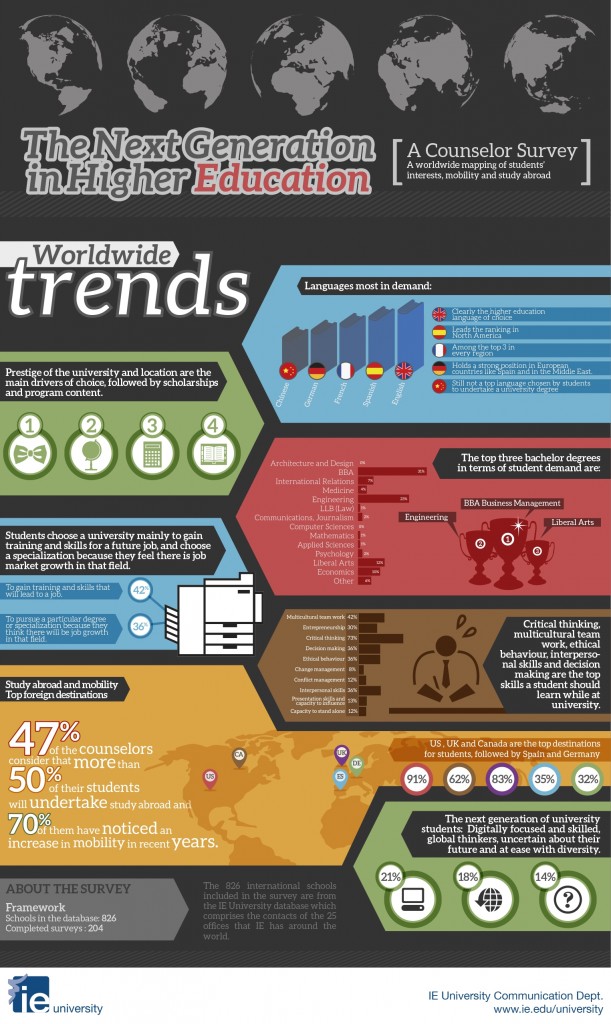
Infographic_TrendsinHigherEd204 university counselors in 33 countries took part in an IE University survey designed to pinpoint the interests and preferences of the upcoming generation of university students with regard to study abroad and most popular degree programs.

The survey shows students choose a university mainly to gain training and skills for a future job, and choose a specialization because they feel there is job market growth in that field. When asked about the main reasons for choosing a university, counselors cited:

Main drivers

  • Prestige
  • Location

Secondary consideration

  • Scholarships
  • Content

These findings suggest there is either a lack of appropriate guidance at the high school level or students are dismissing better advice for how to choose a college or university.

With the percent of students changing majors 2, 3 or 4 times, taking 5 years to complete a 4-year degree and student retention and graduation rates dropping, students need to take a smarter approach to choosing a college or university.

The fact that students list prestige as the #1 consideration creates immediate risk for the student. By not considering newer institutions, that may actually be way ahead of their more traditional and prestigious counterparts, students are missing out on some possibly better choices. But even if your needs are best served in one of the more traditional universities, the most prestigious option may not have the best program for your area of study. Prestige alone is not a good reason to choose a college or university.

The best order of consideration and prioritizing that has been shown to produce the best choice (high satisfaction with choice, retention, graduation in expected time frame) for the student is:

  • Determine career interest(s)
  • Determine education requirements for the career interest(s)
  • Create an education strategy (choice of majors, field of study)
  • Research and identify colleges/universities or vocational learning institutions that are leading in the chosen field(s) of study (a high level of prestige for the specific subject area)
  • Rank findings to create a short list of institutional choices
  • Conduct on-campus visits to all short-listed choices
  • Make the choice

With the cost of higher education so high, a one-semester course correction costs thousands of dollars. By following a smart strategy for decision-making, students can avoid that unnecessary added expense and be much happier with their choice. But it requires students to change the way they think about school choices.

Carl Nielson is an organizational development consultant, executive development coach, career coach and author of the Career Coaching for Students program for high school students and the  Career and Success Skills Mastery for College Students and Recent Grads. Assessment and coaching packages start at $349 – checkout the Summer 2013 special offer.


7 Myths About Career Exploration in High School


5 Myths about Career Exploration blog picAround 2004, as a parent with kids approaching high school, I found myself curious about the “state-of-the-art” in career exploration and coaching that the students would receive. As a corporate organizational development consultant and executive coach, focusing mainly on adults either in career transition or executive/high-potential development, I had some insight into “talent” and success in life and work.

My adult clients would ask me to coach their “graduating senior in college” who hadn’t figured out what they wanted to do with their life. That was a warning sign to me – not about the person but about the system. How could a student go all through high school, choose a major, complete an undergraduate degree in college and not have a clue about what they wanted to do? What was the root cause of the failure? What was being done to help students and why was it not working?

Fast forward to 2013, and nothing has changed. Students continue to struggle with who they are and how their personal talent design connects to career choices and educational strategy. In some ways, it comes down to something even broader – learning how to make big decisions. But I am finding the same assessments used in 2004 are being used today. And schools are letting technology deliver career coaching.

Based on what I am seeing and hearing from school administrators, parents and students, I’ve put together a list of myths that are in desperate need of being corrected. These myths are prevalent with teachers, counselors, school boards and parents. See if you carry some of these myths as your own beliefs:

  • Myth #1 The high school has this covered. They’d like you to believe they’ve got career exploration covered. Even community colleges and universities want you to think they’ve got it covered. Be wary of the high school’s use of buzz words and descriptions of programs. For example, “all students take one or more career assessments to help them identify careers” may be technically true as a task they have the students complete. Ask your son or daughter what they thought of the assessment results. Ask them to show you the report. Ask them how the results are being used and what are they doing for career exploration. And for the bottom line question, ask them if they feel they are getting appropriate and tangible support for identifying and evaluating personal career options.
  • Myth #2 The assessments used by your high school are valid and insightful. The best way to check this myth is to take the assessments yourself and check your reaction to the report. As for technical information about the validity and reliability of the assessments, the school’s website will point you to the organization’s website that produces the assessments. With a little digging, you’ll find some kind of statement about validity and reliability. Some assessment companies will actually state “this type of assessment does not fit the criteria for validity and reliability studies”.  Taking the assessments yourself will surely enlighten you to the horribly designed assessment that is expected to “tell” your student which careers will be best for them. But even if you were to accept the quality of instrument as credible, what insights has it produced for the student?  What insights has the student learned about themselves after taking the assessment?
  • Myth #3 Counselors and teachers are focused on this. Ask a counselor about the amount of time they focus on coaching students in making career decisions and they will start explaining (after they stop laughing) how their day, week and semester is spent. It isn’t focused on coaching students in career decisions. Some counselors are leaving schools because their job isn’t about helping students, its about pushing paper.
  • Myth #4 The paid-with-tax-dollars school-site subscription to a cloud-based software program (Naviance, XAP, etc.)  is focused on helping the student find their path in life. Actually, many of these site-licensed “portals” are administrative tracking systems to help teachers be more productive. It is possible they also help students to be more productive with the college application process too. However, the primary focus isn’t on helping a student gain insight into who they are and what they want to become (even though the web-based marketing lingo sounds like they do focus on this). These systems are more focused on workflow management, specifically, “the process of getting students into college”. Who cares if the reason they are going to college is faulty or once they get there they change majors 3 times and graduate in 5 years. Put the ladder on the wrong building and you get to the top of a building with no purpose for being there.
  • Myth #5 High school students are too young and immature to focus much on career exploration or make any kind of career choice. This one is mostly on the parents. All I can tell you is if you think this, you are wrong. I am consistently amazed at the level of engagement and deep thinking that students put into developing a future direction, career exploration, choosing a major, choosing the right college for what they want to do and setting goals for themselves. Even those students that start the Career Coaching for Students program with less maturity quickly shed that cover and engage effectively. Watch for the colleges and universities to  empathize with the “high school is too early to know what you want to do with the rest of your life” thinking. The standard language at on-campus college visit presentations is to tell the student and parents it is perfectly fine to come in “undeclared” and take a year or two to decide what to study. Sure, you can start taking the “required Freshman classes” and a few electives to see what floats your boat. In the meantime, some students are figuring out a lot while still in high school and walking into college with a clear plan that may include double majoring, targeting specific companies for internships and obtaining summer jobs that will give them experience that makes them a top prospect upon graduation. In the meantime, being undeclared seems like a slow path to nowhere, and let’s not to mention the extra expense (thousands of dollars) for changing majors and extending the college stay by just one semester. Oops, I guess I did.
  • Myth #6 High achieving students don’t need as much career exploration support. One of the most challenging (and exciting) situations in coaching students is when the student is “All American” (or “All Canadian” for my Canadian readers). You know the type – very high GPA, active in sports, band, club officer, outside activities, loved by the teachers, respected by the administration, etc.).  The fact that these special individuals have so many capabilities, they have the most choices available to them. Many of these report feeling that they are expected to just know some how what they are going to do. The pressure to have a career direction figured out “on their own” is tremendous. From where I sit, there is no class of students that holds some special psychic ability to know what they want to do. All groups of students from under-achievers to over-achievers need professional career coaching.
  • Myth #7 Career exploration and planning is a “nice to have” but not the primary purpose of high school so it doesn’t deserve the funding or attention in high school. Many research studies have shown a clear connection between a student’s clarity about their future and their level of engagement in school. The result – higher academic achievement. If a student is under-performing academically, there is a good chance it is because they don’t see the potential in themselves and how that potential relates to a future. Many parents have reported back to me that their son/daughter raised their GPA the very next semester after going through the Career Coaching for Students program. But it doesn’t stop there. Students who were never on the academic honor roll in high school, and went through the Career Coaching for Students program their senior year were found two years later to have been on the Dean’s list at college every semester. The studies say this happens with credible career coaching at the high school level. Our experience is saying the same thing.

Carl Nielson is an organizational development consultant, executive development coach, career coach and author of the Career Coaching for Students program for high school students. For information about career direction and job search coaching for college students, check out Career and Success Skills Mastery for College Students and Recent Grads. Assessment and coaching packages start at $349 – checkout the Summer 2013 special offer.

My Summer Internship was an incredible and valuable experience


Mentoring is a big part of a summer internshipSummer internships, and summer jobs in general, are in short supply. They are also over in a flash. Regardless of what you are doing for the summer, starting with a mindset that you will get the most out of that summer internship or job is critical to leveraging the opportunity. If you are thinking, “Wow! I got the job, I can’t wait to see who of the opposite sex will be working there too. I hope they’re hot!“, your hormones are creating a barrier to you having your priorities straight.  That isn’t what we mean when we say “get the most”.

The best internships are win-win relationships where both parties get everything they want: At the end of an ideal summer, you’ll be able to say yes when anyone asks if you have experience and you’ll also be able to speak clearly about the value of the experience (what you learned, technical skills, soft skills you developed, etc.). And your employer will feel good about the investment they made (time and money) to hire you, train you to do the work, mentor you and pay you.

So how can you make sure both of you walk away satisfied when the summer wraps up and your internship comes to a close? Keep these tips in mind.
  1. Build credits first before you ask for what you want. There’s no need to be intimidated by your internship “boss”, this experience belongs to both of you. If you’re being tucked away in a corner to sort paper clips and you aren’t getting the exposure and experience you need, first, gain the trust and confidence in your manager by doing good work. Get the menial tasks done as quickly as you can (but with quality) and then ask for other projects you can help with. Asking to work on “projects” is key here. Task completion is the test for more responsibility. Let other people know you. Introduce yourself to other managers in other departments. Do not complain to anyone about anything – be optimistic when interacting with others.
  2. Recognize that “learning” in the workplace doesn’t happen the way it does in school. In the real world, lessons are in the air all around you, and they don’t announce themselves when they show up. Don’t wait for your boss to tell you to pick up a note pad and write things down. Take responsibility for keeping your eyes and ears open, asking your own questions, and making the most of the answers that come your way.
  3. Talk to people. During your internship, you’ll be surrounded by professional working adults who have been immersed in this business for years, and these people have plenty to teach you. But they may not open up unless you make the first move. Eliminate the thought that you can’t ask for something. Your youth and inexperience give you a certain freedom in this regard that won’t last forever. Ask all the stupid questions you want. Now’s the time.
  4. Make yourself valuable. Even if you aren’t a licensed practitioner and you aren’t able to take on high levels of real responsibility, try to make your presence a welcome sight. Keep your attitude cheerful, keep your hands busy, keep your eyes up—not on the floor or your desk—and keep your mind open. There’s nothing more appealing than an enthusiastic intern who helps older employees remember why they first got into this business.
  5. Develop a thanking habit. Showing appreciation is a habit that will serve you well throughout your professional life. The more generous you are with your thanks, the better. Keep them sincere.

The most important thing to remember as you launch into your internship can be summarized in one word: respect. Show respect for your employer, your coworkers, the work you complete on the job, your company’s customers, and yourself. The more respect you give, the more respect you’ll get, and with respect comes opportunity. Walk away from this experience with everything you need to get your career off to a strong start after you graduate.

Are “soft skills” really that important?


Adapted from: Downing, Skip. (2005). On Course: Strategies for Creating Success in College and in Life. Originally posted on http://advising.wvu.edu

The key to success is in the connected mindCareer success or lack of it affects nearly every part of your life: family, income, self-esteem, who you associate with, where you live, your level of happiness, what you learn, your energy level, your health, and maybe even the length of your life.

Some students think, “All I need for success at work is the special knowledge of my chosen career.” All that nurses need, they believe, are good nursing skills. All that accountants need are good accounting skills. All that lawyers need are good legal skills. These skills are called hard skills, the knowledge needed to perform a particular job. Hard skills include knowing where to insert an intravenous feeding tube, how to write an effective business plan, and what the current inheritance laws are. These are the skills you’ll be taught in courses in your major field of study. They are essential to qualify for a job. Without them you won’t even get an interview.

But, most people who’ve been in the work world a while will tell you this: Hard skills are necessary to get a job but often insufficient to keep it or advance. That’s because nearly all employees have the hard skills necessary to do the job for which they’re hired. True, some may perform these skills a little better or a little worse than others, but one estimate suggests that only 15 percent of workers who lose their jobs are fired because they can’t do their job. That’s why career success is of ten determined by soft skills. As one career specialist put it, “Having hard skills gets you hired; lacking soft skills gets you fired.”

A United States government study agrees that soft skills are essential to job success. In the early 1990’s, the Secretary of Labor asked a blue-ribbon panel to determine what it takes to be successful in the modern employment world. This panel published a report called the Secretary’s Commission on Achieving Necessary Skills (SCANS). The SCANS report presents a set of foundation skills and workplace competencies deemed essential for work world success today.

No one familiar with today’s work world will find many surprises in the report, especially in the foundation skills.

The report calls for employees to develop the same soft skills that are asked for in employment ads, that employers look for in reference letters and job interviews, and that supervisors assess in periodic evaluations of their work force.

The SCANS report identifies the following soft skills as necessary for work and career success:

  • taking responsibility
  • making effective decisions
  • setting goals
  • managing time
  • prioritizing tasks
  • persevering
  • giving strong efforts
  • working well in teams
  • communicating effectively
  • having empathy
  • knowing how to learn
  • exhibiting self-control
  • believing in one’s own self worth

Learning these skills will help you succeed in your first career after college. And, because soft skills are portable (unlike most hard skills), you can take them with you in the likely event that you later change careers. Most career specialists say the average worker today can expect to change careers at least once during his or her lifetime. In fact, some 25 percent of workers in the United States today are in occupations that did not even exist a few decades ago. If a physical therapist decides to change careers and work for an internet company, he needs to master a whole new set of hard skills. But the soft skills he’s mastered are the same ones that will help him shine in his new career.

So, as you’re learning these soft skills, keep asking yourself, “How can I use these skills to stay on course to achieving my greatest potential at work as well as in college?” Be assured, (these soft skills) can make all the difference between success and failure in your career.

How to tackle development of soft skills

Self-directed work is possible using the Life Skills for Students program offered at Career Coaching for Students. However, using the same material and content, holding weekly focus groups with friends is much more meaningful and fun.

Carl Nielson is the creator of Career Coaching for Students and Student Resource Central, the most comprehensive one-stop resource for career exploration, major and education institution research and leading thought for students in high school and college.