Tag Archives: scholarships

Free Career Counseling is the Most Expensive Option


Yes, we’ve all had that experience where “free” turned out to be the most expensive option. When the risk is low, it is a great first strategy. When the stakes are really high, taking the free approach may not be the best way to go. When it comes to student career exploration, that free career counseling received in high school and college has generated some interesting statistics for those adults now trying to reap the benefits of that career counseling. To be certain, while these offerings may be free to the student and parents, there is a cost for the time and resources assigned. In addition, student feedback and national data suggest traditional career counseling strategies used by most high schools and colleges are not effective.     
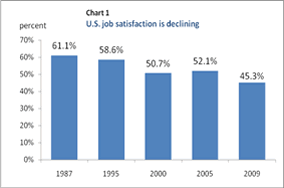
US Job Satisfaction Trend

US Job Satisfaction Trend


According to The Conference Board, as reported January 5, 2010, of 5,000 households, finds only 45 percent of those surveyed say they are satisfied with their jobs, down from 61.1 percent in 1987, the first year in which the survey was conducted. “While one in 10 Americans is now unemployed, their working compatriots of all ages and incomes continue to grow increasingly unhappy,” says Lynn Franco, director of the Consumer Research Center of The Conference Board. “Through both economic boom and bust during the past two decades, our job satisfaction numbers have shown a consistent downward trend.”     
The drop in job satisfaction between 1987 and 2009 covers all categories in the survey, from interest in work (down 18.9 percentage points) to job security (down 17.5 percentage points) and crosses all four of the key drivers of employee engagement: job design, organizational health, managerial quality, and extrinsic rewards. 
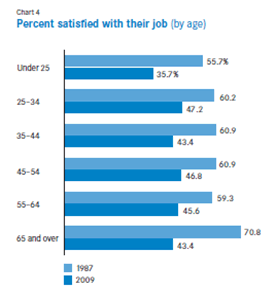
Trend Percent by AGE of US Satisfied in Job

Satisfaction Trend by Age


“Challenging and meaningful work is vitally important to engaging American workers,” adds John Gibbons, program director of employee engagement research and services at The Conference Board. “Widespread job dissatisfaction negatively affects employee behavior and retention, which can impact enterprise-level success.” In fact, 22 percent of respondents said they don’t expect to be in their current job in a year. “This data throws up a big, red flag because the increasing dissatisfaction is not just a ‘survivor syndrome’ artifact of having co-workers and neighbors laid off in the recession,” says Gibbons.     

Chart 4 on the left makes a strong statement. Those in the workforce under age 25 (group most recently having received career counseling as a student) are the most dissatisfied with their job. That was the case in 1987 as well but the amount of dissatisfaction has changed dramatically. Is there a correlation between job dissatisfaction of the younger adults and career counseling strategies being used by high schools and colleges? All age categories show drastic shifts downward in job satisfaction. Yet, we can assume that within all age groups it is likely there are people that are experiencing very high job satisfaction. Is there a common denominator for those that are experiencing high job satisfaction? The short answer is “YES”. Everyone with high job satisfaction have found the job and career that matches to their passions and talent.     

Is the economy to blame or is the cause more stealth?     

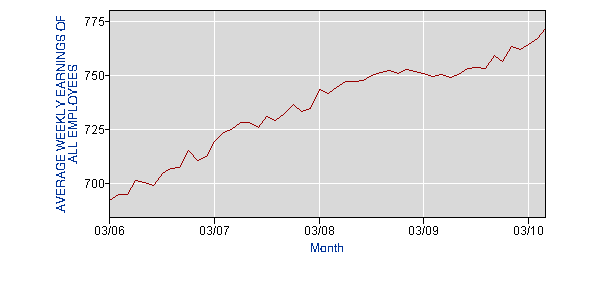
The Stealth Bomber from the movie StealthLooking at the different Bureau of Labor Statistics’ data, earnings were flat for most of 2009. That might explain a dip in job satisfaction in 2009 but not in 1987 – 2008 (Chart 1 above).  A closer look at hourly compensation, manufacturing output and business output do not show a correlation between economic indicators and job satisfaction.     

Real Hourly Comp Business 1987 - 2010 BLS

Real Hourly Comp Business 1987 - 2010 BLS


While the 2009 recession could be “predicted” by some of the previous year data, it doesn’t seem to matter what is going on economically. Job satisfaction is dropping. The only data that might give some correlation to the economy is Real Hourly Compensation. From 1987 to 1998 there were wide swings both up and down. Those wide swings could explain a level of job dissatisfaction. From 1998 to 2009 the Real Hourly Compensation shows a steady drop.    

We could easily make a correlation between dropping compensation and job satisfaction. In 2005, we see a high point    

Output per Hour Mfg 1988 - 2010 BLS

Output per Hour Mfg 1988 - 2010 BLS


for job satisfaction in the first decade of the 21st century that contradicts the correlation between compensation and job satisfaction. We also see a spike in manufacturing output in 2005 that might suggest that is “the” driver of job satisfaction.    

So with contradictions in the data, we are left searching for better explanations. Those of us working in the organizational development and human capital management field like to point to the intangibles of work. Within that realm, there is a body of knowledge and hard data that suggests “job fit” is the real “controlling factor” for job satisfaction. This implicates high school and college career counseling programs as not only being ineffective but perhaps detrimental to future job satisfaction.    
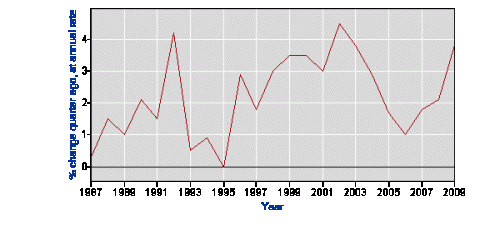
Output per Hour Business 1987 - 2010 BLS
Output per Hour Business 1987 – 2010 BLS

So back to the point about “free is the most expensive option”.  When  it comes to career exploration, there are three possible ways to receive free career coaching as a student:    

  • in high school
  • through the government’s military recruitment program
  • at college/post secondary school 

The first  free opportunity comes in high school.
High Schools are signing “career Internet portal site licenses” with companies like Kuder, Bridges by XAP or Naviance to meet state graduation requirements related to career exploration and career planning. Teachers or counselors are providing guidance to the students that ranges from a PowerPoint presentation on how to use the career portal to one-on-one meetings to “guide” the student in choosing AP classes and taking the SAT or ACT exams. English teachers may assign a writing assignment to focus on career exploration. Some high schools like Eugene Oregon’s school district have a comprehensive suite of tangible offerings and a career coordinator to coordinate the offerings. For most high schools, the counselors will say the last thing they have time for is to provide quality individualized (or even group) career coaching. Carol Christen, coauthor of What Color Is Your Parachute? For Teens: Discovering Yourself, Defining Your Future states, “Academia seems to be stuck in the 19th century. They have polarized the discussion into parts that are nearly irrelevant. Research shows that all students do better when they have a plan. A detailed and well vetted plan is as necessary as good grades for success, and that students with a plan go on to and graduate from higher education in greater numbers.”    

ASVAB Wants YOU

ASVAB is the Dept of Defense's Military Entrance Exam


The second free opportunity is the Department of Defense ASVAB Career Exploration program.
The Armed Services Vocational Aptitude Battery (ASVAB) is a timed multi-aptitude test, which is given at over 14,000 schools and Military Entrance Processing Stations (MEPS) nationwide and is developed and maintained by the Department of Defense. The military is offering free career exploration that includes the ASVAB assessment and a full personal debriefing of the ASVAB assessment results. The people providing the assessment debriefing are not career coaches. They are Recruiters working for the military. If you are already considering or want to look at careers in the military, take advantage of this free offer. To access a wider student population (top students), the military has dressed this program up as a “taxpayer benefit that everyone should use”.    

 The third free opportunity is the college career placement and counseling office.

College Placement and Counseling OfficeEvery college or university has an office of Career Placement and Counseling. Trade schools and “for profit” institutions also have a similar office. The “for profit” organizations use the name to cover their true purpose to use the “career counseling” for recruiting new students.    

Like high school, universities and colleges have more of an advisory system in place that is offered to students. Unfortunately, most of these institutions use similar assessments used by high schools – not the kind of assessments used by companies to match people to jobs. Advisors in colleges and universities rely on the student to come to them. Based on college staffing of career advisors, less than 5% of the student population actually utilize the services. The services utilized look much more like a high school offering than actual career coaching. But lately, colleges are introducing classes like those listed at Cleveland State University. An example of a Law School career counseling services video go here. Watch the Career and Job Fair video to see the typical college student admit they did no career planning before choosing a college  major or delayed thinking about career and jobs until their graduation year.    

The best advice I can offer to teens or parents is “find and enroll in a credible career exploration program that takes a career coaching approach”. Do this before you leave high school. Do this before you choose a college. Do this before you choose a college major. Pay for it unless you know someone that will provide it to you for free. If you can’t find a local program, consider Career Coaching for Students™ Home Study Personal Edition. With parent assistance, students who seriously pursue career planning using credible methods can gain an advantage that impacts academics now and avoids missteps down the road.    

The second piece of advice is for students. Take your high school “career” writing assignments seriously. Take full advantage of any career counseling that is offered if you feel it is credible and helpful.  

Carl Nielson is the developer of Career Coaching for Students™, the premier career exploration program for high school and college students. Nielson is the founder of Success Discoveries (www.successdiscoveries.com) and The Nielson Group (www.nielsongroup.com), an international corporate organizational management consulting firm. Prior to consulting, he served over 20 years in corporate human resources management. He holds a degree in organizational psychology from Texas A&M University. Find Carl on LinkedIn.    

If you are looking for true career coaching for students, look at http://www.careercoachingforstudents.net. Are you past the high school and college years? Check out free resources at Success Discoveries. Professional career coaching services offered. See what a real career coach looks like.    

Copyright © 2010 Success Discoveries, LLC
Career Coaching for Students™ is a trademark of Success Discoveries, LLC
Life Skills for Students™ is a trademark of Success Discoveries, LLC

Preliminary Study Shows Critical Skill Missing in College Freshman


One of the most valuable relationships I have is being part of a professional family called TTI Performance Systems Ltd (TTI). TTI is the worldwide leader in personal and professional assessment tools. With years of research and validation, TTI assessments are time-tested and proven to provide timely solutions for today’s personal talent and business challenges. TTI tools are utilized in over 50 countries and 26 languages to help individuals, businesses and organizations. TTI assessments are used in my Career Coaching for Students™ program for high school and college students. I’ve been a member of TTI’s Chairman’s Club for several years now. This has enabled me to learn about different studies and stay in touch with one of the true thought leaders in personal talent measurement,  Bill Bonnstetter.

Bill Bonnstetter, Founder and Chairman, TTI Performance Systems, Ltd.Bill Bonnstetter, Founder and Chairman of TTI keeps his finger on the pulse by doing research. This not only keeps TTI in the leader position but gives me the ability to apply and share critically significant findings.  Bonnstetter recently conducted a preliminary study of incoming Freshman students in college that showed among other things a significant lack of competency in a particular skill – “Decision Making“.

Why is this skill important for students?
One characteristic that “successful people” share is the ability to make sound and timely decisions. The best student decision makers are able to synthesize a variety of factors, such as personal opinion, group needs and professor instructions, and make decisions that at least come close to satisfying the major requirements of all involved parties.

People who are good at Decision Making do not suffer from an imbalance in the amount of focus they place on any one factor. They will most likely make decisions that place equal emphasis on all involved parties or concerns, therefore, making decisions that are more likely to satisfy all needs.

People whose Decision Making skills need work typically don’t place equal importance on all aspects of a situation and don’t utilize proven processes. Instead, they make decisions that satisfy some, but not all, of the factors or people involved.

Let’s say that a college professor has assigned a research paper that is due in two weeks. A student who is a strong decision maker considers the scope of the professor’s assignment, total class work load, other projects, what part-time work schedule is coming up and next weekend’s social events to decide that it is best to start immediately on the paper and to cancel one of their social plans for the upcoming weekend.  A student who is weak in decision-making may ignore the assignment altogether for the first week and then ignore critical elements of the assignment as they write the paper. Which student is likely to get the better grade on their paper, the one with good decision-making skills or the one with weak decision-making skills?

What skills are associated with Decision Making?

Someone who has mastered skills associated with Decision Making:

• Demonstrates an ability to make difficult decisions in a timely manner.

• Gathers relevant input and develops a rationale for making decisions.

• Evaluates the impact or consequences of decisions before making them.

• Acts decisively despite obstacles, resistance or opposition.

• Accepts consequences of decisions.

• Is willing to correct incorrect decisions when necessary.

• Defends rationale for decisions when necessary.

How do students develop their own skills in Decision Making?

• Don’t make hasty decisions unless the situation requires some type of immediate reaction.

• If the situation requires you to make a quick decision, consider implementing a temporary solution and revisit the issue, incorporating all relevant factors and individuals, when the immediate crisis has passed.

• Don’t always get bogged down in details. Force yourself to look at the situation from a big-picture perspective.

• Practice being a good communicator. Share information as often as possible and be open to suggestions, comments and opinions from others.

• Be sure that everyone who will be affected by the decision you are trying to make has an opportunity to state an opinion about it.

• If you determine that a decision should be made with the help of others, create formal opportunities for the decision-making group to discuss and analyze options.

• Brainstorm to create a variety of potential solutions for each problem you face.

• Don’t be afraid to change your decisions if new information clarifies issues or presents new options.

• Look for creative ways to approach the situation by determining how others have handled similar situations in the past.

• Carefully evaluate the options you have identified based on relevant criteria. How well does each option address the issue at hand? What resources does each option require to be successful? Which options can be completed within the relevant time frame? Is each option a realistic, workable solution?

• Be sure to create potential solutions that are easily put into place. The solution or decision should make things easier, not harder!

• Be educated about the consequences of your decisions. Try to determine how each option you have identified affects others, the budget, the goal of the program or company, and even people outside the organization such as clients or suppliers.

• If you don’t feel that you have enough information, determine what is the worst possible thing that could happen if you made a decision right now without getting any new information. This may help you feel better about making a decision, or it may strengthen your resolve to gather more data.

• If a course of action is unclear and you cannot make a truly informed decision, choose what seems to be the best solution and implement it temporarily. The temporary solution may work well, or it may help you determine an alternate course of action.

• If you make an erroneous decision, be willing to improve it or take corrective action to solve the problem in a more effective manner.

• If others are affected by your decision, not only involve them in the planning process, but also keep them informed of your final decision as well as the results of your decision.

• Always behave ethically. Don’t let stress, time pressures or other people convince you to make decisions that don’t fit within your value system.

Decision Making is one of the Life Skills for Students™ e-learning modules, a highly effective self-directed 12-week program that includes 16 critically important skill learning modules. Each module was selected based on studies of highly successful people and includes simple exercises to develop each skill. Life Skills for Students™ is also included in the Career Coaching for Students™ program. Click on this link for more information about Life Skills for Students™.

Copyright © 2010 Success Discoveries, LLC
Career Coaching for Students™ is a trademark of Success Discoveries, LLC
Life Skills for Students™ is a trademark of Success Discoveries, LLC

School Principal – Most Hated Profession?


The website About.com has a post to ask the question “why is school principal one of the most hated professions”? Is the school principal really hated? As the about.com article suggests, the school principal is like the CEO of the school. If a school principal did their job in a very respectable manner (highly effective communicator, consistently making good decisions, setting clear strategies and goals, supporting all stakeholders effectively) would they really be hated? Experience and research  in the work world suggests that someone in a job that can be “disliked for what it is” can actually change the perception, and in fact, not be hated. It is based on the person’s talents and how well they match to the job’s requirements.Teacher to School Principal - Should I or Should I Not?

The position of School Principal is ususally obtained through the teaching path. So which teachers make good Principals? Is it possible that there are some teachers that are not cut out to be teachers but could be great school principals? The two jobs are so different that it is very likely that a mediocre teacher can make a great school principal. However, there are certain personal leadership qualities that a teacher must have that will serve a person in the principal’s role. Without those, the person would fail in the principal’s role.

If you are a teacher or Principal of a school and want to assess your personal talent skills (no cost) please complete the information request form on our home page.  You may also e-mail directly to Carl Nielson, Chief Discovery Officer, Success Discoveries. For the subject line, please reference: Personal Talent Skills for School Principal, skill assessment request.

What Will You Be Doing 7 Years From Now?


This is a special article written by Augie Mendoza and re-posted from Bob Proctor’s Insight of the Day. This story connects to graduating high school students of today. As you will read, Augie graduated from high school in 1972. Read the story to get some insight into how career planning was addressed “back in the day”.


by Augie Mendoz,
I graduated from Brazosport High School in Freeport, Texas in May 1972. Not dressed in white (honors), but I graduated.

That summer like the previous summer, I worked as a longshoreman loading corn, flour and corn sacks weighing 50 to 140 lbs. and 900 lbs. caustic soda drums on freight ships bound to other countries at nearby Brazos Harbor and Dow Chemical A2 Dock.

This was one of the better paying jobs in the area. It was grueling, hard, heavy work, but I loved it at the time. My father had been doing this job most of his life since it paid well.

Fall came around and I had already decided that I did not want to make my living as a longshoreman. Work was inconsistent and when it was there it only went to the ones with the most seniority, unless there was too much. There was very little opportunity for a better job when you got older.

I had always heard that a college education would get you a better job and decided to find out. So I went to nearby Brazosport College and set up an appointment with a counselor.

I got to his office at the appointed time and he asked me what work or profession interested me the most. I had taken Auto Mechanics I & II during my junior and senior years in high school and asked him if Brazosport College had an auto mechanics program.

He said “no.” I asked him if they had anything similar to it. He said that the Machine Tools Technology program was very similar and described the program to me.

I was very interested and asked him how long it would take if I went full time. He said “4 years.” I said I couldn’t go full time since I am working (whenever work was available).

I asked how long would it take if I go part time? He said “7 years.” I was shocked. I said, “Man, I’ll be old then, I’ll be 25 years old. I don’t thing so.”

He asked me, “what did you say you did for a living right now?”

I told him again that I worked as a longshoreman throwing bags and manhandling drums. Then he bent over his desk and looked me square in the eye and asked me the most significant words I will never forget in my life:

“IF YOU DON’T TAKE ANY CLASSES. WHAT WILL YOU BE DOING 7 YEARS FROM NOW?”

These words hit me like a ton of bricks! I sheepishly told him that I would be doing the same thing. I signed up for the classes right then and there.

These prophetic words have inspired many of my relatives and friends. The sun will rise and fall 365 days a year. What you choose to do in between will determine many things in your life.

This story alone has inspired relatives and friends to realize an age-old truth: Time will go on regardless and it waits on nobody.

Years later, I told a co-worker this story. He got inspired enough that he went on and got 3 different degrees in computers in less than 7 years! He said afterwards, “7 years ago I would’ve been saying to myself, ‘If only I had the opportunity.'”

TIME WILL PASS REGARDLESS!
Augie Mendoza


My impression is that there are millions of Augies graduating this year – in 2010. Yes, some kind of career planning efforts are going on in high school. Yes, career interest assessments are being offered. Yes, the Internet has opened an entire world of opportunity to all students. Do college admissions counselors care today, yes, very much. Based on job satisfaction surveys, people are very effectively getting college degrees and going into “jobs” but too few are finding their passion. Finding your passion and immersing in that passion is like getting a 50 point boost in your IQ. Are you engaged in your own career planning?

So how is today’s career planning different than it was “back in the day”?
Let’s put it this way. If you are wanting to learn how to cook would you go to your local certified mechanic or would you look for a culinary class. Receiving career counseling from teachers and counselors in high school is certainly a good start. Receiving educational advice from a college placement office is also good to do. But if you want to seriously explore careers and create the plan that positions you for success, wouldn’t it be best to utilize a career coach who has extensive knowledge and experience “outside the academic world”? Career Coaching for Students™ is delivered by professional career coaches that have a passion for helping students and the right expertise to help you to create a strategic career path that leverages your passions. The program’s internet resources save considerable time finding the information that is most useful for you. To see what a career coach looks like, check out the Career Coaching for Students™ Career Coaches Profiles.

What is the Primary Reason Students Don’t Receive Career Coaching?


Getting a college education has been the #1 advice from school counselors and parents. “Go to school, get a good education, and get a good job” has been the advice for many generations. But what does this mean for the high school student?Student Career Coaching? What a Concept!

Career counseling is offered in most high schools today, but actual career coaching (more often referred to as career planning) is virtually nonexistent. Students go to college and obtain degrees only to discover that they have climbed the wrong mountain. After all those years of work, they find that they are either unhappy with their career choice or can´t get a job in the career area they’ve selected. Many graduate from college without really knowing what they want to do with the degree that they have earned.

Unfortunately, many of those students will go on to climb another mountain by getting another degree, only to find that yet again they can´t find a job in their chosen field or they don´t much care for the career options they have selected. Many people have multiple college degrees they have obtained through a trial and error process. Some of these students may be attracted to the learning environment and have chosen to hide out in the academic world until they find the right career. Instead of spending time up front researching and planning, they just begin climbing the mountain and figure they´ll make their plan once they get to the top. But there is nothing there.

Today´s educational planning is akin to building a house without any purpose and design in mind (and obviously without an architectural rendering of the house plans). Sure you can look at magazines and online resources to get some ideas about what the features of the house might be. Can you imagine the look on the delivery guys face when he shows up with a truck load of concrete and asks where to pour it only to be told you’re not sure but maybe pour a little over here, a little over there and some back here? Likewise, many students spend time planning what college they are going to go to, how they are going to pay for it, and even what they are going to study, without actually planning what they will do with the degree once they get it.

As a management consultant specializing in organizational development and hiring, I can say with confidence this is all too common in today´s society. Employers are baffled at the lack of clarity around career direction shown by graduating college students. Having a “I’ll take any job I can get” strategy for job search after college is a strategy but it won’t generate the desired results.

So what is the answer? A more in-depth career coaching class for high school students would be a way to introduce the topic and the importance of making a plan and begin the journey with confidence. Offering career coaching at the college level would allow students to follow through with the actual planning process that was started in high school. Both high schools and colleges have done a good job of presenting an image of providing career coaching. Very few are really doing it.

It is essential that young people learn the value of career coaching and actually plan their careers before deciding on education. And it wouldn’t hurt to throw in a little bit of life skills development that will give the student a leg up when they actually arrive at college or in their first job or summer internship.

Of course, no plan is set in stone and gets implemented as is. This is the main reason so many people don’t spend time planning. But when it comes to career and college, not planning is a very expensive strategy. Any career plans can be modified throughout the journey and should be modified to fit a person’s evolving interests and knowledge (I refer to this as focusing). Introducing career exploration and coaching at the Freshman level in high school has significant potential of impacting the student’s academic performance throughout high school and into college. But most importantly, career coaching reduces the likelihood of students climbing many wrong mountains and significantly increases the likelihood of finding the right path without getting lost in the forest.

There is a perception that true career coaching that results in making great personal choices and following through to see positive results isn’t possible. There used to be a perception that a person’s success couldn’t be predicted. Today, employers are using highly sophisticated yet simple talent assessments to determine “job fit” of applicants. This same science is being used by only one career planning program: Career Coaching for Students™.

To readers: What is the primary reason high school students don’t receive career coaching?

Student Career Exploration Requires HARD Goals


In my last article, I discussed traditional goal setting, that the concept comes out of the world of business management and MBA programs and how goal setting needs to be addressed differently for students to set goals that truly enable them to achieve great things?Students: Combine a vision with some small steps and you have forward

I converted the wording of a Leadership IQ study findings (see my previous article) to be applicable to a high school student’s situation, and made the focus specific to career exploration and career planning that leads to “achieving great things“. HARD goals look like this:

Heartfelt — My career goals will enrich the lives of somebody besides me in a way that I can connect with
Animated — I can vividly picture how great it will feel when I achieve my career goals
Required — My personal goals are necessary to help me
Difficult — I will have to learn new skills and leave my comfort zone to achieve my career goals

I went on to argue, like the study’s findings in the corporate world, that students fail to use career counseling, and parents don’t search out career coaching independently, for the same reasons employees report that using techniques such as SMART goals is “not helpful for achieving great things“. The aha moment about this is “Why pursue something that doesn’t work (the school’s curriculum around career counseling)?

Does the career planning program at your high school (or college) incorporate a strategy to generate HARD career goals? Are students engaged in their own career exploration. Are they driving their own achievement? Based on the four HARD goals listed, if you were to measure the effectiveness of most career planning and development programs offered to teenagers, would the program pass the test?

If you didn’t complete our Student Priorities Survey in the previously article please help us collect research data …and see how others have responded as well.

Parents: Want your teenager to better understand and communicate with you? Take the Family Insights parent behavioral style assessment (we call it the Parent User Manual). Complete the information form at bottom of home page to receive instructions.

So how does Career Coaching for Students™ align with and support the concept of using HARD goals and what results are we seeing with students going through the program? Here are the main bullet points:

  • Our assessments speak to the student (and parents) in a way that provides incredible insight, validation, confidence
  • Our exercises are tangible yet enable the student to have a heartfelt and animated experience throughout the program and beyond
  • Students are taking the vivid picture they develop from the program beyond the exercises. They come away with a new and sustained energy that says “I’ve found my passion, I have to do this, I can do this”. Sound too rosy? In our post workshop evaluation research, we found every student we talked with actually felt this way – even for those students that were less confident at the end of the workshop or non-committal, with parents present (choosing a career by the end of the workshop is not the goal of the Career Coaching for Students™ program).
  • The “difficult” part actually turns out not to be so difficult. We work on action planning in small increments that are very doable. Combine a vision with some small steps and you have forward movement. Students can never dream too big. We also recognized that having the soft skills necessary to be successful is just as important as making a good career choice. We addressed soft skill development as an extra module in the program and called it Life Skills for Students™.

Just for reading this article, thank you! As a sincere show of appreciation, we’re offering to you the Life Skills for Students™ 12-week e-learning module. To get this program started for your student, go to Life Skills for Students™ 12-week e-learning module registration and for coupon code enter ccfshardgoals. Once you complete the registration form (you will not need to enter any credit card information) you’ll begin receiving the 12-week Life Skills for Students™ program via e-mail. Be sure to check your “junk folder” if you don’t receive the intended e-mails.

And let us know what you think!

Should Students Have Career Goals? What We’re Learning About Career Goal Setting


Traditional goal setting comes out of the world of business management and MBA programs. In my work with corporations and coaching adults in career transition, I see the greatest success stories when people connect with their personal passions. Notice, I didn’t say …when people do better at goal setting. This article summarizes a recent study about goal setting and transfers the learning to high school (and college) students. Do we want students to set goals that truly enable them to achieve great things? If so, how do we do that?

Leadership IQ, a leadership training and research company, studied 4,182 workers from 397 organizations to see what kind of goal-setting processes actually help employees achieve great things. There is great potential here for a connection to “helping students achieve great things”.

The study discovered that, in organizations, people’s goals are not particularly helpful. In fact, the survey found that only 15% of employees strongly agree that their goals will help them achieve great things. And only 13% of employees strongly agree that their goals this year will help them maximize their full potential.

The study and analysis revealed 8 statistically significant predictors of whether somebody’s goals were going to help them achieve great things. In other words, if you want employees to say, “Wow, my goals this year are really going to help me achieve great things”, there are eight characteristics that their goals should have.

Here’s are the Top 8 Factors for predicting a goal will help a person achieve great things, in order of statistical importance:

  1. I can vividly picture how great it will feel when I achieve my goals.
  2. I will have to learn new skills to achieve my assigned goals for this year.
  3. My goals are absolutely necessary to help this company.
  4. I actively participated in creating my goals for this year.
  5. I have access to any formal training that I will need to accomplish my goals.
  6. My goals for this year will push me out of my comfort zone.
  7. My goals will enrich the lives of somebody besides me (customers, the community, etc.).
  8. My goals are aligned with the organization’s top priorities for this year.

A few things jump out of the analysis according to the authors:

  • Whether goals were specific, measurable, attainable, realistic and timely (businesses call these SMART goals) had no unique predictive power in the analysis
  • For people to achieve great things, their goals must require them to learn new skills and leave their comfort zone
  • So we’ve just learned that the typical goal-setting processes companies have been using for decades are NOT helping employees achieve great things. And, in fact, the type of goal-setting we SHOULD be doing (assuming we actually want our employees to achieve great things) is pretty much the OPPOSITE of what organizations have been doing for the past few decades.

  • Another insight from the analysis is that goals need to be much more than just words on a little form. For a goal to help people achieve great things, that goal has to leap off the paper. It has to be so vividly described that people can feel how great it will be to achieve it. It has to sing to them, to touch the deepest recesses of their brain. When’s the last time your goals did that?
  • And statistically, to achieve greatness, a goal also has to be bigger than ourselves. We have to identify whose lives will be enriched by our goals. And those goals had better be absolutely necessary (and also aligned with our organization’s top priorities) or they just aren’t going to help employees achieve great things.

To summarize briefly, HARD goals are:

  • Heartfelt — My goals will enrich the lives of somebody besides me—customers, the community, etc.
  • Animated — I can vividly picture how great it will feel when I achieve my goals.
  • Required — My goals are absolutely necessary to help this company.
  • Difficult — I will have to learn new skills and leave my comfort zone to achieve my assigned goals for this year.

Applying the learnings to Students

Let’s convert the wording of the study’s findings to be applicable to a high school student’s situation, and make the focus specific to career exploration and career planning that leads to “achieving great things”.

Heartfelt — My career goals will enrich the lives of somebody besides me
Animated — I can vividly picture how great it will feel when I achieve my career goals
Required — My personal goals are absolutely necessary to help me
Difficult — I will have to learn new skills and leave my comfort zone to achieve my career goals

Does a student need some kind of goal setting? Of course. But I’ll argue, like the study’s findings, that students fail to utilize career counseling, and parents don’t search out career coaching independently, for the same reasons employees report that using techniques such as SMART goals is “not helpful for achieving great things”. Why pursue something that doesn’t work?

Does the career planning program at your high school (or college) incorporate a strategy to generate HARD career goals? Are students engaged in their own career exploration. Are they driving their own achievement? Based on the four HARD goals listed, if you were to measure the effectiveness of most career planning and development programs offered to teenagers, would the program pass the test?

Complete a Student Priorities Survey and see how others have responded.

Parents: Want your teenager to better understand and communicate with you? Take the Family Insights parent behavioral style assessment (we call it the Parent User Manual). Complete the information form at bottom of home page to receive instructions.

In my next article, I’ll address how Career Coaching for Students™ is totally aligned with HARD goals and what results we’re seeing with students going through the program.

Least Valued, Highest Value: Student Career Planning


Career planning is often minimized during high school to a few school English papers, a local career fair and a questionable career test. However, choosing a career direction is one of the most important decisions that students will make. Without proper career planning, many students take 5-6 years to complete a degree. We also see many students who didn’t do much career planning receiving degrees in declining growth fields or fields with a surplus of applicants and having difficulty finding employment after graduation. This data is not improving with the growth of high school site-licensed web-based offerings. The services offered at college counseling and placement offices is also not improving the situation.

Proper and intentional career planning while in high school plays a critical role in reducing the overall cost of college and increases a students self-esteem and academic success. A contributing factor in the college dropout and transfer rates is a lack of career planning and the failure to make college decisions based on career goals. Research by the US Department of Education (DOE) and American College Testing show that each year, about 50% of college freshman leave the college in which they first enrolled. Of the dropouts, about 30% transfer to other colleges at least once, and 20% transfer twice and typically take 6 or more years to complete a 4-year program.

Students who receive career planning prior to college choice and attendance have fewer changes in college major and fewer college transfers, graduate on time, and tend to be more goal- and academic-focused. Why is that? These students know themselves better than their peers. They also have focused on a career (or career options) that matches their talents. This “match” creates enthusiasm and passion to achieve a future that the student has defined. When you know what you want and you know how to get it, doing the work required to reach your goal is much easier.

So what does an effective career planning program produce:

  1. Significantly greater self awareness, an understanding of a person’s talent beyond the feedback given in school
  2. Valid and reliable career-focused assessments that give the student useful information about their talent
  3. A clear connection between a person’s talent and possible career choices that will produce satisfaction and success
  4. Implementation of strategies for learning about high-potential career choices
  5. Implementation of strategies for learning about educational options to support high-potential career options
  6. Developing clear action steps that the student is able to execute independently without outside motivation

Myths that create problems years later
Career coaching is something students will have access to in high school or at college
Investing in career coaching for a student is not necessary
Academically high achieving students don’t need career coaching
Average academic students don’t need career coaching
Future success is dependent on how well you do in school

Truisms
A person who has chosen a path they are passionate about will be much more likely to experience high levels of satisfaction and success
Students who have a clear and positive future-view do better in all areas – academically, overcoming personal obstacles, relationships, etc.
A student who takes personal accountability for their future is more likely to succeed

There are many web-based career planning sites being implemented at high schools across the country. A few of the programs are Kuder, Naviance and Bridges Career Choices. There are others. They all provide a similar set of features.  A program that is different is Career Coaching for Students™. This is a program that utilizes “career coaching” as its foundational center and uses assessments for career matching and enhancing self-awareness. The guidebook provides a step-by-step approach so that any parent, coach, counselor or teacher can deliver the content and support the student. Consequently it is effective as an in-home parent-student self-directed program or as a student-parent workshop with a professionally trained facilitator coach or as a semester class. The semester curriculum can be integrated into an existing school program. Student workshops are held in various cities around the U.S. and each of the licensed facilitators offer one-on-one programs as well.

Waiting for Superman


Filmmaker Davis Guggenheim reminds us, in the soon-to-be-released film Waiting for Superman, that education “statistics” have names: Anthony, Francisco, Bianca, Daisy, and Emily, whose stories make up the engrossing foundation of WAITING FOR SUPERMAN. As he follows a handful of promising kids through a system that inhibits, rather than encourages, academic growth, Guggenheim undertakes an exhaustive review of public education, surveying “drop-out factories” and “academic sinkholes,” methodically dissecting the system and its seemingly intractable problems.

However, embracing the belief that good teachers make good schools, and ultimately questioning the role of unions in maintaining the status quo, Guggenheim offers hope by exploring innovative approaches taken by education reformers, inspiring teachers and charter schools that have—in reshaping the culture—refused to leave their students behind. The movie promises to receive high marks and has already been recognized at the Sundance Film Festival.

Guggenheim discusses his film

From Student to College to Career: Fun or Terrifying Journey?


We’ve all been there. High School. Whether you were at the top of your class or just proud to be graduating, high school provided that tension to bring adulthood and career planning into the forefront. A news article that was just posted online discusses how the ACT for Middle School students is shaping students’ opinion about career choices. Another article by an owner of a student career coaching business in Minnesota blended the economy and school career counselor limitations as the reason student career coaching outside of school is expanding. Based on feedback from parents and students in our Career Coaching for Students™ workshops and our one-on-one student coaching services, true career coaching hasn’t really been a part of the high school offering.

Take our Student Priorities Survey

Today, high schools are doing some exciting things to expose students to possible career areas, especially in the tech school vocational area. From photography and television production to welding and drafting, high schools are doing a great job of providing a broad offering of job skill development classes. Many schools have purchased and implemented subscriber-based online programs like Kuder, Naviance, Bridges Career Choices and other web-based career sites that give students access to career exploration tools. Most English classes include an assignment to research and write about a career. High schools are administering assessments to help students look at possible careers. The effort isn’t the question.

So with all that is going on, why do high school students continue to enter post-high school programs with a lack of confidence in career direction? Here are my top reasons:

  • True career coaching isn’t happening in high school. Coaching is very different from offering counseling and web-based tools – and much more time-consuming.
  • Assessments used by high schools aren’t focused to enable greater self-awareness about their talent and are not recognized in the work world as effective for matching people to jobs. Also, students report the assessment reports they receive in high school were either a “waste of their time” (no perceived value) or created greater confusion – both of which actually have a negative impact on the student’s interest in career exploration. However, we have seen a very strong positive reaction (face validity) from students after they received our assessment reports and debriefing in our workshops. The most common statement is “Wow! This is incredible and extremely helpful. It blows the [one received at school] out of the water.” Sounds a little dramatic but actually it is consistently the response we receive. The point here is that an assessment designed properly and presented properly is helpful and one that is not designed properly and explained properly is damaging.
  • Students, Parents, Teachers and School Counselors are overwhelmed by their daily schedule. Even career exploration assignments are completed by students in a haphazard and single-focused manner – to complete the assignment.

Effective career coaching integrates valid assessment results and other “student self-awareness” tools with web-based research tools and specific strategies for exploring careers. Coaching and coach-focused exercises are all geared to support the student in their journey. Career coaching enables the student to start broadly and quickly narrow high-potential career options regardless of current academic achievement. The student that has already embraced a career choice will find career coaching looks for ways to affirm their choice and works to support that choice and avoid missteps along the way.

The fact that the Middle School ACT test scores are influencing students about career options is very concerning. We all know of people (click link to see a “best motivation video” -scroll down page ) who have become highly successful but were told in high school by teachers, advisors or “academic test results” that they should (or should not) go in certain career directions. That, if the advice had been followed, would have steered the person away from their success. Today, that false thinking is unfortunately alive and well. The reason – academic achievement (current achievement) or lack there of does not consider a person’s talents.

The Learning
Choosing a career should be about aligning talent with career options. Talent is very different from academic achievement or current student achievement. In fact, we know that a very average academic student will excel and be successful when they have connected their talent to a career direction. They see their purpose. That purpose creates passion. Passion drives success. We’ve also seen high academic achievers (top 2% of their class) become lost in college and bounce from job to job after graduating – all because they hadn’t found their purpose. This is completely unnecessary. Let’s not put off true career coaching. College graduation or after quitting or getting fired from jobs is not the only time to do career coaching. The ideal time is in high school, somewhere between their Freshman and Junior year.

About Career Coaching for Students™
Career Coaching for Students™ utilizes professional coaching strategies with highly valid assessment tools (used in the work world to match people to jobs) to create a strong understanding of one’s talent and how to connect that talent to career options. The program impacts the student’s intrinsic motivation and self confidence and includes a 12-week self-directed program called Life Skills for Students™ based on what we know about highly successful people. Workshops are offered throughout the United States. To see a schedule of workshops, go to the Career Coaching for Students™ website.

About Carl Nielson
Carl Nielson is Chief Discovery Officer of Success Discoveries and the developer of Career Coaching for Students™. He also has a management consulting practice through The Nielson Group where he provides executive coaching, organizational development services and hiring-for-fit strategies using the same assessment technology used for Career Coaching for Students™.