Category Archives: career choices

Freshman Year: The Big Picture by guest blogger Jennifer Karan, Executive Director, SAT Program, College Board


Happy TeensAs a former English teacher and Dean of Students (9th and 10th grade), I know that there are few things as daunting, mysterious and exciting to a teenager than freshman year of high school. It’s a whole new world: the hallways are foreign and at larger schools, students sometimes feel as though they need a GPS to get from class to class; the upperclassmen seem so much older and are brimming with a glowing confidence; teacher expectations and homework may require substantial adjustment. And college seems like a distant point on the horizon.

Part of the trepidation may be what adults would understand as not being able to see the forest for the trees. However, when a student is able to see how the various academic courses, opportunities in arts and athletics and programs that develop other interests (the school paper, community service or a part-time job) that form the Big Picture, he or she is able to navigate this terrain successfully, with greater purpose and enjoyment.

high school students see the big picture and plan carrersAn excellent first step towards realizing this Big Picture is to encourage a student to make an appointment with a school counselor early on. Where access to a counselor is difficult, students can approach a trusted teacher of a favorite subject. If a student is willing to share information with this new advisor, he or she can help that student make sure he taking the right classes to graduate on time and taking the types of classes colleges are looking for. Students should discuss favorite subjects to learn about additional opportunities as well as to get the necessary help with the more intimidating courses before it’s too late. Students can even share hobbies as well as aspirations; a counselor or advisor can help find extracurricular activities to help develop these interests.

Big Future, sponsored by the College Board, is an incredibly useful tool in helping students of all ages contemplate and understand what it takes to get to the college – or major – of their dreams. Starting early can help high school freshmen plan an academic path and start to understand the financial aid process, including scholarships and merit aid. It also provides information on how to make high school count, things to discuss with a counselor, planning college visits and other avenues to success.

Becoming aware of all the available resources and understanding how the decisions made now will offer benefits later on is one way to start the planning process. Actively utilizing those resources and building a unique and representative academic and extracurricular profile puts students on track for the Big Picture: showing colleges who they really are.

Career Coaching for Students is the solutionCareer Coaching for Students™ offers high school students the opportunity to develop a clear picture of self and their future that lifts self-esteem, increases academic performance and helps the family avoid unnecessary costs of changing majors and extending college due to changes in direction. Student Resource Central, the most comprehensive resource portal for career exploration and educational strategy research includes Big Future by College Board among its recommended resources. Freshman spring semester is the ideal time to take part in the Career Coaching for Students program. For more information, visit the website at http://www.careercoachingforstudents.net.

About the SAT Test

Why You Will Fail


Larry Smith is a different kind of inspirational speaker. His presentation on TEDx is so entertaining and insightful I felt compelled to post it on my blog. If you are a parent, please watch the video. If you are a student, please watch the video. If you watch the video, share comments here.

Throughout his three-decade career at the University of Waterloo, Larry Smith has inspired legions of students to take up the mantle of economics with his passionate and homespun tales of economic wizardry. A renowned story-teller, teacher and youth leadership champion, Larry has also coached and mentored countless numbers of students on start-up business management and career development strategies.

Having taught introductory microeconomics, macroeconomics and entrepreneurship classes, he recently celebrated assigning his 29,000th grade earlier this year.

Recipient of the Distinguished Teacher Award, Larry has also coached several of his former students to help them position and develop their businesses, the most famous of which is Research in Motion (RIM), maker of the revolutionary BlackBerry wireless mobile smartphone. Larry also sits on the advisory panels of start-ups to provide his guidance on financing and negotiation with investors and venture capitalists.

Watch the presentation on TEDx.

Carl Nielson is an organizational development consultant, professional career and executive/leadership coach and creator of the nationally recognized program Career Coaching for Students™ . Career Coaching for Students is available as a district-wide high school program and in group and on-one-one offerings through certified career coaches throughout the United States, Canada and other countries. Contact Carl Nielson at carl@successdiscoveries.com or call 972-346-2892 to discuss specific needs. Or visit us at http://www.careercoachingforstudents.net

How to Stand Out


Jeff Haden (Inc. Magazine and Business Insider) posted two articles that any college student (and high school students for that matter) should use to “audit” their resume and their elevator speech. I’ve provided highlights of the main points here with my own bits of advice. The full articles are:

6 Ways Successful People Stand Out by Jeff Haden

10 Ways You Should Never Describe Yourself by Jeff Haden

Let’s face it. Your resume is a frustrating document to write. Do you include details or keep it high level? Do you include all work history or just the relevant stuff for the position you are applying for? Is one page the rule or is it best to have multiple pages?   The article “10 Ways You Should Never Describe Yourself” makes some very valid points. But how do you describe yourself? As Jeff states in his article, the 10 ways to describe yourself are great for others to say about you but probably not okay for putting on your resume.

At the end of this article, I’ll offer a complimentary assessment that will give you words to describe yourself. Yes, putting a few descriptors on your resume isn’t wrong, just don’t put words that are too general. My rule of thumb is, “if you are using a descriptive word because you think it is what the employer is looking for then you are misusing the space in your resume.

Haden’s 10 Words You Shouldn’t Use

Motivated – A better word might be “self motivated” which can be substantiated by things you’ve done.

Authority – Taking charge and leading (position authority) or having exceptional expertise (knowledge authority) need to be self-evident in your resume. A better strategy might be a statement like “Recognized for my leadership on the xyz project.” or “Recognized for my research on the zyq study.”

Global Provider – This may not be applicable to students, at least not right now, but many students have taken advantage of a Study Abroad program. This doesn’t make you a global expert. List the overseas period and describe what it gave you.

Innovative – Some people actually are innovative. That can be a good thing or a curse depending on the job. Some bosses don’t want a young upstart coming in and challenging or changing everything. They want you to learn. Employers want to know you are able to appreciate and follow their policies, procedures and work strategies. A better word might be creative if you were solely responsible for something new and creative that was recognized. However, that word has been overused.

Creative – We gave this one away as part of Innovative. Overused is the issue. Just be sure you have been recognized for something special. If not, don’t bother using it.

Passionate – This has no value. However, in the assessment report you might see “customer focused” or “results oriented” or “goal oriented”. Use those if you have a story to connect the word to.

Unique – Everyone is unique. I don’t see this word used too often but if I did, I think I’d file the resume in the round file.

Guru – Even if you could substantiate this some how, a student or recent grad isn’t a guru in anything. Be a learner.

Incredibly… – This is way too informal and is an exaggeration word. Avoid all words that exaggerate what you are trying to say.

Words that Work

If you’d like to take an online assessment to find better descriptors for your resume and for your interviews, go to http://www.ttisurvey.com///142181FUW This assessment takes about 20 minutes (2 parts @ 10 minutes each). The report is approximately 46 pages and will come directly to your email.

Haden has also made a list of 6 ways to stand out. There are many ways to stand out. I saw a person with pink and yellow hair. Yes, they stood out. Many young people today are  getting tattoos. To stand out from an employer standpoint, get into the recruiter or hiring managers head. What if you were them? What would you be looking for in a new hire?

Haden’s 6 Ways to Stand Out

Be first, with a purpose – From showing for the interview, to finding the job opportunities before they are posted on the company website. A position is officially approved and being recruited for 10 to 15 days before it gets any public exposure. Also, some companies have a policy of posting a position for as much as 30 days internally before posting it publicly. Make it your business to get the inside scoop from current employees and managers at the company you want to get hired. A great starting point is LinkedIn. But you have pursue that rich networking tool with purpose.

Be known for something specific – My son was advised to play down some of his high school accomplishments in his resume by a visiting industry mentor. The fact that he was accepted to and graduated (June 2012 –  and yes I’m very proud) from a prestigious university “assumes your high school years were impressive.” Whether it is high school or college stuff, be known for something! If you are currently in high school (or a parent of a HS student), be involved in something. I recently provided career coaching to a group of HS students (see Career Coaching for Students) and one student took this advice to heart and met with the school counselor and principle of the HS to request formation of a Poetry Society/Club. Stating on your college application resume “Founded and served as President of the Poetry Club” is what colleges and employers like to see. Just be sure you are able to say something about what you did after you founded it, such as, “grew first year membership to 48 students” and/or “Held 8 club meetings where 25 student-written poems were presented.”

Create your own side project – Integrating the project with another activity makes it exponentially easier and more likely to be completed. Many students are critical of, or sarcastic about, students that are in Boy Scouts or Girl Scouts but colleges and employers value the experience. Both of these organizations have an “ultimate level” (Eagle Scout or Gold Award respectively) that is usually attained during high school that includes a significant project.  My daughter was president of the ecology club and also achieved the Gold Award by designing and building out the grounds as part of a “Greenhouse Enrichment Project”. This required fund raising, organizing volunteers and working with the high school administration for approval and support. The fact that she was involved with the Ecology Club gave her the ability to offer service hours to club members. Getting volunteers was easy.

Put your muscle where your mouth is – Don’t talk about what is wrong, even if the interviewer asks you to describe something that someone else screwed up. When put in that awkward situation, always share a situation or problem that you were at least partly responsible for delivering the solution – even if you were the one that screwed it up. Being part of the solution is what everyone wants.

Show a little of your personal side – Personal interests help others to identify and remember you. For many interviewers, asking the proverbial “tell me about yourself” can lead to all kinds of responses. Stay focused on the purpose of the question and environment you are in. If the interview is a standard 30 minutes, and you talk for 10 minutes about “who you are”, it is likely you won’t be getting the job or internship. Be prepared for how to “share a little.”

Work harder than everyone else – There is a book titled “Only the Paranoid Survive” by Andy Grove, ex-CEO of Intel, that gets this point across and then some. If you are in the right major and career for you, (or soon will be) this isn’t a hard thing to do. If you feel apathetic about your major/career choice, now is the time to do the work to find your passions. Working harder than everyone else should not be a chore. Look for the career that you can say “I can’t believe they pay me to do this stuff.”

Carl Nielson is an organizational development consultant, professional career and executive/leadership coach and creator of the nationally recognized program Career Coaching for Students™ . Career Coaching for Students is available as a district-wide high school program and in group and on-one-one offerings through certified career coaches throughout the United States, Canada and other countries. Contact Carl Nielson at carl@successdiscoveries.com or call 972-346-2892 to discuss specific needs. Or visit us at http://www.careercoachingforstudents.net

Choosing and Changing Majors: Status Quo or A New Standard?


The following graphic is from The College Board. We’ll start the discussion here.Is Changing Majors OK?

From the quote in the green bubble, “It’s okay to change your plans even if it means changing your major.” Well, yes, if you find yourself going in the wrong direction, change direction. But The College Board position, and that of most colleges and universities, is that changing majors multiple times to “find yourself” is okay. It isn’t. What it tells me is that the student didn’t do the work to determine a career path prior to showing up at college.

Many colleges and universities report the statistics that support the 2005 article by MSNBC.com that indecision about what major to choose can prove very expensive.  According to Dr. Fritz Grupe, founder of majors.com, eighty percent of college-bound graduating high school students have yet to choose a major before arriving on campus.

With tuition averaging $18,000 or higher in 2012-2013 at public universities, and much higher at private universities, indecisiveness can drain college savings accounts as students restart course sequences or transfer schools – losing credits in the process. Ultimately the result is that the student extends their college days beyond the four years parents planned to finance.

According to College Board, five- and  six-year students are not uncommon. Roughly 40% of those who start a four-year degree program still have not earned one after year six!

There are a variety of good reasons for dragging a college career into its fifth and sixth years—from taking time off for foreign study, to taking advantage of internships and co-ops or needing to balance academics with part-time employment to pay tuition. But changing majors is the one thing that drives up an education’s cost while potentially driving down a student’s self-esteem. It is also the easiest to avoid.

Bad Advice?

There are many (too many) assessments that aren’t valid and reliable. There are also “exercises” that professional counselors recommend if you don’t have access to professional tools such as valid and reliable assessments.

Kate Brooks, director of liberal arts career services at the University of Texas at Austin, thinks surveys can help focus a student’s attention on potential courses of study but she warns about the the students tendency to apply the results too inflexibly. “Often a student will say, ‘the test says I should be a florist, so that’s what I have to be,’” she says. A valid and reliable assessment and process doesn’t result in one career choice. A student that has that belief wasn’t counseled properly and was most likely not using a valid and reliable assessment instrument.

“Nationally, we see statistics quoted that as many as 80% of all college students change their major or that the average college student changes his/her major an average of 3-5 times. If you were able to count how many times students change their mind about what they want to do after graduation, it would be much higher. “
University of Missouri • MU Career Center, 2010
Student Success Center

Rather than properly designed, validated and reliable assessments, Brooks favors an exercise to help undecideds identify and translate interests into majors and eventually careers they will succeed in and enjoy.

She sends students to the nearest Barnes & Noble to browse the magazine racks. They are instructed to buy the three magazines they find most interesting. “We then discuss what prompted them to buy those magazines. It may be they chose Newsweek because they are interested in current events and politics. Or possibly there was an article in ESPN about nutritional sports bars. We talk about how pursuing chemistry could lead them to create a better bar or sports drink. Or maybe it is the marketing aspect that appeals to them — the ads. The point is to help them understand what things excite them and what careers are connected to those things, and which majors would lead them to those careers,” explains Brooks.

That exercise is wonderful but too simplistic. Choosing a career and the best major for that career direction is a little more complicated than that.

Tips for helping your student choose major

What can parents do to help their children get through college in a timely fashion while staying passionate about their choice of major? Here are some suggestions I think are worthy of considering:

  • Refrain from pressuring children into making quick choices or pursuing majors associated with high income professions. Not everyone should or can be a doctor or a lawyer.
  • Focus attention on pursuing courses of interest based on a career direction, even if the immediate relationship to a major or career is not obvious.
  • Double-majoring is a great way to keep opportunities open. With good planning in high school, double-majoring is not only very doable, it may very well be more interesting and provide an extra level of motivation and self esteem.
  • Encourage participation in job shadowing — going to work with people to see what their jobs actually entail and asking people they meet how they got into their careers. While in high school, interview people in the career of interest that are passionate and successful. Parents can help set this up.
  • If they do enter school undecided, engage in a career coaching program that provides professional-grade (highly valid and reliable) assessments and a process that leads to clarity and good decisions. It doesn’t hurt that the program will also assist in a broader sense of creating success across the bigger picture of life.
  • Refrain from giving advice based on the job market of twenty-some years ago or the “parent ego”. Today’s employers need a different kind of worker and favor different degrees. Many parents see their own career as a great direction for their son or daughter. Genetics may have played a part in creating that awesome son or daughter but choosing a career is a highly individualized event.
  • Urge them to take full advantage of campus advisory services to avoid floundering, shifting from one course of study to the next, and prolonging their dissatisfaction and their academic careers. While I am generally strongly negative in my bias about college advisory competencies when it comes to assisting students in choosing a career direction and then matching potentials majors for that career, if you are taking any of the other advice above, this may not be necessary but it is usually the first option. students rely on and is the one option with the greatest gap between expectation of value and actual value. Just keep in mind, you might be told to go to the local magazine store to find your career.
  • Help them understand that a major is not a career. There are multiple paths to most careers, just as there are multiple careers that can be had from a single major. Encourage them to explore their options. Having a career direction is much more powerful than choosing a major.
  • Help them prepare academically before arriving at college to avoid spending their high-priced time on remedial or review classes.
  • If a child is undecided, consider seeking out a college with the resources to acquaint them with all the options to make a well-founded decision. Not all schools have or emphasize such programs.
  • Understand that the student-to-counselor ratio averages 450-to-1 nationally at the high school level. Do not rely on high school counselors to guide children through the exercise of choosing a major.

However they get there, encouraging children to think through their career interests before choosing a school or program can help them avoid future frustration, academic let-down or feelings of failure. It is also key to helping them graduate in four years and move into their ‘real’ lives before they out-spend their college savings accounts.

A more up-to-date and informative article is available.

2015 national webinar to be held in July for career exploration and planning that leads to choosing a major

Parents Guide to Career Exploration and Planning


It isn’t possible for every high school student to benefit from the Career Coaching for Student program (maybe some day). If it were, you’d be sure to receive assistance in all of the areas listed in this article and your teen would be on solid footing for the path ahead. Short of that honorable goal of serving every student, the following ideas are for parents of incoming high school students and any teen ready to consider and explore their future.Happy Teens

Parents are a teens primary counselor. As much as teachers, school counselors and other professionals try, parents play a crucial role in drawing a study plan and shaping the career direction and future of their children. Entry into high school is the time parents need to acquire knowledge about educational options, objectively understand their teens interests and skill sets and “parent” them through the exploration and decision-making process. Decision making doesn’t have to mean “choose” a career while in high school. Decision making needs to be focused on strategic direction. That may result in a career decision or it may set the student on an informed path to explore and evaluate the best potential opportunities that lead to happiness and success.  Either way, a good career choice will be made.

Why parents’ guidance is important for student career exploration

  1. Because parents have rich knowledge and experience. The teen’s interests and talents may be very different from a parents, however, the parent has the knowledge and experience to bring greater wisdom to the process.
  2. Many students choose their school or college of study after a brief, mostly subjective look at a few choices, without research and due diligence, often times going by just the hearsay. In this situation, parents can encourage their teen to gather all relevant information to make a more informed choice, considering both the short- and long-term benefits and prospects.

How parents can help in career selection

  1. A parent’s attitude matters a great deal! Stay positive and focused on a future of success. The work place today is always changing and may seem scary. Don’t make the past seem perfect and the future terrifying. Encourage your teen to develop a positive attitude and learn about a variety of industries. Many career choices can be applied in diverse industries which present very different experiences.
  2. Do not shoot down ideas that your children may come up with on their educational and career choices. If you react negatively, it will likely shut down or reduce the communication process. Keep the lines open as you encourage information gathering and informed choices rather than “your” choices.
  3. Jump on opportunities. Informal discussions about the world of work with your teen can be productive. Current news and websites like www.ted.com can be a catalyst to a rich discussion.
  4. Provide guidance and blind encouragement. Do not impose your ideas against theirs. Your goal is to help your children find their own way based on their interests and skills and not follow your ideas and interests, which could prove counter-productive. By discussing interests, dreams and goals, you can get to know your children better, which will help you guide them.
  5. Encourage your teen to set goals. By starting early with goal setting and action planning, simple and rewarding goals will lead to extremely valuable skills for life and more consistent achievement of goals as an adult.
  6. Be practical and realistic in your approach but don’t assume something isn’t possible. Examine and find out whether their interests are genuine, or mere aspirations influenced by external forces.
  7. Encourage your child to explore their options through work experience and by talking to people in occupations that interest them. Visits to relevant businesses will help. Putting your teen in contact with those in a career of interest is extremely valuable. Meeting multiple people to gain “inside” career information can be more valuable than a summer job.
  8. Let your teen identify and select their area of interest. Parents can help students to identify the broad area of work that interests them, what sort of environment they would like to work in and then link it to their skills, interests, abilities and values. Be wary of popular assessments used for students. Many are not effective and can create confusion. Their validity and reliability may also be questionable.

How to begin

1. The best way to begin career exploration with your children is by talking about your own career. What do you do in your job. What decisions did you make that led you to this point in your career. Teens aren’t always overly interested when parents begin to share their wisdom with them. Be patient. When it comes to “telling”, asking questions more often is a better strategy for opening the door to rich discussions. Discuss a variety of occupations that you observe in everyday life and what those jobs may involve.

2. Emphasize personal accountability and self management. These are two critical skills consistently found in highly successful people – regardless of what career they choose to follow.

THE ACTION PLAN

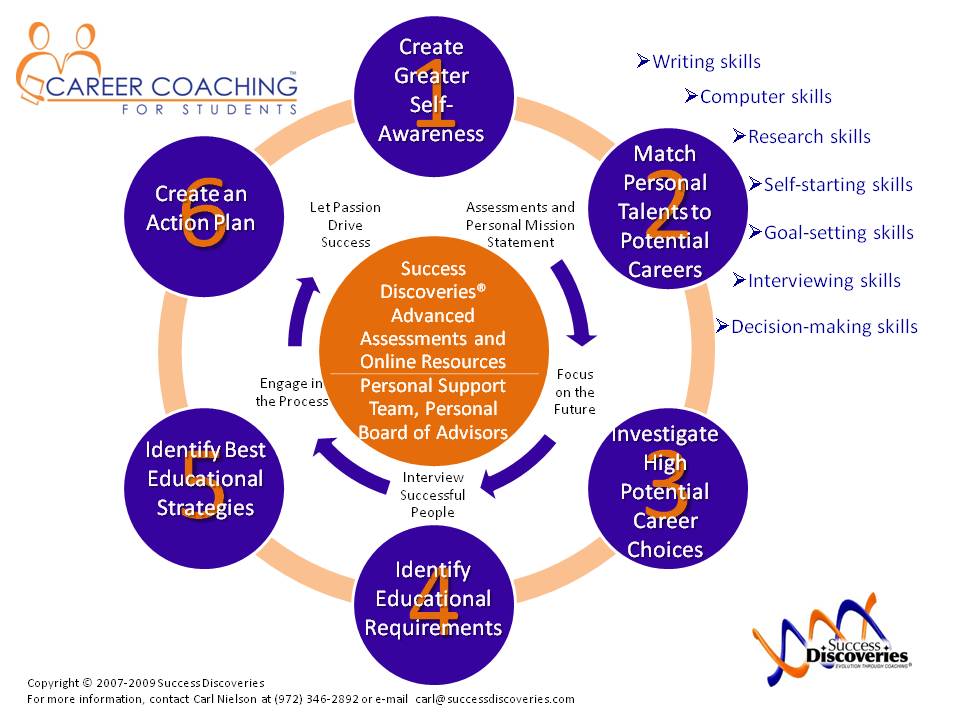
The career decision-making process described below includes activities that can begin pre-high school and go through high school and post-secondary education.

Action 1 – Enable self-awareness through valid and reliable assessments. When it comes to assessments, start with yourself. Evaluate the assessment administration experience and the results.

Action 2 – You and your teen may also want to consider lifestyle implications and the overall impact that lifestyle preferences will have on career choice. For instance, will the job require irregular hours? Will the salary support the lifestyle your child wants? How much education does the occupation require vs the desire for continuing education? It’s important for your child to understand the relationship between lifestyle, personal preferences, occupational choice, and educational pursuits. Help your children understand and balance the difference between wants and needs.

Action 3 – Help your teen stay focused on career exploration.
Help your child to explore a variety of options with the goal of narrowing those options to a manageable few. Most students want to look at college choices first, major second and career third. Help them avoid that mistake.

Action 4 – Evaluate educational strategies that support a career direction. Evaluate educational options before looking at college choices. Schools vary greatly in their reputation for different areas of study. The best employers know which schools are at the top for a subject and which are not.

Action 5 – Research school choices based on career direction and desired post-secondary education. No school has everything for everyone. Even the most prestigious schools such as Harvard might not be the best school for what your teen is interested in. Choosing a college or university takes a little work.

Action 6 – Make choices based on quality information. Encourage your child to explore a variety of career areas, before making a choice. The economy, demographics, and technology will continue to change the workplace. Some jobs become obsolete while other new jobs emerge. Some occupations may maintain the same title, but they may change or evolve so drastically that they no longer resemble what they were a decade earlier. As the workplace continues to change, it will be more important to focus on personal soft skills and how they can be applied. Some soft skills are more important than others depending on the career. Decision making has been identified as one of the most important soft skills required for career success. It has also been identified as the weakest of soft skills of incoming Freshmen in college.

Action 7 – Create an action plan

Planning is much easier to do when a passionate future view exists. The passionate future view serves to motivate your teen to take challenging courses.

Action 8 – Begin planning for the expense of college. Motivation goes up when a teen sees that excellent grades will pay off in significant scholarship money and improved odds of being accepted to their first school of choice. Don’t think you can afford the most expensive colleges and universities? Explore all options available to get scholarships, financial aid, fellowships and interest free students loans. Why? Many of the scholarships will be based on achievement and required courses through the high school years. Many students of lower income families are provided significant financial support.

Action 9 – Take action. Encourage your child to stick with a rigorous school curriculum to build a strong foundation in math, reading, writing, computer skills, and science. The stronger the foundation, the more career options will be available later in life.

Action 10 – Review and revise. As your child matures and gains more knowledge and experience, his/her interests may change.

Course selection in high school will determine what opportunities are presented and the available course of action after graduation. For instance, if your child wants to go to college and she/he hasn’t taken the required advanced level courses, remedial courses may be necessary.

Help your child to stay on target by taking the necessary courses. Remember that all plans should be flexible in case your child wants to change some of the goals she/he set earlier on.

It is your child’s future, not yours! It is your role to separate your innermost desires and wishes from that of your child. Help them reach their own dreams.

Carl Nielson is an organizational development consultant, professional career and executive/leadership coach and creator of the nationally recognized program Career Coaching for Students™ . Career Coaching for Students is available as a district-wide high school program and in group and on-one-one offerings through certified career coaches throughout the United States, Canada and other countries. Contact Carl Nielson at carl@successdiscoveries.com or call 972-346-2892 to discuss specific needs. Or visit us at http://www.careercoachingforstudents.net

Six Mistakes Made on Resumes


It has been over 20 years since I was in the corporate HR world handling 200 resumes for one job opening and handling 50 job openings at once. Today, being focused on organizational development consulting and coaching for the corporate world  I still get involved in helping mid-career professionals as well as provide the Career Coaching for Students program to high school and college students. Whether you are a college grad hoping for that first break out job or looking to make a 5th job change due to lay offs, mergers and acquisitions, a resume is more of a show stopper  than a qualifier unless you are utilizing relationships to get that interview.

Your network, statistically speaking, will most likely be the way you obtain the job, but every once in a while your resume is one of the 250 resumes that HR filters through before handing off 100 to the hiring authority. So your resume must be right.  I’ve compiled six reasons from my own experience and that of other bloggers in “corporate HR/recruiting”.  I’m amazed at how the reasons for going in the trash haven’t changed in 20 years. Here are six reasons your resume will get thrown in the trash.

#1 You don’t meet the minimum criteria. From a hiring manager: “It took only two minutes to find that first red flag in my four-inch stack. I saw an application on which someone from human resources had written ‘experience may not qualify.’ The candidate had spent two years working at a work-force-development agency, but the HR staff member didn’t know if that would count toward our need that the applicant have experience in vocational education. After reading the job summary on the résumé, I knew the experience wouldn’t count. Case closed.

The first step in the application process is understanding whether or not you even qualify for the job. Your application typically will not go straight to the hiring committee. Instead, it will first go through the filter of the human-resources staff members who won’t forward unqualified applicants or will flag someone whose qualifications are uncertain. If you don’t have the job’s minimum requirements, the process is over. Note those minimum requirements and clearly demonstrate how you meet them.

#2 Employers fail candidates for bad grammar. It’s sad that I have to write that. The number of misspelled words, incomplete sentences, and other cardinal sins of writing is shocking. While the average employer would certainly drop you for such transgressions, some employers get twice as irritated about it. Misspellings signal laziness, inattention to detail, and just the overall sense that you aren’t taking this seriously.

Here are three pieces of advice: proofread, proofread, proofread. Every word processor on the planet has spellcheck. Is it that hard to click the little button? You’ve already (I hope) spent an hour or more writing the thing. Would taking another five minutes for a once-over be too much to ask? Ask someone that is known for their editing prowess to review your writing. One final question: Would you take this article seriously if I butchered the wording? Of course not. The same perspective applies.

#3 Did you even try to tailor your résumé? The next red flag comes from an excellent, well-crafted résumé. Clearly demonstrating the candidate’s expertise in accounting, it included specific accomplishments in previous accounting jobs. It was without flaw. The HR screener may have even said aloud, “This is the best I’ve seen in a while.” There was one small problem, though. The company isn’t hiring for an accounting position. On to the next candidate.

I’m sure many of us have either used or heard of the “spray and pray” method of applying for jobs. It means rapid-firing your résumé to every opening you can find. I have rarely seen that strategy work. In fact, one of the best things that applicants can do is demonstrate that they know what they are applying for. Mentioning specific programs or people you know that work at the company will be seen very positively. But the biggest desire is that HR wants résumé that deal with the company’s specific needs as a department line by line. You can’t do that if you haven’t bothered to notice what the department or company has open.

#4 I know you’re lying to me. Here’s a great rule of thumb—don’t lie on your application or resume. In fact, don’t ever lie, because the truth eventually surfaces. With social media, networking everyone to everyone, employers can chat with someone who will know you didn’t do half of the things listed on your application or will have very different dates of employment. Once that happens, into the shredder you go. Even worse, you might get hired and the truth will get you fired quicker than you can say “oops”.

Even if your lies help you make the first cut, you should know that HR and hiring managers (in small and large organizations, with or without HR expertise) will do research on you before the call for the interview. If they sniff deception, you’re gone.

#5 You didn’t speak our language. Here’s a strategy connected to #3 above used to land jobs: Copy specific phrases and buzzwords from the job posting into your résumé. Then build them into the bullet points. “Instructional design a plus” from the posting becomes “experience in instructional design” on your application. (Obviously, only do that when the statements are true.) Don’t refer to the descriptive term (instructional design) as something else not relevant or valued by the employer (such as “building course materials”).

Hiring Committee members who quickly scan résumés often look for the specific phrases they put in the job posting. Using other phrases to describe the same activity might cause a committee member to unknowingly pass over critical parts of your experience while they speed read. Many corporate employers are now using an automated filter that electronically weeds out applications if they lack the right number of “keywords,” which essentially are the words from the job posting. That is why so many refer to the online job posting systems as the “black hole”.

#6 You used too much personality fluff. This one is claimed to be a common mistake as reported by HR recruiters. It happens when candidates use descriptive phrases about themselves like, “dedicated worker,” “innovative thinker,” “cares about …” Those read like fillers you stuck in because you didn’t have enough concrete work experience to fill a page or perhaps you were trying to populate your resume with key words.

The problem is that the descriptors must be substantive and job-related. I coach my clients to add descriptors that come from their talent assessment results. For example, the following are from a mid-career client assessment and are listed on the first page of the resume prior to the Experience section:

Here is the challenge in using these descriptors. As one HR person stated, “I don’t care if you think you’re ‘motivated to succeed’ or ‘enjoy new challenges.’ Anyone can say those things and most people do, to the point of being cliché. Furthermore, just because you can say them doesn’t mean they’re true. I will be able to read your personality from the interview. That’s what the interview is for.” The person was making a fair statement until the end. “I will be able to read your personality from the interview” was arrogance and ignorance at its best, however, explaining why that statement totally discredited the HR person is outside the scope of this article. For each “talent descriptor” you include in your resume, be prepared with a job-related story that supports the claim. For example, in the list above, “Likes to bring people of common interest together” is something that came from the assessment report but is a huge strength for this person. She is in sales. She has many examples of how she not only exceeded sales quotas but connected others in her organization to selling opportunities – because she enjoys it.

Your résumé should show why you have the best background and skills for the job. Your “talent” as I refer to it includes your personality. That is part of why you have the best “total talent” for the job. As the arrogant/ignorant HR person stated, “If you are good at written communications, I should be able to glean that from a perfectly written resume.”

As you assemble your application, remember: When employers sift through a giant stack of applications, they look for excuses to end the relationship quickly. Don’t give them one.

Carl Nielson is an organizational development consultant, professional career and executive/leadership coach and creator of the nationally recognized program Career Coaching for Students™ . Career Coaching for Students is available as a district-wide high school program and through certified career coaches throughout the United States and other countries. Call Carl Nielson at 972-346-2892 to discuss specific needs.

New College Grad Survey Finds High Hopes for First Job


Reposted from Workforce Online magazine.

Despite spending most of their college years at the depths of the Great Recession, new graduates have high expectations of their earning power. About 40 percent said they expect a starting salary of $50,000 to $75,000 for their first job out of college.

The Class of 2012, soon to be spilling out of colleges and universities and applying for jobs, has high expectations for their career prospects.

In a new joint study by websites Experience and Achievers, this new batch of millennials is shown to be career-minded, loyal, brand-savvy and likely to know from the get-go at which company they want to work. Further, they’re most likely to simply pick up their smart phone and apply for a job online at that company’s website.

And apparently money isn’t everything to new graduates. Even though the Class of 2012 collectively is graduating with more debt than ever from student loans, 54 percent said career advancement opportunities were more important than salary, according to the study, which is in its third year.

Despite spending most of their college years at the depths of the Great Recession, new graduates have high expectations of their earning power. About 40 percent said they expect a starting salary of $50,000 to $75,000 for their first job out of college.

According to an annual survey by the National Association of Colleges and Employers, new grads may be aiming a bit high. Bethlehem, Pennsylvania-based NACE’s April 2012 Salary Survey report—the first report on salaries for the Class of 2012—shows the overall median starting salary for a bachelor’s degree graduate has risen 4.5 percent to $42,569 for the Class of 2012 from the last median salary of $40,735 for the Class of 2011.

“The overall median salary increase is the result of gains throughout most sectors,” says Marilyn Mackes, NACE executive director. “Even in those sectors that showed decreases in median starting salaries, the dips were very slight.”

Education and communications majors are seeing the most significant increases to their median salaries over last year. Graduates with education degrees are entering the work force with a median salary of $37,423, 4.5 percent higher than the $35,828 earned by members of the Class of 2011.

Hiring of graduates is up as well and is improving. NACE actually revised its figures upward in April, showing that businesses expect to hire 10.2 percent more graduates this year.

Razor Suleman, founder and CEO of San Francisco-based Achievers, said the study also uncovered a disconnect between statistics and reality when it comes to millennials. Twenty-two percent of respondents expect to stay with their first employer more than 10 years.

“According to the U.S. Bureau of Labor Statistics, they stay 18 months on average” in a job, Suleman says. “But that’s not what they’re telling us their intent is. They’re entering this relationship with their employer, and on average they’re telling us they want to stay for 4.7 years.”

Knowing what this new generation of workers wants vs. what they do in the workplace is an opportunity for companies to change their approach to millennials, Suleman says. Most companies tend to be stuck in the past, using antiquated notions of performance review and recognition that don’t cut it with Gen Y workers, Suleman says. For example, a gold watch after 25 years of service means nothing to them.

“Gen Y grew up being praised, getting gold stars, getting trophies just for participating,” Suleman says. “When they enter the workforce, they’re not going to change; companies need to. If you want to keep them engaged in a workplace, feedback and recognition on a weekly basis is paramount. Of the nearly 8,000 respondents to our study, 84 percent said that is what they wanted.”

Suleman adds that employer branding has never been more important to the recruiting process. The study notes that 87 percent said they would apply for their first jobs at a company website. “These students already know who you are. You need to fish where the fish are biting, which is online.”

Carl Nielson is a professional career and executive/leadership coach and creator of the nationally recognized program Career Coaching for Students™ . Career Coaching for Students is available as a district-wide high school program and through certified career coaches throughout the United States and other countries. Call Carl Nielson at 972-346-2892 to discuss specific needs.

High Schools Recognize Online Student Career Planning Solutions Aren’t Making the Grade


According to an article in Education Week, more and more schools are recognizing that career and education planning for secondary students is essential to producing self-sufficient graduates ready for the workforce of today. With post-secondary education receiving an increasing amount of attention nationwide, many high schools are finding that helping students choose a career goal encourages improvement in academic performance and achieves significant results for their students.

Any increase in planning is welcomed, but many planning programs focus solely on admissions test prep and non-directed career exploration, relying on a series of questionable online inventories and surveys that do not allow for the introspection and guidance needed for such a consequential decision. In contrast, the American School Counselor Association’s National Standards for Students and The George Washington University Freshman Transition Initiative’s Standards for Freshman Transition find three areas of development are key to effective guidance and planning: academic, career, and personal/social development.

Online solutions may seem adequate but are poorly suited for promoting personal/social development, creating intentional student engagement in academics and achieving the results that will make a measurable difference for students. Many high school programs often settle for (and demand) the creation of a 4-year plans starting with the freshman year. Choosing a track is great if it is based on an informed decision by the student. Most high school freshmen are not given the opportunity to do quality research and introspection to make an informed decision – yet the chosen track will impact them for years to come. And these plans only focus on taking the student through a “chosen track” through the end of high school and neglect planning for post-secondary completion and workforce entry, unlike the 10-year career and educations plans recommended in the Standards for Freshman Transition.

There is one alternative – Career Coaching for Students™. To learn about the Career Coaching for Students program, which meets all the Standards for Freshman Transition recommendations, check out the information at http://www.careercoachingforstudents.net.

Carl Nielson is a professional career and executive/leadership coach and creator of the nationally recognized program Career Coaching for Students™ . Career Coaching for Students is available as a district-wide high school program and through certified career coaches throughout the United States and other countries. Call Carl Nielson at 972-346-2892 to discuss specific needs.

The Worst and Best Paying College Majors – Are we asking the right question?


Are you driven by high earning potential? I mean real money. Payscale.com recently published their 2011/2012 salary survey by college major. I guess when you have data you can do anything with it.

For some college majors, for some people, the Payscale.com survey data is meaningful. For it to be useful, it has to be a specialized major that connects (strong correlation) to a specific type of work. For example, it is likely that those who complete an undergraduate degree in Elementary Education are teaching elementary education. In that scenario, the Payscale survey is meaningful and helpful. If you are fully self-aware, understand what a career in elementary education entails (what soft skills, continuing education, etc. are required)  and see yourself as a good fit to the job/career, then you can expect to earn right around the median (geographic differences will explain most of the higher or lower pay range). Money won’t be a personal motivator for that career. However, helping others is a personal motivator for the Elementary Education Teacher career path. What that means is that the job of Elementary Education Teacher rewards “work” that helps others.

If you look at the survey list of college majors, there is one fundamental flaw. The data does not take into account what the person is doing job- and career-wise. Isn’t that the better (more valid) question? How you get there is insightful but not predictive of your potential income as much as “what” you do in your career.

I had a boss back in the ’80s by the name of Don J. Redlinger. He was actually my bosses’ boss. Don was business unit VP, Human Resources. His income, including stock options, put him on a trajectory to being a millionaire. He later was promoted to SVP, Human Resources for the entire multi-national Allied Signal corporation. He was in his 30’s at the time. What degree did Don have? A B.A. in History. Looking at the listing of college majors based on mid-career median income, Don should have been at about $69,000. If he had received a degree in Human Resources, his salary might have been around $62,600. Both are wrong. His degree was a strategic choice along with the college he went to. “What” he was doing was most important and relevant to his income. The industry he was in, and the career path he pursued are much greater predictors of income. How he got to the VP position early in his career has a lot to do with the “total package” which includes your “talent” as well as what you did back in high school, college, internships and early jobs out of college.  My learning – a B.A. degree in History can be extremely valuable across a broad range of careers. Your talent and your strategy determine how well you leverage the degree.

Let’s look at another example – a long-time colleague and client of mine, Freddye Silverman. Freddye has a B.A. degree in  Spanish and M.Ed in Spanish and Education. So what is she doing today, 20+ years since her completion of her education? She is Vice President, Eastern Region at Jeitosa Group International. She is a respected and recognized leader in the HR technology solutions field who has more than 25 years experience as a practitioner and consultant in HR IT.  Freddye also has a teaching background in foreign languages which “enhances her global view”. Prior to Jeitosa she was VP, HR Technology Solutions for Cendant Corporation.

Because she has been a long-time client of The Nielson Group (corporate consulting where we use assessments to coach professionals and executives and assist with evaluating candidates during the hiring process using assessments), Freddye has been assessed using the same assessments used in the Career Coaching for Students program. When she reads her assessment results, she quickly says, “this is who I’ve been all my life“.

We know a great deal more than we did 20+ years ago about measuring personal talent and job matching. In Freddye’s case, what we now know, if used back then, might have suggested she look at a double major, Spanish (foreign language is a passion of hers) and Business Management, specializing in IT project management. Instead of starting her career in teaching (she is “behaviorally” a good fit for teaching/training as well) she might have gone directly into a corporate environment where her income in those early years might have been higher and she would have experienced much greater passion for what she was doing.

Hierarchy of Personal Motivators

Freddye's Personal Motivators

Behavior Insights Wheel

Freddye's Behavioral Style

For Freddye to have remained in teaching (lower pay, help others), her Social motivator (see chart above) would have needed to be much higher and her Utilitarian much lower. While Freddye may not have recognized the forces at work, she has the kind of behavioral style that “easily recognizes and accepts the need for change”. She isn’t one to stay in a situation that doesn’t excite her. She made a career shift early on. Over 50% of the population (including student populations) do not have a behavioral style that can shift as easily and dramatically as Freddye’s.

Many adults are in roles they chose while in college – by default. For those where the choice was a good one (the job’s talent demands fit the person’s talent make-up) it worked out well. For those that weren’t so lucky (around 50%), the chance of watching ten or more years tick off while they feel less than fulfilled and mediocre is high. Choosing a major based on “earning potential of that major” isn’t a good strategy.

We can’t predict the future. But we can do a much better job of helping students look at careers/jobs that match their talent design (behaviors, motivators, sometimes referred to as personality). If a student has a clearer idea of what makes them excited to get up in the morning and how the work they do feels natural to them, they will be much more likely to be successful. Money is one type of reward. There are other types of rewards that are equally powerful and important for success. Look at the job or career-match to your talents rather than the income potential of a major as a first step. Then look at the possible educational strategies that will support your career aspirations. If your career choice is aligned with your talent, any major that allows you to enter that career will work.

Degrees
Degrees
Methodology
Annual pay for Bachelors graduates without higher degrees. Typical starting graduates have 2 years of experience; mid-career have 15 years. See full methodology for more.

By the way, there is no “best major” for a Sales career (see article about groundbreaking research on top performing sales professionals) yet, sales is one of the highest median income career paths. The type of sales and choice of industry are much greater predictors of potential earnings.

Best and Worst Undergrad College Degrees by Major - Are we asking the right question?

Carl Nielson is a professional career coach, creator of Career Coaching for Students™ and managing principal of The Nielson Group, a management consulting firm specializing in hiring and selection, team effectiveness and executive coaching.

Fear of Failure, Success, the Unknown: Which One Controls You?


Your key to successFear of Failure. Fear of Success. Fear of the Unknown. Any of these can be the handcuffs for teens looking at the future and wondering what it holds. What career direction should I pursue? What educational strategy is best for me? What college should I choose? Any of these questions can play an invisible role in hindering pursuit of our potential.

High school academics doesn’t reveal much when it comes to identifying those that have a fear that hinders their success. A student can excel in academics, even be labeled “most likely to succeed” by their class mates. Yet, we see many of these enter college, change majors multiple times and procrastinate as they approach college graduations.

Teens that are academically performing at a level lower than their potential may also be challenged with fear. Today’s educational system allows just about anyone to excel if they have the ambition. Most students are very bright and capable regardless of their academic standing. If they missed developing the foundation for success in reading, writing, math, it is harder to show academic excellence but that does not change the fact that they are likely very bright.

If fear is playing a role in limiting a person future, it is helpful to understand which fear it might be. Fear of success, fear of failure and fear of the unknown are reviewed in this article. A few strategies are also offered for conquering the fear.

Fear of Failure

Fear of failure is related to fear of criticsim and rejection. Successful people see failure as simple feedback and nothing more. Unsuccessful people or those not moving forward look at mistakes as permanent and personal.

Most people self-limit themselves. They don’t achieve a fraction of what they are capable of achieving because they fear they will fail.

Fear of Success

Fear of success can be just as paralyzing as fear of failure. Many people fear success because it tests their limits and makes them vulnerable to new situations. Even worse, success can expose weaknesses and force people to deal with their flaws.   Success is scary because it involves change.

For people with a fear of success, the internal feelings when thinking about the possibility of success are very close to what is felt when we are failing at something. Success can be intimidating and hard to handle. With success comes more challenges and responsibilities – and that can be threatening.

Sometimes people fear success because they don’t know if they can live up to their achievements. They don’t think they’re good enough or smart enough. They’re afraid they don’t have what it takes to rise to the challenge, and they don’t know if they can sustain their success.

There is another condition that feeds the fear of success. Many of us have been conditioned to believe that the road to success involves risks such as “getting one’s hopes up” – which threatens to lead to disappointment. And many of us-especially if we’ve been subject to verbal abuse-have been told we were losers our whole lives, in one way or another. We have internalized that feedback and feel that we don’t deserve success. Even those of us who were not abused or otherwise traumatized often associate success with uncomfortable things such as competition.  Take a simple Fear of Success quiz.

Fear of the Unknown

Fear of the unknown is a peculiar condition in most of us, where we find ourselves freezing up as we think of embarking upon something we are not acquainted with.  Fear of the unknown can leave a person in a frozen status. They are afraid of entering and exploring the new ground, because they think they might get in trouble. They are afraid of losing what they already have by jumping into the unknown.

Fear of the unknown is a common phenomenon with young people, when they don’t wish to accept or pursue anything unfamiliar. There is a certain safety radar in our body that keeps us alarmed of the various dangers that come into our life.  These safety limits are learned during our growing years as a child.

While as a child we were often restricted by our parents or taught to fear unusual situations. We then become apprehensive about meeting anything new and foreign. This fear, in a way, restricts an individual into a particular fenced area of the “known”, depriving him from the excitement of meeting the future with enthusiasm.

If allowed to persist, the fear can ultimately lead to a very restricted lifestyle, devoid of the various essences in life. They know what they should be doing, but they can’t take action because they think there is a risk involved with this big life transition.

The Internal Conflict Between What You Want and What You Already Have

Yes, you will be leaving your well known life and begin to embrace a totally new lifestyle. But, here’s something that’s worth thinking about: Aren’t you already in trouble? What urged you to search for your true passion? Aren’t you hungry for a meaning in your life? Aren’t you already feeling the fear of being lost and wandering aimlessly through life lacking a real purpose? Are you happy with the idea of doing work that has no meaning and wasting your precious time doing something that doesn’t really matter to you?

Be Smart About FearSo what can you do?

If you think you have a fear of failure, start looking at life with a new paradigm: there is no failure, only feedback. The only way we learn is through trial and error experience. The only way you have learned anything is through mistakes. The only way to be successful is to learn (fail).

To overcome the fear of failure, first take action. Bold, decisive action.  Fear of failure immobilizes you. To overcome this fear, you must act. When you act, act boldly.   Action gives you the power to change the circumstances or the situation. You must overcome the inertia by doing something. What would you do if you knew you could not fail? As the Nike commercial says, just do it. If it doesn’t work out the way you want, then do something else. But DO SOMETHING NOW. Second, be persistant. Successful people just don’t give up. They keep trying different approaches to achieving their outcomes until they finally get the results they want. Third, don’t take failure personally. Failure is about behavior, outcomes, and results. Failure is not a personality characteristic. Fourth, do things differently. If what you are doing isn’t working, do something else. There is an old saying, “if you always do what you’ve always done, you’ll always get what you always got.” If you’re not getting the results you want, then you must do something different. And finally, look for possible opportunities that result from the experience. Napoleon Hill, author of Think and Grow Rich, says “every adversity, every failure and every heartache carries with it the seed of an equivalent or a greater benefit.” Look for the opportunity and the benefit.

If you think you have a fear of success, first differentiate between feelings of excitement (positive) and a “trauma reaction.” Think of a time in your past when you were very successful. Recall your body’s physical response. Perhaps your heart rate was up. What other physical responses can you recall? Now think of a time when you failed and the failure was a public embarrassment. What was your body’s physical response? What we’ve found is that failure (stress) and success (excitement) produce similar physical reactions in our body. So differentiate your feelings of success as positive, not negative.

Second, look for actions or behaviors that are self-sabotaging. For example, partying or watching TV the night before the big exam or presentation at school, or you somehow always ruin the opportunity for a good night’s sleep. Third, stop procrastinating. Putting projects, assignments, or duties off while you take care of non-essential fluff or “make-work” chores can be a sign of fear of success. If you putter around instead of taking care of business, you may be subconsciously sabotaging yourself.

Fourth,  stop talking about it and start doing. Sometimes certain behaviors look like laziness, but they reveal a fear of success. For instance, you may talk about your life dreams and goals all the time, but you watch TV every night and surf the Internet for hours every day. You never actually take practical steps or exert self-discipline to move in the direction of your goals.

And last, stop creating negative, pessimistic talk. Fear of success can involve an extremely negative perspective of life. “What’s the point of dressing up for the job interview? I probably won’t get it anyway.” Not trying – and focusing on all the things that can go wrong – is self-sabotaging behavior.

If you think you have a fear of the unknown, first know this type of fear is not that fatal to an individual, yet it should definitely be remedied in order to enjoy a healthy life. For that, first of all, we have to turn the unfamiliar into the familiar.

This can be successfully achieved through meditation and by playing upon our imagination. Our mind does not care for any restriction. Neither does our imagination. Our thoughts and imagination, if applied, can definitely solve much of the problem of the fear of the unknown. As Steve Jobs says, “You’re already naked, so there is no reason why you don’t follow your heart”.

The only way to beat the fear of the unknown is to take the first step. If you’re afraid of getting in trouble, remember that you’re already in a bigger trouble by not following your heart. If you listen to the voice of your fears, you’ll live an empty life. But, if you listen to the voice of your heart, you’ll live a remarkable life.

Take the first step and beat your fears. There is nothing to lose and everything to gain.

Carl Nielson is a professional career coach, creator of Career Coaching for Students™ and managing principal of The Nielson Group, a management consulting firm specializing in hiring and selection, team effectiveness and executive coaching.