Category Archives: Student Career Exploration

Student Resource Central 10x more useful than ConnectEDU, Naviance, Kuder, Career Cruisin or XAP


The Career Coaching for Students™ program has so much to it. Independent career coaches, high school counselors and college career center counselors are finding the assessments and strategies creating significant breakthroughs. We call this disruptive technology.

This article focuses on one part of the program that other programs minimize. Student Resources Central™ offers students and parents access to the best resources on the web. From career research, choosing a major, choosing a school, financial aid, scholarship research, college admissions and application process to the latest in resume portfolios, this portal to the vast unlimited resources on the web has it all. The website sprinkles advice throughout. The organizational layout enables the user to go exactly where they need to within two clicks.        SRC Welcome Page

Below are screen shots of the main tabs. Each main tab has subtabs that offer carefully selected resources. Click on the screenshot to see a larger view to read the subtabs.

Criteria for a resource to be included in Student Resource Central:

Quality of information. Including the source, we don’t think it helps you to receive bad, biased, out-dated or partial information.

Agenda-free. The recommended resources are not operating a marketing data collection site that will use your personal information to market their sponsors.

Ease-of-use. There are plenty of web information pages. Just do a simple search on one topic and you’ll find millions of pages. Which are really worthy of your time? How much time will you have to spend shuffling through hundreds of pages before you get to the right pages of information? With SRC, you’ll quickly find your way through any webpage we direct you to.

Several great take-action recommendations

Several great take-action recommendations


Career Coaching for Students extensive library of worksheets, videos, and more

Career Coaching for Students extensive library of worksheets, videos, and more

The most extensive Career Research portal on the web - and easy to use

The most extensive Career Research portal on the web – and easy to use – including several extensive career video libraries.

Education Research that gives you what you need - like college freshman retention rates and graduation rates

Education Research that gives you what you need – like college freshman retention rates and graduation rates

Straight scoop, how to and information with integrity is what the Financial Aid and Scholarship resources are about. Most scholarship websites are nothing more than marketing websites. Not at SRC.

Straight scoop, how to and information with integrity is what the Financial Aid and Scholarship resources are about. Most scholarship websites are nothing more than marketing websites. Not at SRC.

Writing a resume and developing interview skills are just the beginning. So much for you to leverage including career advice videos.

Writing a resume and developing interview skills are just the beginning. So much for you to leverage including career advice videos.

Using social networking sites is key to career research, getting inside information about colleges and universities, finding internships and landing the first job out of college. The latest in using Portfolios is reviewed with a list of free cloud-based portfolio apps.

Using social networking sites is key to career research, getting inside information about colleges and universities, finding internships and landing the first job out of college. The latest in using Portfolios is reviewed with a list of free cloud-based portfolio apps.

If all of that isn’t enough, Student Resource Central is including the Life Skills for Students™ program too – for the one price.

The good news is that if you’ve purchased the Home Study Personal Edition of Career Coaching for Students or engage one of the licensed facilitators for a one-on-one service or workshop in your area, you receive Student Resource Central automatically. Purchasing the full package is the best way to go.

However, if you don’t want to buy the entire Career Coaching for Students program and receive the cool assessments and student binder, Student Resource Central is available, for a limited time, at a ridiculously cheap rate. The same rate applies for families or teachers wanting to use the resources for an entire class.

After comparing to other offerings, it becomes obvious that those other programs are trying to do the minimum while maximizing profits. Student Resource Central – well – is just simple, common sense that everyone can benefit from.


Warning: Campus Career Services NOT There to Help Students Choose a Career


B-Schools With Career Services That Rock—MaybeBusinessweek conducts a survey of college career centers each year. The way they wrote the article (see link), apparently college campus career services are not expected to assist students in choosing a career. So do you go to academic advising for help? Not really. They refer you over to the career center.

++++++++++++++++++++++++++++++
Excerpt from the Businessweek article:
One of the more perplexing things about business school career services is that student perceptions of how good a job their school is doing often bear no relation to the school’s real-world performance at placing students in high-paying jobs.

But wait, maybe there’s hope
Based on the survey data, students who took the Businessweek survey (summary article at http://www.businessweek.com/articles/2012-11-13/b-schools-with-career-services-that-rock-maybe) consider career services to be more than just placement and salaries.

In fact, the services include much more, from organizing career events on campus to connecting students with alumni who work in their targeted industries and providing help on job applications and résumés. Students who rate their school’s career services highly—notwithstanding mediocre success in the job market—are effectively giving them an “A” for effort. So if you’re looking for schools where you’ll get lots of help in your job search, consider those on our “best” list—you may not land your dream job, but it won’t be for lack of trying.
++++++++++++++++++++++++

Many career centers offer career counseling. Just keep in mind the “counselor” you are working with may be a grad student who has never had a job outside of the college. Or the counselor’s skill set may be stronger around how to write an effective resume than how to understand your talents and identify careers that are ideally suited to your talent makeup. Even if you are aiming for a business school education, there are many career paths that your education will support that you are less or more suited for talent-wise.

So where does a student go for assistance in choosing a career?

Countering College Student Objections to Joining LinkedIn


LinkedIn5 COLLEGE STUDENT Objections to Joining LinkedIn

While it is true that some college students may be beyond help, below are some excuses you can meet head on. To support students, my connections exceed over 2,000 which connect me to over 17 million on LinkedIn. I use my connections to help both high school and college students find people in their career of interest as part of the Career Coaching for Students program (high school program or college student program).

Your key to success1. “Creating a LinkedIn profile takes too much time” is a common complaint; however, creating a profile is actually a motivational exercise. Students can easily copy and paste their résumé to their LinkedIn profile and revise it from there. Once their profile starts to fill out, they begin to feel better about their developing profile.

2. “I don’t have time to add a LinkedIn update once a week?” Posting an update once a week is not that hard to do. With most students now on Facebook and Twitter, posting an update takes the same effort. It’s as simple as commenting on a topic such as something interesting being covered in a core course that aligns with your career direction, attaching an article, posting a great quote, letting people know what you are up to, etc.

3. “I don’t think people in my occupation use LinkedIn” might have been a valid point two or three years ago. Some occupations, namely the trades, were slower to jump on the LinkedIn wagon. Today, people in all industries and all types of work are on LinkedIn. With the number of connections I have, I love taking friendly bets on this false perception. I’ve won every bet.

4. “There’s no way I can get 50 connections” is an interesting challenge. LinkedIn allows users to download contacts from their e-mail account from the beginning of registering for membership. One just has to select the members they want to invite and soon acceptances and invites will come their way. An exercise I do with high school and college students is to have them write down on a worksheet everyone they know (friends, extended family, parents of friends, professional contacts). I then poll everyone to see how many they wrote down. In a 5 minute time limit, the average student writes down between 30 and 50 names. I then ask them if it is reasonable to expect each person they wrote down to have the same number of contacts. We then do the math. Using the least (30), the math looks like this: 30 x 30 = 900. Each of us can easily get something between our direct contact count and the 900 within one week. For college students, making this a competitive challenge with a reasonable $$ prize for the highest number of contacts after one week generates amazing results.

5. “I’m just a college student.” LinkedIn will most likely not offer immediate gratification. This isn’t a sprint; it is more like a marathon. The smartest students will invest in the time to begin their lifelong network. They’ll be ahead of their classmates and will most likely receive more interviews and offers when the time comes for the payout.

Carl Nielson is an organizational development consultant, professional career and executive/leadership coach and creator of the nationally recognized program Career Coaching for Students™ . Career Coaching for Students is available as a district-wide high school program, college program and in group and on-one-one offerings through certified career coaches throughout the United States, Canada and other countries. Contact Carl Nielson at carl@successdiscoveries.com or call 972-346-2892 to discuss specific needs. Or visit us at http://www.careercoachingforstudents.net

Dr. Phil’s Sweet 16 Tips for Success – for High School and College Students


Dr. Phil Sweet 16 Life Rules on The DoctorsDr. Phil McGraw shares part of his formula for success with “The Sweet 16,” featured in his new book, Life Code: The New Rules for Winning in the Real World. He makes the point in the promo piece on The Doctors television show that success requires living authentically through these 16 rules. I’ve created a matrix of these Sweet 16 with critical soft skills for success that we introduce and coach on in the Career Coaching for Students program. These are skills that are aligned with and critical to teens and college students creating a successful launch from child to adult and being over-the-top happy in career and life. The two lists are independent of each other.

Dr. Phil McGrawFor college students, the heat is high enough to hold their attention on this subject – if it is offered as part of a college freshman seminar or provided proactively by the family as part of a personal career coaching program. For high school students, the ability to internalize these 16 life rules in order to leverage the opportunity to explore and plan for a career that is ideal for them is a tough challenge. However, some students are doing this and reaping the rewards in a big way. Dr. Phil’s Sweet 16 and the Life Skills for Students offered in the Career Coaching for Students program are both critically relevant for those wanting to experience success in life and work.

“I have studied success all of my life and I found that success leaves clues,” Dr. Phil says. “There is a formula for success and I’ve boiled it down to what I call The Sweet 16.”

The first column displays Dr. Phil’s Sweet 16 Rules. We’ve listed 16 “Life Skills for Students” that are key to success. Each of Dr. Phil’s rules align nicely to our Life Skills for Students content.

Dr. Phil’s Sweet 16 Rules for Success

Life Skills for Students™
1 Have a defined “image” and never go out of character.
You must know both yourself and how to present yourself.
Interpersonal Skills
Effectively communicating, building rapport and relating well to all kinds of people requires knowing yourself.
2  Create a perception of uniqueness.
Choose to define your image so that you distinguish yourself from anyone else in the world.
Creativity and Innovation
Adopting traditional or devising new approaches, concepts, methods, modes, designs, processes, technologies and/or systems helps to distinguish you.
3 Play “big,” not just long.
Playing big is different than playing long because even reliable and competent people that play long seldom win big, if at all.
Proactive Thinking
The capacity to think ahead in order to realistically evaluate the consequences of current actions, processes and decisions shows you are thinking big.
4 Learn to claim and accept praise, and acknowledge it in a gracious way, but do accept it.
The goal is to get noticed and acknowledged for who you are and what you do.
Decision Making
Utilizing effective processes to make decisions will be one of the biggest generators of praise.
5  Become “essential.”
If you want to succeed in any situation, it is important to be needed and good to be relied upon.
Initiative
The compelling desire to get into the flow of work in order to accomplish the vision and complete the goal makes you essential.
6 Know your real currency.
Don’t waste time working for what you don’t want.
Self Management
The ability to prioritize and complete tasks in order to deliver desired outcomes within allotted time frames is valued like gold by your employer/boss but will also help you create self-worth. Also see Goal Orientation below.
7 Always, always have a plan.
If you want to achieve a sustained measure of success in any area of your life, you need a specific plan that begins with identifying what you want.
Planning and Organizing
Utilizing logical, systematic and orderly work procedures to meet objectives.
8 Keep things “close to the vest.”
To be interesting you have to maintain a certain degree of mystery, because it gives you a degree of mastery.
Project and Goal Focus
The capacity to concentrate one’s full attention on the project or goal at hand, regardless of distractions or difficulties gives enables your mind to discipline itself.
9 Always be in investigatory mode.
You have to constantly be gathering relevant information that may empower you to do and achieve what you desire.
Continuous Learning
Check this module out by clicking on the link. Taking initiative in learning and implementing new concepts, technologies and/or methods. Let others be part of the source of your learning.
10 Must “stretch” and behave your way to success, even if it feels like “fake it until you make it.”
Have confidence and be bold enough to stretch yourself, scramble to close the gap if one exists, and grow into new opportunities.
Flexibility
The ability to readily modify, respond to and integrate change with minimal personal resistance.
11 Always keep your options open.
It is important to always leave yourself a face-saving way out.
Goal Orientation
Energetically focus your efforts on meeting your personal goals. Create a personal mission statement. Having a longer-term vision for yourself makes seeing the value of different options easier.
12 Always master the system and figure a way to make it work for you.
You can gain distinct advantage if you know the game better than anybody else.
Problem Solving
The ability to identify key components of the problem, possible solutions and the action plan to obtain the desired result.
13 Create a passionate nucleus of supporters.
Surround yourself with people who share your passion and vision, and support your pursuit of your goals.
Persistence
The capacity to steadily pursue any project or goal that a person is committed to in spite of difficulty, opposition or discouragement. Distance yourself emotionally from those that are naysayers to your goals.
14 Deal only with the truth.
You must resolve to never fail to acknowledge if you have a problem or are in some kind of toxic situation that is draining your life energy.
Personal Accountability
The capacity to take responsibility for one’s own actions, conduct, obligations and decisions without excuses. Everyone makes mistakes, everyone fails at some point. Some believe failing is the best way to learn – as long as you try again. Don’t fear owning your mistakes with others.
15 Recognize and use the ego and greed of others to create a path to success.
If you want acceptance and to be heard and well-regarded, you can create receptivity by being sensitive to your listener’s ego.
Futuristic Thinking
Imagining, envisioning, projecting and/or predicting what has not been realized yet. Others’ egos are not relevant to your long-term goals but may be valuable for your current situation.
16 Pick your battles and never let your opponent have control.
Never put yourself in an untenable position by picking a battle that you don’t need to fight and don’t know with great certainty that you can win.
Persuading Others
The capacity to influentially present one’s positions, opinions, feelings or views to others in such a way that they will listen and adopt the same view. Knowing others better than they know themselves puts you in control.

Carl Nielson is an organizational development consultant, professional career and executive/leadership coach and creator of the nationally recognized program Career Coaching for Students™ . Career Coaching for Students is available as a district-wide high school program, college program and in group and on-one-one offerings through certified career coaches throughout the United States, Canada and other countries. Contact Carl Nielson at carl@successdiscoveries.com or call 972-346-2892 to discuss specific needs. Or visit us at http://www.careercoachingforstudents.net

Job Hunting in the 21st Century for Students and recent College Grads


Forbes The ConnectorFor some time now, I’ve watched the number of college students graduating without a job go to unacceptable levels. We can blame the economy of course. But how does that explain that some students are getting jobs. And these are graduating seniors with GPA or class standing all over the board. In fact, there are some graduating seniors with extremely high GPAs being passed over for others with a substantially lower GPA. The solution is more complex than any one thing. The economy isn’t even close to the top reason (I’m sure some readers will disagree and argue this point but watch the slide show below first).

Part of the solution is something called “networking”. Let me share a real story that emphasizes the value and “fun” in networking as part of that solution.

Recently, a college junior (engineering major) discussed their passion for sports equipment engineering as a career. Short term, this student had hoped for a student internship before entering their senior year. Long term he wanted to know the industry and work for the best company engaged in sports equipment engineering. – What a vision! –

I suggested he “search for and find” the professional association that served the continuing education needs of sports equipment engineers. Sure enough there is such a thing (http://www.continuinged.uml.edu/isea2012/) and he signed up as a student member (discounted price) and flew from Dallas to Massachusetts to attend the conference last summer. He met many in the “business” and has built a networking foundation that will very likely lead to a great first career job and perhaps a career company when he graduates this next year. He doesn’t have a 4.0 GPA. What he has is passion for the career, a good GPA from a good university and a vision.

To help students and recent grads in the job hunt, I’ve put together a slide show that can easily be narrated by a Career Services professional but is also of value as just a slide show for anyone trying to figure out the mystery to effective job hunting. This “guide” applies to the hunt for an internship as well.

Click on the “Full Screen” button (bottom right) to view the presentation. Good luck in your job search!

Career Coaching for Students is the solution
Career Coaching for Students™ offers high school and college students (two versions of the program) the opportunity to develop a clear picture of self and their future that lifts self-esteem, increases academic performance and helps the family avoid unnecessary costs of changing majors and extending college due to changes in direction. Student Resource Central is the most comprehensive resource portal for career exploration and educational strategy research links. The Career Coaching for Students program assists students in finding their passion and establishing a path to success. For more information, visit the website at http://www.careercoachingforstudents.net.
Chief Discovery Officer, Success Discoveries

Carl Nielson

Carl Nielson is an organizational development consultant, professional career and executive/leadership coach and creator of the nationally recognized program Career Coaching for Students™ . Career Coaching for Students is available as a district-wide high school program, college freshman class and in group and on-one-one offerings through certified career coaches throughout the United States, Canada and other countries. Contact Carl Nielson at carl@successdiscoveries.com or call 972-346-2892 to discuss specific needs. Or visit us at http://www.careercoachingforstudents.net

Freshman Year: The Big Picture by guest blogger Jennifer Karan, Executive Director, SAT Program, College Board


Happy TeensAs a former English teacher and Dean of Students (9th and 10th grade), I know that there are few things as daunting, mysterious and exciting to a teenager than freshman year of high school. It’s a whole new world: the hallways are foreign and at larger schools, students sometimes feel as though they need a GPS to get from class to class; the upperclassmen seem so much older and are brimming with a glowing confidence; teacher expectations and homework may require substantial adjustment. And college seems like a distant point on the horizon.

Part of the trepidation may be what adults would understand as not being able to see the forest for the trees. However, when a student is able to see how the various academic courses, opportunities in arts and athletics and programs that develop other interests (the school paper, community service or a part-time job) that form the Big Picture, he or she is able to navigate this terrain successfully, with greater purpose and enjoyment.

high school students see the big picture and plan carrersAn excellent first step towards realizing this Big Picture is to encourage a student to make an appointment with a school counselor early on. Where access to a counselor is difficult, students can approach a trusted teacher of a favorite subject. If a student is willing to share information with this new advisor, he or she can help that student make sure he taking the right classes to graduate on time and taking the types of classes colleges are looking for. Students should discuss favorite subjects to learn about additional opportunities as well as to get the necessary help with the more intimidating courses before it’s too late. Students can even share hobbies as well as aspirations; a counselor or advisor can help find extracurricular activities to help develop these interests.

Big Future, sponsored by the College Board, is an incredibly useful tool in helping students of all ages contemplate and understand what it takes to get to the college – or major – of their dreams. Starting early can help high school freshmen plan an academic path and start to understand the financial aid process, including scholarships and merit aid. It also provides information on how to make high school count, things to discuss with a counselor, planning college visits and other avenues to success.

Becoming aware of all the available resources and understanding how the decisions made now will offer benefits later on is one way to start the planning process. Actively utilizing those resources and building a unique and representative academic and extracurricular profile puts students on track for the Big Picture: showing colleges who they really are.

Career Coaching for Students is the solutionCareer Coaching for Students™ offers high school students the opportunity to develop a clear picture of self and their future that lifts self-esteem, increases academic performance and helps the family avoid unnecessary costs of changing majors and extending college due to changes in direction. Student Resource Central, the most comprehensive resource portal for career exploration and educational strategy research includes Big Future by College Board among its recommended resources. Freshman spring semester is the ideal time to take part in the Career Coaching for Students program. For more information, visit the website at http://www.careercoachingforstudents.net.

About the SAT Test

Informational Interviews are There for the Asking


For students contemplating career direction, it can be hard to know how happy you’ll be in a new job or industry. Find out more about the career you are interested in by finding three to five people who are doing the kind of work you’re interested in. Contact them to set up informational interviews. If you don’t know anyone, find people through your parent’s friends and your friend’s parents or use social media (LinkedIn is the largest networking site).

Don’t feel timid about contacting someone. People are usually flattered when you ask for their opinions, and most enjoy talking about what they do. For college students, you can always offer to take the contact to lunch to sweeten the pot. If you are a high school student, arrange to meet them at their office or place of work and be prompt.

Before the meeting, prepare a list of questions you’d like to ask the interviewee. These may range from “What do you like most about your work?” to “What’s an average day like for you?” to “What does someone have to do to get ahead in your field?”

In the Career Coaching for Students program, we have a set of 18 interview questions you can use. We prepare the students by having a “guest” come in to be interviewed by the students. Having the students see first hand how simple and enjoyable the dialogue can be with a complete stranger prepares and motivates students to leverage this strategy. The pay back for moving outside your comfort zone to pursue and do informational interviews will be significant. You might even be offered the opportunity to job shadow for a day or land a summer job. Wouldn’t that be worth it.

Carl Nielson is an organizational development consultant, professional career and executive/leadership coach and creator of the nationally recognized program Career Coaching for Students™ . Career Coaching for Students is available as a district-wide high school program and in group and on-one-one offerings through certified career coaches throughout the United States, Canada and other countries. Contact Carl Nielson at carl@successdiscoveries.com or call 972-346-2892 to discuss specific needs. Or visit us at http://www.careercoachingforstudents.net
Why You Will Fail


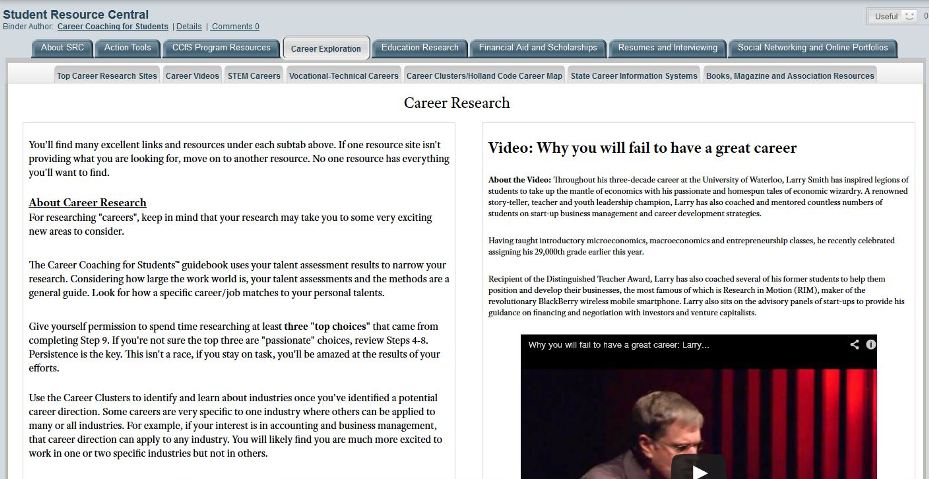
Larry Smith is a different kind of inspirational speaker. His presentation on TEDx is so entertaining and insightful I felt compelled to post it on my blog. If you are a parent, please watch the video. If you are a student, please watch the video. If you watch the video, share comments here.

Throughout his three-decade career at the University of Waterloo, Larry Smith has inspired legions of students to take up the mantle of economics with his passionate and homespun tales of economic wizardry. A renowned story-teller, teacher and youth leadership champion, Larry has also coached and mentored countless numbers of students on start-up business management and career development strategies.

Having taught introductory microeconomics, macroeconomics and entrepreneurship classes, he recently celebrated assigning his 29,000th grade earlier this year.

Recipient of the Distinguished Teacher Award, Larry has also coached several of his former students to help them position and develop their businesses, the most famous of which is Research in Motion (RIM), maker of the revolutionary BlackBerry wireless mobile smartphone. Larry also sits on the advisory panels of start-ups to provide his guidance on financing and negotiation with investors and venture capitalists.

Watch the presentation on TEDx.

Carl Nielson is an organizational development consultant, professional career and executive/leadership coach and creator of the nationally recognized program Career Coaching for Students™ . Career Coaching for Students is available as a district-wide high school program and in group and on-one-one offerings through certified career coaches throughout the United States, Canada and other countries. Contact Carl Nielson at carl@successdiscoveries.com or call 972-346-2892 to discuss specific needs. Or visit us at http://www.careercoachingforstudents.net

How to Stand Out


Jeff Haden (Inc. Magazine and Business Insider) posted two articles that any college student (and high school students for that matter) should use to “audit” their resume and their elevator speech. I’ve provided highlights of the main points here with my own bits of advice. The full articles are:

6 Ways Successful People Stand Out by Jeff Haden

10 Ways You Should Never Describe Yourself by Jeff Haden

Let’s face it. Your resume is a frustrating document to write. Do you include details or keep it high level? Do you include all work history or just the relevant stuff for the position you are applying for? Is one page the rule or is it best to have multiple pages?   The article “10 Ways You Should Never Describe Yourself” makes some very valid points. But how do you describe yourself? As Jeff states in his article, the 10 ways to describe yourself are great for others to say about you but probably not okay for putting on your resume.

At the end of this article, I’ll offer a complimentary assessment that will give you words to describe yourself. Yes, putting a few descriptors on your resume isn’t wrong, just don’t put words that are too general. My rule of thumb is, “if you are using a descriptive word because you think it is what the employer is looking for then you are misusing the space in your resume.

Haden’s 10 Words You Shouldn’t Use

Motivated – A better word might be “self motivated” which can be substantiated by things you’ve done.

Authority – Taking charge and leading (position authority) or having exceptional expertise (knowledge authority) need to be self-evident in your resume. A better strategy might be a statement like “Recognized for my leadership on the xyz project.” or “Recognized for my research on the zyq study.”

Global Provider – This may not be applicable to students, at least not right now, but many students have taken advantage of a Study Abroad program. This doesn’t make you a global expert. List the overseas period and describe what it gave you.

Innovative – Some people actually are innovative. That can be a good thing or a curse depending on the job. Some bosses don’t want a young upstart coming in and challenging or changing everything. They want you to learn. Employers want to know you are able to appreciate and follow their policies, procedures and work strategies. A better word might be creative if you were solely responsible for something new and creative that was recognized. However, that word has been overused.

Creative – We gave this one away as part of Innovative. Overused is the issue. Just be sure you have been recognized for something special. If not, don’t bother using it.

Passionate – This has no value. However, in the assessment report you might see “customer focused” or “results oriented” or “goal oriented”. Use those if you have a story to connect the word to.

Unique – Everyone is unique. I don’t see this word used too often but if I did, I think I’d file the resume in the round file.

Guru – Even if you could substantiate this some how, a student or recent grad isn’t a guru in anything. Be a learner.

Incredibly… – This is way too informal and is an exaggeration word. Avoid all words that exaggerate what you are trying to say.

Words that Work

If you’d like to take an online assessment to find better descriptors for your resume and for your interviews, go to http://www.ttisurvey.com///142181FUW This assessment takes about 20 minutes (2 parts @ 10 minutes each). The report is approximately 46 pages and will come directly to your email.

Haden has also made a list of 6 ways to stand out. There are many ways to stand out. I saw a person with pink and yellow hair. Yes, they stood out. Many young people today are  getting tattoos. To stand out from an employer standpoint, get into the recruiter or hiring managers head. What if you were them? What would you be looking for in a new hire?

Haden’s 6 Ways to Stand Out

Be first, with a purpose – From showing for the interview, to finding the job opportunities before they are posted on the company website. A position is officially approved and being recruited for 10 to 15 days before it gets any public exposure. Also, some companies have a policy of posting a position for as much as 30 days internally before posting it publicly. Make it your business to get the inside scoop from current employees and managers at the company you want to get hired. A great starting point is LinkedIn. But you have pursue that rich networking tool with purpose.

Be known for something specific – My son was advised to play down some of his high school accomplishments in his resume by a visiting industry mentor. The fact that he was accepted to and graduated (June 2012 –  and yes I’m very proud) from a prestigious university “assumes your high school years were impressive.” Whether it is high school or college stuff, be known for something! If you are currently in high school (or a parent of a HS student), be involved in something. I recently provided career coaching to a group of HS students (see Career Coaching for Students) and one student took this advice to heart and met with the school counselor and principle of the HS to request formation of a Poetry Society/Club. Stating on your college application resume “Founded and served as President of the Poetry Club” is what colleges and employers like to see. Just be sure you are able to say something about what you did after you founded it, such as, “grew first year membership to 48 students” and/or “Held 8 club meetings where 25 student-written poems were presented.”

Create your own side project – Integrating the project with another activity makes it exponentially easier and more likely to be completed. Many students are critical of, or sarcastic about, students that are in Boy Scouts or Girl Scouts but colleges and employers value the experience. Both of these organizations have an “ultimate level” (Eagle Scout or Gold Award respectively) that is usually attained during high school that includes a significant project.  My daughter was president of the ecology club and also achieved the Gold Award by designing and building out the grounds as part of a “Greenhouse Enrichment Project”. This required fund raising, organizing volunteers and working with the high school administration for approval and support. The fact that she was involved with the Ecology Club gave her the ability to offer service hours to club members. Getting volunteers was easy.

Put your muscle where your mouth is – Don’t talk about what is wrong, even if the interviewer asks you to describe something that someone else screwed up. When put in that awkward situation, always share a situation or problem that you were at least partly responsible for delivering the solution – even if you were the one that screwed it up. Being part of the solution is what everyone wants.

Show a little of your personal side – Personal interests help others to identify and remember you. For many interviewers, asking the proverbial “tell me about yourself” can lead to all kinds of responses. Stay focused on the purpose of the question and environment you are in. If the interview is a standard 30 minutes, and you talk for 10 minutes about “who you are”, it is likely you won’t be getting the job or internship. Be prepared for how to “share a little.”

Work harder than everyone else – There is a book titled “Only the Paranoid Survive” by Andy Grove, ex-CEO of Intel, that gets this point across and then some. If you are in the right major and career for you, (or soon will be) this isn’t a hard thing to do. If you feel apathetic about your major/career choice, now is the time to do the work to find your passions. Working harder than everyone else should not be a chore. Look for the career that you can say “I can’t believe they pay me to do this stuff.”

Carl Nielson is an organizational development consultant, professional career and executive/leadership coach and creator of the nationally recognized program Career Coaching for Students™ . Career Coaching for Students is available as a district-wide high school program and in group and on-one-one offerings through certified career coaches throughout the United States, Canada and other countries. Contact Carl Nielson at carl@successdiscoveries.com or call 972-346-2892 to discuss specific needs. Or visit us at http://www.careercoachingforstudents.net
Choosing and Changing Majors: Status Quo or A New Standard?


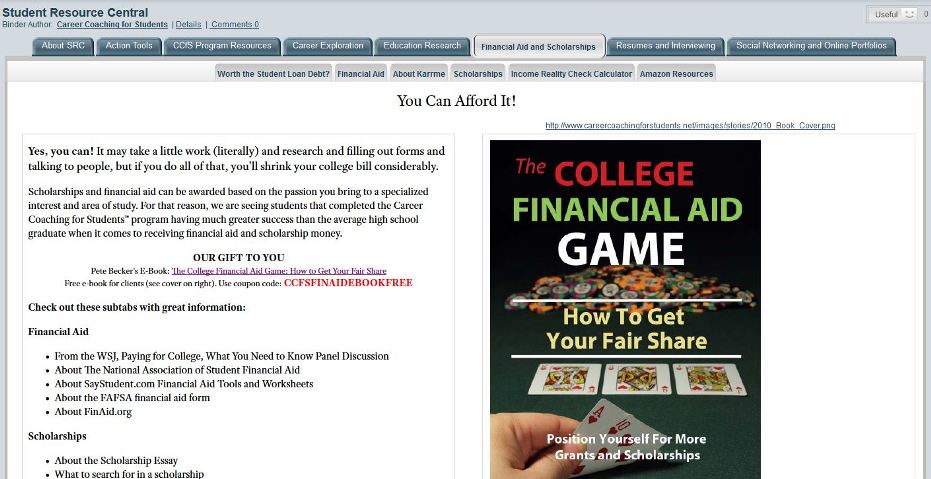
The following graphic is from The College Board. We’ll start the discussion here.Is Changing Majors OK?

From the quote in the green bubble, “It’s okay to change your plans even if it means changing your major.” Well, yes, if you find yourself going in the wrong direction, change direction. But The College Board position, and that of most colleges and universities, is that changing majors multiple times to “find yourself” is okay. It isn’t. What it tells me is that the student didn’t do the work to determine a career path prior to showing up at college.

Many colleges and universities report the statistics that support the 2005 article by MSNBC.com that indecision about what major to choose can prove very expensive.  According to Dr. Fritz Grupe, founder of majors.com, eighty percent of college-bound graduating high school students have yet to choose a major before arriving on campus.

With tuition averaging $18,000 or higher in 2012-2013 at public universities, and much higher at private universities, indecisiveness can drain college savings accounts as students restart course sequences or transfer schools – losing credits in the process. Ultimately the result is that the student extends their college days beyond the four years parents planned to finance.

According to College Board, five- and  six-year students are not uncommon. Roughly 40% of those who start a four-year degree program still have not earned one after year six!

There are a variety of good reasons for dragging a college career into its fifth and sixth years—from taking time off for foreign study, to taking advantage of internships and co-ops or needing to balance academics with part-time employment to pay tuition. But changing majors is the one thing that drives up an education’s cost while potentially driving down a student’s self-esteem. It is also the easiest to avoid.

Bad Advice?

There are many (too many) assessments that aren’t valid and reliable. There are also “exercises” that professional counselors recommend if you don’t have access to professional tools such as valid and reliable assessments.

Kate Brooks, director of liberal arts career services at the University of Texas at Austin, thinks surveys can help focus a student’s attention on potential courses of study but she warns about the the students tendency to apply the results too inflexibly. “Often a student will say, ‘the test says I should be a florist, so that’s what I have to be,’” she says. A valid and reliable assessment and process doesn’t result in one career choice. A student that has that belief wasn’t counseled properly and was most likely not using a valid and reliable assessment instrument.

“Nationally, we see statistics quoted that as many as 80% of all college students change their major or that the average college student changes his/her major an average of 3-5 times. If you were able to count how many times students change their mind about what they want to do after graduation, it would be much higher. “
University of Missouri • MU Career Center, 2010
Student Success Center

Rather than properly designed, validated and reliable assessments, Brooks favors an exercise to help undecideds identify and translate interests into majors and eventually careers they will succeed in and enjoy.

She sends students to the nearest Barnes & Noble to browse the magazine racks. They are instructed to buy the three magazines they find most interesting. “We then discuss what prompted them to buy those magazines. It may be they chose Newsweek because they are interested in current events and politics. Or possibly there was an article in ESPN about nutritional sports bars. We talk about how pursuing chemistry could lead them to create a better bar or sports drink. Or maybe it is the marketing aspect that appeals to them — the ads. The point is to help them understand what things excite them and what careers are connected to those things, and which majors would lead them to those careers,” explains Brooks.

That exercise is wonderful but too simplistic. Choosing a career and the best major for that career direction is a little more complicated than that.

Tips for helping your student choose major

What can parents do to help their children get through college in a timely fashion while staying passionate about their choice of major? Here are some suggestions I think are worthy of considering:

  • Refrain from pressuring children into making quick choices or pursuing majors associated with high income professions. Not everyone should or can be a doctor or a lawyer.
  • Focus attention on pursuing courses of interest based on a career direction, even if the immediate relationship to a major or career is not obvious.
  • Double-majoring is a great way to keep opportunities open. With good planning in high school, double-majoring is not only very doable, it may very well be more interesting and provide an extra level of motivation and self esteem.
  • Encourage participation in job shadowing — going to work with people to see what their jobs actually entail and asking people they meet how they got into their careers. While in high school, interview people in the career of interest that are passionate and successful. Parents can help set this up.
  • If they do enter school undecided, engage in a career coaching program that provides professional-grade (highly valid and reliable) assessments and a process that leads to clarity and good decisions. It doesn’t hurt that the program will also assist in a broader sense of creating success across the bigger picture of life.
  • Refrain from giving advice based on the job market of twenty-some years ago or the “parent ego”. Today’s employers need a different kind of worker and favor different degrees. Many parents see their own career as a great direction for their son or daughter. Genetics may have played a part in creating that awesome son or daughter but choosing a career is a highly individualized event.
  • Urge them to take full advantage of campus advisory services to avoid floundering, shifting from one course of study to the next, and prolonging their dissatisfaction and their academic careers. While I am generally strongly negative in my bias about college advisory competencies when it comes to assisting students in choosing a career direction and then matching potentials majors for that career, if you are taking any of the other advice above, this may not be necessary but it is usually the first option. students rely on and is the one option with the greatest gap between expectation of value and actual value. Just keep in mind, you might be told to go to the local magazine store to find your career.
  • Help them understand that a major is not a career. There are multiple paths to most careers, just as there are multiple careers that can be had from a single major. Encourage them to explore their options. Having a career direction is much more powerful than choosing a major.
  • Help them prepare academically before arriving at college to avoid spending their high-priced time on remedial or review classes.
  • If a child is undecided, consider seeking out a college with the resources to acquaint them with all the options to make a well-founded decision. Not all schools have or emphasize such programs.
  • Understand that the student-to-counselor ratio averages 450-to-1 nationally at the high school level. Do not rely on high school counselors to guide children through the exercise of choosing a major.

However they get there, encouraging children to think through their career interests before choosing a school or program can help them avoid future frustration, academic let-down or feelings of failure. It is also key to helping them graduate in four years and move into their ‘real’ lives before they out-spend their college savings accounts.

A more up-to-date and informative article is available.

2015 national webinar to be held in July for career exploration and planning that leads to choosing a major