Tag Archives: career counseling

Six Mistakes Made on Resumes


It has been over 20 years since I was in the corporate HR world handling 200 resumes for one job opening and handling 50 job openings at once. Today, being focused on organizational development consulting and coaching for the corporate world  I still get involved in helping mid-career professionals as well as provide the Career Coaching for Students program to high school and college students. Whether you are a college grad hoping for that first break out job or looking to make a 5th job change due to lay offs, mergers and acquisitions, a resume is more of a show stopper  than a qualifier unless you are utilizing relationships to get that interview.

Your network, statistically speaking, will most likely be the way you obtain the job, but every once in a while your resume is one of the 250 resumes that HR filters through before handing off 100 to the hiring authority. So your resume must be right.  I’ve compiled six reasons from my own experience and that of other bloggers in “corporate HR/recruiting”.  I’m amazed at how the reasons for going in the trash haven’t changed in 20 years. Here are six reasons your resume will get thrown in the trash.

#1 You don’t meet the minimum criteria. From a hiring manager: “It took only two minutes to find that first red flag in my four-inch stack. I saw an application on which someone from human resources had written ‘experience may not qualify.’ The candidate had spent two years working at a work-force-development agency, but the HR staff member didn’t know if that would count toward our need that the applicant have experience in vocational education. After reading the job summary on the résumé, I knew the experience wouldn’t count. Case closed.

The first step in the application process is understanding whether or not you even qualify for the job. Your application typically will not go straight to the hiring committee. Instead, it will first go through the filter of the human-resources staff members who won’t forward unqualified applicants or will flag someone whose qualifications are uncertain. If you don’t have the job’s minimum requirements, the process is over. Note those minimum requirements and clearly demonstrate how you meet them.

#2 Employers fail candidates for bad grammar. It’s sad that I have to write that. The number of misspelled words, incomplete sentences, and other cardinal sins of writing is shocking. While the average employer would certainly drop you for such transgressions, some employers get twice as irritated about it. Misspellings signal laziness, inattention to detail, and just the overall sense that you aren’t taking this seriously.

Here are three pieces of advice: proofread, proofread, proofread. Every word processor on the planet has spellcheck. Is it that hard to click the little button? You’ve already (I hope) spent an hour or more writing the thing. Would taking another five minutes for a once-over be too much to ask? Ask someone that is known for their editing prowess to review your writing. One final question: Would you take this article seriously if I butchered the wording? Of course not. The same perspective applies.

#3 Did you even try to tailor your résumé? The next red flag comes from an excellent, well-crafted résumé. Clearly demonstrating the candidate’s expertise in accounting, it included specific accomplishments in previous accounting jobs. It was without flaw. The HR screener may have even said aloud, “This is the best I’ve seen in a while.” There was one small problem, though. The company isn’t hiring for an accounting position. On to the next candidate.

I’m sure many of us have either used or heard of the “spray and pray” method of applying for jobs. It means rapid-firing your résumé to every opening you can find. I have rarely seen that strategy work. In fact, one of the best things that applicants can do is demonstrate that they know what they are applying for. Mentioning specific programs or people you know that work at the company will be seen very positively. But the biggest desire is that HR wants résumé that deal with the company’s specific needs as a department line by line. You can’t do that if you haven’t bothered to notice what the department or company has open.

#4 I know you’re lying to me. Here’s a great rule of thumb—don’t lie on your application or resume. In fact, don’t ever lie, because the truth eventually surfaces. With social media, networking everyone to everyone, employers can chat with someone who will know you didn’t do half of the things listed on your application or will have very different dates of employment. Once that happens, into the shredder you go. Even worse, you might get hired and the truth will get you fired quicker than you can say “oops”.

Even if your lies help you make the first cut, you should know that HR and hiring managers (in small and large organizations, with or without HR expertise) will do research on you before the call for the interview. If they sniff deception, you’re gone.

#5 You didn’t speak our language. Here’s a strategy connected to #3 above used to land jobs: Copy specific phrases and buzzwords from the job posting into your résumé. Then build them into the bullet points. “Instructional design a plus” from the posting becomes “experience in instructional design” on your application. (Obviously, only do that when the statements are true.) Don’t refer to the descriptive term (instructional design) as something else not relevant or valued by the employer (such as “building course materials”).

Hiring Committee members who quickly scan résumés often look for the specific phrases they put in the job posting. Using other phrases to describe the same activity might cause a committee member to unknowingly pass over critical parts of your experience while they speed read. Many corporate employers are now using an automated filter that electronically weeds out applications if they lack the right number of “keywords,” which essentially are the words from the job posting. That is why so many refer to the online job posting systems as the “black hole”.

#6 You used too much personality fluff. This one is claimed to be a common mistake as reported by HR recruiters. It happens when candidates use descriptive phrases about themselves like, “dedicated worker,” “innovative thinker,” “cares about …” Those read like fillers you stuck in because you didn’t have enough concrete work experience to fill a page or perhaps you were trying to populate your resume with key words.

The problem is that the descriptors must be substantive and job-related. I coach my clients to add descriptors that come from their talent assessment results. For example, the following are from a mid-career client assessment and are listed on the first page of the resume prior to the Experience section:

Here is the challenge in using these descriptors. As one HR person stated, “I don’t care if you think you’re ‘motivated to succeed’ or ‘enjoy new challenges.’ Anyone can say those things and most people do, to the point of being cliché. Furthermore, just because you can say them doesn’t mean they’re true. I will be able to read your personality from the interview. That’s what the interview is for.” The person was making a fair statement until the end. “I will be able to read your personality from the interview” was arrogance and ignorance at its best, however, explaining why that statement totally discredited the HR person is outside the scope of this article. For each “talent descriptor” you include in your resume, be prepared with a job-related story that supports the claim. For example, in the list above, “Likes to bring people of common interest together” is something that came from the assessment report but is a huge strength for this person. She is in sales. She has many examples of how she not only exceeded sales quotas but connected others in her organization to selling opportunities – because she enjoys it.

Your résumé should show why you have the best background and skills for the job. Your “talent” as I refer to it includes your personality. That is part of why you have the best “total talent” for the job. As the arrogant/ignorant HR person stated, “If you are good at written communications, I should be able to glean that from a perfectly written resume.”

As you assemble your application, remember: When employers sift through a giant stack of applications, they look for excuses to end the relationship quickly. Don’t give them one.

Carl Nielson is an organizational development consultant, professional career and executive/leadership coach and creator of the nationally recognized program Career Coaching for Students™ . Career Coaching for Students is available as a district-wide high school program and through certified career coaches throughout the United States and other countries. Call Carl Nielson at 972-346-2892 to discuss specific needs.

New College Grad Survey Finds High Hopes for First Job


Reposted from Workforce Online magazine.

Despite spending most of their college years at the depths of the Great Recession, new graduates have high expectations of their earning power. About 40 percent said they expect a starting salary of $50,000 to $75,000 for their first job out of college.

The Class of 2012, soon to be spilling out of colleges and universities and applying for jobs, has high expectations for their career prospects.

In a new joint study by websites Experience and Achievers, this new batch of millennials is shown to be career-minded, loyal, brand-savvy and likely to know from the get-go at which company they want to work. Further, they’re most likely to simply pick up their smart phone and apply for a job online at that company’s website.

And apparently money isn’t everything to new graduates. Even though the Class of 2012 collectively is graduating with more debt than ever from student loans, 54 percent said career advancement opportunities were more important than salary, according to the study, which is in its third year.

Despite spending most of their college years at the depths of the Great Recession, new graduates have high expectations of their earning power. About 40 percent said they expect a starting salary of $50,000 to $75,000 for their first job out of college.

According to an annual survey by the National Association of Colleges and Employers, new grads may be aiming a bit high. Bethlehem, Pennsylvania-based NACE’s April 2012 Salary Survey report—the first report on salaries for the Class of 2012—shows the overall median starting salary for a bachelor’s degree graduate has risen 4.5 percent to $42,569 for the Class of 2012 from the last median salary of $40,735 for the Class of 2011.

“The overall median salary increase is the result of gains throughout most sectors,” says Marilyn Mackes, NACE executive director. “Even in those sectors that showed decreases in median starting salaries, the dips were very slight.”

Education and communications majors are seeing the most significant increases to their median salaries over last year. Graduates with education degrees are entering the work force with a median salary of $37,423, 4.5 percent higher than the $35,828 earned by members of the Class of 2011.

Hiring of graduates is up as well and is improving. NACE actually revised its figures upward in April, showing that businesses expect to hire 10.2 percent more graduates this year.

Razor Suleman, founder and CEO of San Francisco-based Achievers, said the study also uncovered a disconnect between statistics and reality when it comes to millennials. Twenty-two percent of respondents expect to stay with their first employer more than 10 years.

“According to the U.S. Bureau of Labor Statistics, they stay 18 months on average” in a job, Suleman says. “But that’s not what they’re telling us their intent is. They’re entering this relationship with their employer, and on average they’re telling us they want to stay for 4.7 years.”

Knowing what this new generation of workers wants vs. what they do in the workplace is an opportunity for companies to change their approach to millennials, Suleman says. Most companies tend to be stuck in the past, using antiquated notions of performance review and recognition that don’t cut it with Gen Y workers, Suleman says. For example, a gold watch after 25 years of service means nothing to them.

“Gen Y grew up being praised, getting gold stars, getting trophies just for participating,” Suleman says. “When they enter the workforce, they’re not going to change; companies need to. If you want to keep them engaged in a workplace, feedback and recognition on a weekly basis is paramount. Of the nearly 8,000 respondents to our study, 84 percent said that is what they wanted.”

Suleman adds that employer branding has never been more important to the recruiting process. The study notes that 87 percent said they would apply for their first jobs at a company website. “These students already know who you are. You need to fish where the fish are biting, which is online.”

Carl Nielson is a professional career and executive/leadership coach and creator of the nationally recognized program Career Coaching for Students™ . Career Coaching for Students is available as a district-wide high school program and through certified career coaches throughout the United States and other countries. Call Carl Nielson at 972-346-2892 to discuss specific needs.

High Schools Recognize Online Student Career Planning Solutions Aren’t Making the Grade


According to an article in Education Week, more and more schools are recognizing that career and education planning for secondary students is essential to producing self-sufficient graduates ready for the workforce of today. With post-secondary education receiving an increasing amount of attention nationwide, many high schools are finding that helping students choose a career goal encourages improvement in academic performance and achieves significant results for their students.

Any increase in planning is welcomed, but many planning programs focus solely on admissions test prep and non-directed career exploration, relying on a series of questionable online inventories and surveys that do not allow for the introspection and guidance needed for such a consequential decision. In contrast, the American School Counselor Association’s National Standards for Students and The George Washington University Freshman Transition Initiative’s Standards for Freshman Transition find three areas of development are key to effective guidance and planning: academic, career, and personal/social development.

Online solutions may seem adequate but are poorly suited for promoting personal/social development, creating intentional student engagement in academics and achieving the results that will make a measurable difference for students. Many high school programs often settle for (and demand) the creation of a 4-year plans starting with the freshman year. Choosing a track is great if it is based on an informed decision by the student. Most high school freshmen are not given the opportunity to do quality research and introspection to make an informed decision – yet the chosen track will impact them for years to come. And these plans only focus on taking the student through a “chosen track” through the end of high school and neglect planning for post-secondary completion and workforce entry, unlike the 10-year career and educations plans recommended in the Standards for Freshman Transition.

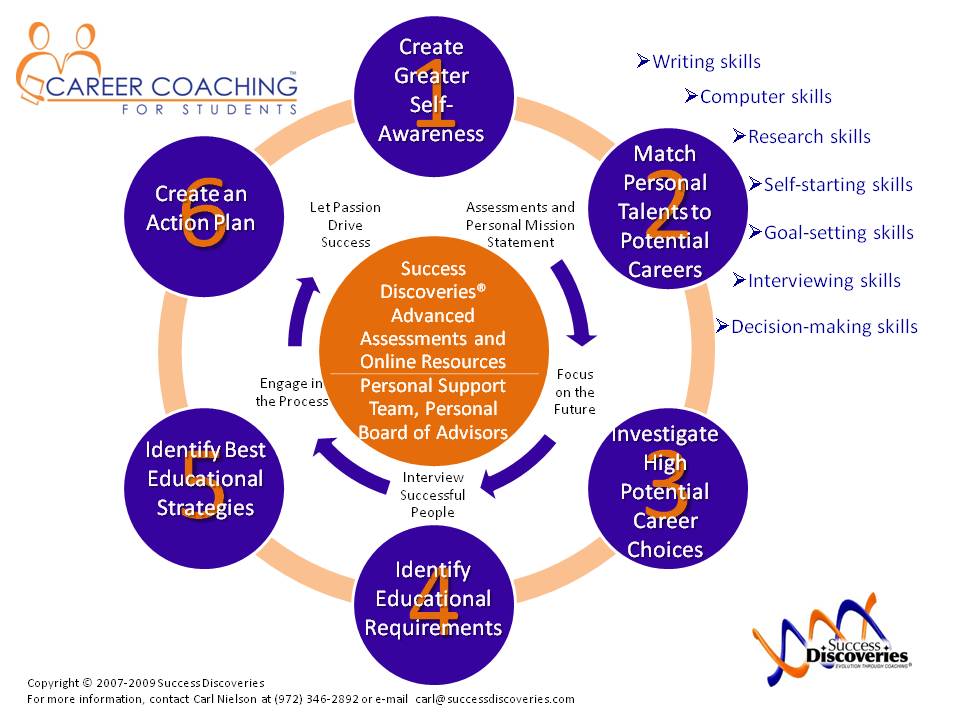
There is one alternative – Career Coaching for Students™. To learn about the Career Coaching for Students program, which meets all the Standards for Freshman Transition recommendations, check out the information at http://www.careercoachingforstudents.net.

Carl Nielson is a professional career and executive/leadership coach and creator of the nationally recognized program Career Coaching for Students™ . Career Coaching for Students is available as a district-wide high school program and through certified career coaches throughout the United States and other countries. Call Carl Nielson at 972-346-2892 to discuss specific needs.
Career Mapping Catching on in High Schools


The article Career Mapping Eyed to Prepare Students for College by Caralee J.  Adams, reviews the current state of high school student preparation strategies for researching and making career choices. I’ve pulled a few quotes and provided some comments and insights into what the reality of today’s efforts are producing.

Secondary schools are becoming more intentional about helping students discover their career interests and map out a plan to achieve them.

This effort is only as good as the foundational approach. As the article suggests, “Finding time during the school day can be a challenge, and the job of overseeing the process often falls on already stretched counselors, according to researchers and program administrators.” The assessments that schools use (see comment further down about Naviance) are not valid and can not be used in the work world to match people and jobs. Students recognize these issues quickly and consequently dismiss the entire exercise as a “waste of time”.

About half of all states mandate that schools help create individual or student learning plans, and most others have optional programs.

A student learning plan is something schools have been providing since student guidance counseling was created. Designing and attaching a student learning plan to a career direction is not something that should be done until high school. Mandating this activity has not created any measurable change that can be associated with increased post-secondary education, higher GPA or better test scores.

Enabling students to make their own plans puts them in the driver’s seat and encourages a long-term look at their course selection so their choices match their career goals, experts say.

The key here is “match their career goals”. A high school student is not equipped to make sense of the assessment results and do not have the necessary knowledge about different career paths to make decisions about career direction on their own. Schools do the best they can to expose students to different career areas but it is a shot gun approach that results in students feeling lost and/or overwhelmed.

Often, districts give students online accounts with passwords to track classes; create an electronic portfolio of grades, test scores, and work; research careers; and organize their college search.

These online accounts, including the one mentioned in the article, Naviance, have been around long enough to measure their effectiveness. Ask any student, and I really mean any student, that attends a high school with Naviance (or other online solutions) and ask them how they used Naviance. The answer I receive is “I didn’t.” or “It wasn’t helpful at all.“.

Schools, meanwhile, have not yet experienced the payback on their investment. As with many education programs, the rollout is left up to districts, creating a patchwork of approaches throughout the country.

This is a great “excuse” for the companies such as Naviance and the school administrators. A person I respect who works with at risk kids and served on a school’s trustee board and knows Naviance very well stated the online solution was “used only to help students get into a preferred college” – not to help them identify and focus on career direction.

Students create plans starting as early as the 6th grade. Of course, they can—and often do—change their minds about their career path. …Typically, a student might have a career-exploration unit in 7th grade. Through an interest inventory, in which the student answers a series of questions about preferences for working, say, with people or numbers, indoors or outside, his or her interests are matched with career clusters and pathways.

Childhood development studies clearly show that a student’s behavioral style and motivators are being established through middle school. The motivators (personal values) are set earlier. Behavioral style is in “wet cement” as students enter high school. The behavioral style and motivators are key to aligning a person’s “talent” to career options. Therefore, serious career exploration and career mapping is not useful until high school. Schools need to use a broader “exposure” strategy until high school. In high school, the focus needs to be at the individual level. That is where true career coaching is most effective. Also, did I mention the assessments used in school are not valid and reliable.

Knowing that high school students today connect best with online materials, the College Board recently launched a new interactive college-planning site, the BigFuture.org. And U.S. Sen. Chris Coons, D-Del., recently introduced a bill to pilot a project in which students beginning in 1st grade could start portable online college-planning and -savings accounts.

Students connect best with online materials? Give me a very talented teacher and the student will choose the teacher over online every time. The issue may not be the “preference for online materials” but rather a rejection of low quality teaching. With respect for Senator Coons, if we want to make college more affordable, fund the use of career coaching programs like Career Coaching for Students™  that are known to reduce the risk of changing majors in college and provide a student with an exciting personal future view that leverages their motivational and behavioral career match.

Todd Bloom, the chief academic officer for Hobsons, the Cincinnati-based company that produces Naviance, an online career- and college-readiness system, said the depth and breadth of individual learning plans are expanding, and the cost can run less than $5 per student per year. “It’s not a hard sell,” he said. “It’s socially desirable to have that vehicle. ”

And here you have the issue. School boards look at their budget and what they are “required” to provide and see online systems like Naviance as an “easy” solution to implement. Parents that are aware of the offering assume it is providing something helpful. The saying “you get what you pay for” is very applicable here. There is no hard data that shows any ROI on these “low cost” online system solutions like Naviance.

Yet a goal of the program was to increase high school graduation rates and that did not happen, said Jay Ragley, the director of the office of legislative affairs for the state. “It’s difficult to peg why we are not increasing graduation rates. That goal has still eluded the state,” he said, adding that it’s been a challenge to get parents used to the idea of career planning as early as middle school.

Until parents demand and receive better solutions in schools, I strongly recommend engaging a career coach for your high school student – as early as incoming HS Freshman rank and no later than the beginning of the Sophomore year.

Side Note from the trenches: We’ve approached school districts about integrating the Career Coaching for Students™ program as part of a high school curriculum. This program can easily fit into one class per week for a semester with other classes referencing parts of the program throughout the four years of high school. Students have access to the online career and education research tools throughout the four years. The most common statement we received as feedback: “Wow! This is exactly what we need. If we had this, we’d push our “online-only system” to middle school and have this for all of our HS students.” Our response to that: “Great! What is the next step to make this happen?” Reply: “Oh no, we’re too invested in what we have now. To go back to the school board and say we’ve got something better would not work out well for us. And besides, we know we won’t receive more funding to cover a more expensive solution.

Carl Nielson is a professional career coach, creator of the nationally recognized program Career Coaching for Students™ and managing principal of The Nielson Group, a management consulting firm specializing in hiring and selection, team effectiveness and executive coaching.

Fear of Failure, Success, the Unknown: Which One Controls You?


Your key to successFear of Failure. Fear of Success. Fear of the Unknown. Any of these can be the handcuffs for teens looking at the future and wondering what it holds. What career direction should I pursue? What educational strategy is best for me? What college should I choose? Any of these questions can play an invisible role in hindering pursuit of our potential.

High school academics doesn’t reveal much when it comes to identifying those that have a fear that hinders their success. A student can excel in academics, even be labeled “most likely to succeed” by their class mates. Yet, we see many of these enter college, change majors multiple times and procrastinate as they approach college graduations.

Teens that are academically performing at a level lower than their potential may also be challenged with fear. Today’s educational system allows just about anyone to excel if they have the ambition. Most students are very bright and capable regardless of their academic standing. If they missed developing the foundation for success in reading, writing, math, it is harder to show academic excellence but that does not change the fact that they are likely very bright.

If fear is playing a role in limiting a person future, it is helpful to understand which fear it might be. Fear of success, fear of failure and fear of the unknown are reviewed in this article. A few strategies are also offered for conquering the fear.

Fear of Failure

Fear of failure is related to fear of criticsim and rejection. Successful people see failure as simple feedback and nothing more. Unsuccessful people or those not moving forward look at mistakes as permanent and personal.

Most people self-limit themselves. They don’t achieve a fraction of what they are capable of achieving because they fear they will fail.

Fear of Success

Fear of success can be just as paralyzing as fear of failure. Many people fear success because it tests their limits and makes them vulnerable to new situations. Even worse, success can expose weaknesses and force people to deal with their flaws.   Success is scary because it involves change.

For people with a fear of success, the internal feelings when thinking about the possibility of success are very close to what is felt when we are failing at something. Success can be intimidating and hard to handle. With success comes more challenges and responsibilities – and that can be threatening.

Sometimes people fear success because they don’t know if they can live up to their achievements. They don’t think they’re good enough or smart enough. They’re afraid they don’t have what it takes to rise to the challenge, and they don’t know if they can sustain their success.

There is another condition that feeds the fear of success. Many of us have been conditioned to believe that the road to success involves risks such as “getting one’s hopes up” – which threatens to lead to disappointment. And many of us-especially if we’ve been subject to verbal abuse-have been told we were losers our whole lives, in one way or another. We have internalized that feedback and feel that we don’t deserve success. Even those of us who were not abused or otherwise traumatized often associate success with uncomfortable things such as competition.  Take a simple Fear of Success quiz.

Fear of the Unknown

Fear of the unknown is a peculiar condition in most of us, where we find ourselves freezing up as we think of embarking upon something we are not acquainted with.  Fear of the unknown can leave a person in a frozen status. They are afraid of entering and exploring the new ground, because they think they might get in trouble. They are afraid of losing what they already have by jumping into the unknown.

Fear of the unknown is a common phenomenon with young people, when they don’t wish to accept or pursue anything unfamiliar. There is a certain safety radar in our body that keeps us alarmed of the various dangers that come into our life.  These safety limits are learned during our growing years as a child.

While as a child we were often restricted by our parents or taught to fear unusual situations. We then become apprehensive about meeting anything new and foreign. This fear, in a way, restricts an individual into a particular fenced area of the “known”, depriving him from the excitement of meeting the future with enthusiasm.

If allowed to persist, the fear can ultimately lead to a very restricted lifestyle, devoid of the various essences in life. They know what they should be doing, but they can’t take action because they think there is a risk involved with this big life transition.

The Internal Conflict Between What You Want and What You Already Have

Yes, you will be leaving your well known life and begin to embrace a totally new lifestyle. But, here’s something that’s worth thinking about: Aren’t you already in trouble? What urged you to search for your true passion? Aren’t you hungry for a meaning in your life? Aren’t you already feeling the fear of being lost and wandering aimlessly through life lacking a real purpose? Are you happy with the idea of doing work that has no meaning and wasting your precious time doing something that doesn’t really matter to you?

Be Smart About FearSo what can you do?

If you think you have a fear of failure, start looking at life with a new paradigm: there is no failure, only feedback. The only way we learn is through trial and error experience. The only way you have learned anything is through mistakes. The only way to be successful is to learn (fail).

To overcome the fear of failure, first take action. Bold, decisive action.  Fear of failure immobilizes you. To overcome this fear, you must act. When you act, act boldly.   Action gives you the power to change the circumstances or the situation. You must overcome the inertia by doing something. What would you do if you knew you could not fail? As the Nike commercial says, just do it. If it doesn’t work out the way you want, then do something else. But DO SOMETHING NOW. Second, be persistant. Successful people just don’t give up. They keep trying different approaches to achieving their outcomes until they finally get the results they want. Third, don’t take failure personally. Failure is about behavior, outcomes, and results. Failure is not a personality characteristic. Fourth, do things differently. If what you are doing isn’t working, do something else. There is an old saying, “if you always do what you’ve always done, you’ll always get what you always got.” If you’re not getting the results you want, then you must do something different. And finally, look for possible opportunities that result from the experience. Napoleon Hill, author of Think and Grow Rich, says “every adversity, every failure and every heartache carries with it the seed of an equivalent or a greater benefit.” Look for the opportunity and the benefit.

If you think you have a fear of success, first differentiate between feelings of excitement (positive) and a “trauma reaction.” Think of a time in your past when you were very successful. Recall your body’s physical response. Perhaps your heart rate was up. What other physical responses can you recall? Now think of a time when you failed and the failure was a public embarrassment. What was your body’s physical response? What we’ve found is that failure (stress) and success (excitement) produce similar physical reactions in our body. So differentiate your feelings of success as positive, not negative.

Second, look for actions or behaviors that are self-sabotaging. For example, partying or watching TV the night before the big exam or presentation at school, or you somehow always ruin the opportunity for a good night’s sleep. Third, stop procrastinating. Putting projects, assignments, or duties off while you take care of non-essential fluff or “make-work” chores can be a sign of fear of success. If you putter around instead of taking care of business, you may be subconsciously sabotaging yourself.

Fourth,  stop talking about it and start doing. Sometimes certain behaviors look like laziness, but they reveal a fear of success. For instance, you may talk about your life dreams and goals all the time, but you watch TV every night and surf the Internet for hours every day. You never actually take practical steps or exert self-discipline to move in the direction of your goals.

And last, stop creating negative, pessimistic talk. Fear of success can involve an extremely negative perspective of life. “What’s the point of dressing up for the job interview? I probably won’t get it anyway.” Not trying – and focusing on all the things that can go wrong – is self-sabotaging behavior.

If you think you have a fear of the unknown, first know this type of fear is not that fatal to an individual, yet it should definitely be remedied in order to enjoy a healthy life. For that, first of all, we have to turn the unfamiliar into the familiar.

This can be successfully achieved through meditation and by playing upon our imagination. Our mind does not care for any restriction. Neither does our imagination. Our thoughts and imagination, if applied, can definitely solve much of the problem of the fear of the unknown. As Steve Jobs says, “You’re already naked, so there is no reason why you don’t follow your heart”.

The only way to beat the fear of the unknown is to take the first step. If you’re afraid of getting in trouble, remember that you’re already in a bigger trouble by not following your heart. If you listen to the voice of your fears, you’ll live an empty life. But, if you listen to the voice of your heart, you’ll live a remarkable life.

Take the first step and beat your fears. There is nothing to lose and everything to gain.

Carl Nielson is a professional career coach, creator of Career Coaching for Students™ and managing principal of The Nielson Group, a management consulting firm specializing in hiring and selection, team effectiveness and executive coaching.

Ask for a Favor


Career Coaching for StudentsMost people often hesitate to ask for help because they worry about being intrusive or appearing needy. The truth is that it’s innately satisfying to help others, and most people want to help. Adults especially enjoy helping up-and-coming teenagers that are showing personal accountability and self direction. As you evaluate potential careers, ask adults for favors.

Ask for help in finding and meeting people in your area of career interest. Asking can be a powerful way to get people become invested in your success.

Most people don’t realize the size of their network. And for those that do, very few leverage their network effectively. How large is your network? To find the answer, write down in three columns all of your friends‘ names, your family‘s names and your “professional contacts” that you can think of in a 10 minute timed period (set a timer). For example, I am considered a professional contact, feel free to put me down on your list.

Work on this list until you feel you’ve exhausted your thinking. How many people did you list? Now consider this, what if every person you wrote down had an equal number of people in their network that you have in yours? Some will have more. But let’s use your list count. Take your list count and multiply by the same number. The answer is your true available network.  For example, if you have 45 people in your list multiply 45 x 45 = 2,025. You now have a significant network that will most likely help you contact the right people in your area of career interest.

Be bold enough to use your network. They want to help.

Carl Nielson is a professional career coach, creator of Career Coaching for Students™ and managing principal of The Nielson Group, a management consulting firm specializing in hiring and selection, team effectiveness and executive coaching.

Mountain Top or Dung Heap?


Dung Heap is smelly and dirtyMy colleague Steve Straus provided this insightful thought provocation to his newsletter subscribers. Adults appreciate the distinction Steve provides around being on the Mountain Top vs. being on a Dung Heap when it comes to one’s career. But do high school students see the distinction? Are parents sensitive to the lesson’s in Steve’s message?

“There are many paths to the mountain top” is an ancient bit of wisdom which means don’t get too enamored with the path you’re on, believing it is the only way. If your path works for you, use it.

Let others choose their own, if theirs works for them. It’s an interesting thought, applicable to careers, study, leadership, and families.

However, there is a problem that many who have taken the upward journey have learned. They have discovered, once reaching the top, they were climbing a dung heap. They found themselves dirty, smelly, and exhausted, and looking ‘over there’ at the real mountain top.

Before embarking on your journey make sure of your destination.

Coaching Point: Have you been pausing periodically to take a deep breath and notice the smell of your mountain?

Carl Nielson is a professional career coach, creator of Career Coaching for Students™ and managing principal of The Nielson Group, a management consulting firm specializing in hiring and selection, team effectiveness and executive coaching.

Career Exploration Requires Developing a Personal Idea Network


TED logoSteven Johnson has a great presentation on where ideas come from that has been made available on TED. Taking his message and applying it to career exploration for high school or college students seemed like a fun exercise.

At the end of his presentation, Johnson states “chance favors the connected mind”.  Now shift your thought to people who are successful and happy in their careers. How did these people find their career? Did it come to them in a dream when they were very young? Perhaps it came to them through a high school class. Or from a discussion with one of their friends. Johnson’s research suggests eureka or light bulb moments, a single event, isn’t how people “found” their career match.

The key to success is in the connected mindInstead, Johnson makes a case for the development of an idea network in the brain that leads to “favor”. So if you can make the assumption that the hypothesis “chance favors the connected mind”  is true, you might find that most people that are in highly successful and enjoyable careers didn’t have a eureka moment. Instead, they experienced a process or journey that promoted exploration of career choices in a networked environment.

The idea of a “connected mind” for career exploration suggests the combination of self-awareness about what in the world motivates you, how you like to do things, people that can offer expanded perspective about careers and information resources such as Student Resource Central on the Career Coaching for Students website and a students’ extended social media network.

A Common Misstep
Exploring potential careers of interest comes before researching educational options including choosing a college. Many students choose a college, university or trade school based on many invalid considerations such as football team success, where friends are choosing to go or the beauty of the campus (I could go on).  Why do they do that? I see two primary reasons:

  1. No access to credible career exploration tools and strategies
  2. Effective career exploration requires work
  3. Without “credible” career exploration tools and strategies, blind faith about what that work will produce is required

What if there were personality and interests assessments that were so valid and reliable for increasing self-awareness and identifying potential career choices they eliminated the need for “blind faith”? What if that led to motivation to do the work to investigate high-potential career interests?

So you’re ready to research educational options and choose a college
One exercise that high school students can do to expand their connected mind for choosing a college is use their Facebook extended network to find students attending a particular college of interest. With Facebook for finding those students and Skype for connecting easily for a chat, it is easy to learn about a particular college or university from the inside. Even better, ask those students attending your school of interest to help you connect with students in the specific major that you are targeting.

Remember, “chance favors the connected mind”. What are the chances you are choosing a career direction and education strategy that will favor you ten years from now?

Carl Nielson is the developer of Career Coaching for Students™, the premier career exploration program for high school and college students. Nielson is the founder of Success Discoveries (www.successdiscoveries.com) and The Nielson Group (www.nielsongroup.com), a global organizational management consulting firm. Prior to consulting, he served over 20 years in corporate human resources management. He holds a degree in organizational psychology from Texas A&M University. Find Carl on LinkedIn.

If you are looking for true career coaching for students, look at http://www.careercoachingforstudents.net. We offer a high school program and college program. Are you past the college years? Check out free resources at Success Discoveries. Professional career coaching services offered.

Copyright © 2011 Success Discoveries, LLC
Career Coaching for Students™ is a trademark of Success Discoveries, LLC
Life Skills for Students™ is a trademark of Success Discoveries, LLC

My Graduation Speech…for incoming High School Students


Your personal white board is clean. Write on it wisely.

I posted this as part of another post last June 2010. I’ve updated it and gave it is own post. Incoming high school freshman have a clean white board and an exciting opportunity. As a Dad of a college junior and a high school junior, it is so clear how choices made as an incoming Freshman high school student (not to minimize a foundation for self management and personal accountability that was established years ago) play a significant part in how the student graduates. This isn’t based on just my two kids, it is based on observing them and all of their friends and classmates. So based on my observations, along with my experience in the work world, I offer the following graduation speech for those moving from junior high to senior high school.

As you aim for high school, you have an incredible opportunity before you. Think of this time as a clean white board. I don’t mean to suggest your past doesn’t matter. Your past is a part of your future . If you perceive your past as positive, you can choose to carry those thoughts forward. If you consider your past to be less than you desire for the future, you can make choices about that too. You see, you have choices you are making right now.

But let’s test your perception of your past. Close your eyes. think about your first kiss (if that has happened already). Your favorite book you’ve ever read? Your favorite TV show… and movie? How do you see your parents? Your teachers? Your coaches? Your grades? Your study habits? Your desire to be involved?

All of this is going to impact your future. If you see your past positively, it will serve you well as a foundation for the future. If your past was personally less than ideal, it can serve you well as a motivator for creating that better future for yourself. Either way, the future is totally in your control – others do not have control of your future – only you do.

Even though you’ve taken several history classes already, you relate most easily to events that have occurred in your own past – your own past is like a drop of water in all the oceans of our great world. What that means is, don’t let your personal experiences limit you. Don’t let your current self perception dictate what you do tomorrow. The majority of teenagers feel inadequate and insecure. Some show their insecurity through shyness. Others through egotistical behaviors. This insecurity comes partially from being intelligent and partially from giving too much power to the concern for others’ perceptions. The intelligent part refers to the fact that you recognize your current ignorance about yourself and the world around you – that’s smart.

Giving too much power to others comes from a lack of sense of self. A lack of self understanding is easily changed. The more you do…that is, the more activities you engage in – especially outside your comfort zone, and the more you do for others, will give you a better sense of self. If you choose to disengage or to follow others rather than lead yourself, you’ll still get a sense of self but it won’t be accurate. Also, personal development experiences will come along slower and they will probably not be as beneficial.

Give yourself permission to study and enjoy learning world history. To give you an idea of how important history is, place yourself into the future, let’s say about 30 years. Today becomes the past. Your entire high school experience has already happened. Now let’s say you are extremely successful 30 years into the future. How did that happen? How did you become extremely successful? Was what you did in high school a part of why you are so successful 30 years out? Did any world events during your school years frame your thinking and shape your motivators? Now that you are successful, how do you define success?

As you emerge into adulthood, life experiences will be overwhelming at times. For some of you, that time has already happened. If your life has been hard already, I salute you and send you a big hug. I promise you will be rewarded. For all of you, you will experience tough times and overwhelming events through your entire life. It isn’t a matter of “if” you have a hard life. You will have a hard life. Let me say that again. “You will have a hard life.” The real question is “how will you lead your life?”. Will you see your life with happiness and gratitude? To answer the question for myself, my life has been a journey. Not an easy journey. I’ve come to realize that hard work isn’t good or bad. I’ve chosen my view of acceptance of life’s hard work. I’ve also developed a great appreciation for what I do and for so many people that have been in my life.

So, what’s your opinion?

Does money create happiness? Click on the link to answer the survey question.
Answer with either yes or no or I don’t know.

I think my happiness increased the most when I stopped judging and started learning. Do you judge your classmates? Or do you learn from your classmates? Do you judge your teachers or learn from them? Do you judge your parents or learn from them?

There was a time I thought I wasn’t very intelligent. It was during my elementary and junior high school days. I learned many years later that I had many intelligences and in fact some were much higher than average. Instead of being egotistical about my abilities, I am humbled by my abilities. I also see everyone else with the same colored glasses…each of you are extremely talented and above average.

How do I know that? You see, I’ve been running a quasi-experiment for 30 years without really knowing it. In my work as a consultant to corporations, I help CEOs and managers select the best person for a particular job or position in those companies. In all of my work, I never measure IQ or “intelligence” to  predict how well a particular candidate or employee will perform. What I measure has more to do with something you already have right now. Your personal talent.

Your talents are already established. All you need to do is add a little ingredient called passion. Of course you need Life Skills and knowledge and use your moral compass. But with passion, your talent, knowledge and a solid foundation in specific life skills guided by a moral compass will take you to a successful future – I guarantee it! Without passion, the other stuff won’t matter much. Don’t let anyone convince you that you aren’t smart enough. You are smart enough – regardless of your grades today. What will count most is that you find what excites you and that you always act with integrity. Because what the world needs is more people who have come alive. For success to find you requires you finding what excites you. There are many paths. You will take several of them to find your success in life. You can do it by chance or you can take control. Either way you’ll get there. For example, you’ll probably have the opportunity to do some career exploration in your Freshman year. You can blow it off or see it as an opportunity. One choice is a slower path than the other path. But in the end it is your choice – to take control of your life or not.

In closing, remember the words stated by many including Quarterback Drew Brees at the Loyola University New Orleans, 2010 Commencement: “Love what you do. You will know it when you find it. Enjoy the journey.”

Now is the time to invest in quality research about you – who you are, what you want to do. You are at the beginning of your journey. The white board is clean. Create the journey that fits you.”

Link to Drew Brees’ speech: http://www.loyno.edu/news/story/2010/5/3/2115

I hope you found this entire article helpful including the links to the full commencement speeches. More 2010 commencement speeches are available at http://www.forbes.com/2010/05/03/commencement-graduation-speakers-2010-leadership-speech.html. Also, if you are in search of an effective student career exploration program, please visit http://www.careercoachingforstudents.net.

Carl Nielson is the developer of Career Coaching for Students™, the premier career exploration program for high school and college students. Nielson is the founder of Success Discoveries (www.successdiscoveries.com) and The Nielson Group (www.nielsongroup.com), a global organizational management consulting firm. Prior to consulting, he served over 20 years in corporate human resources management. He holds a degree in organizational psychology from Texas A&M University. Find Carl on LinkedIn.

If you are looking for true career coaching for students, look at http://www.careercoachingforstudents.net. We offer a high school program and college program. Are you past the college years? Check out free resources at Success Discoveries. Professional career coaching services offered. See what a real career coach looks like.

Copyright © 2010 Success Discoveries, LLC
Career Coaching for Students™ is a trademark of Success Discoveries, LLC
Life Skills for Students™ is a trademark of Success Discoveries, LLC

Robbing the Talent Cradle


Amanda Lewis, an Analyst at respected Human Capital Institute, a consulting firm, wrote a blog article about the new Recruiter 2.0. In the article she poses the question “When is it too early to start looking for tomorrow’s leaders?” 

Here is her article:
The military has the ability to recruit public high school students for the armed services because of the Federal No Child Left Behind Act of 2001. I’m not suggesting that we start hiring straight out of high school or even current college students, of course, but this made me start thinking about the branding that occurs before and during military recruitment. This practice is making the actual act of recruiting attractive to a younger generation.

In a recent blog post I talked about the new recruiter, Recruiter 2.0—who is part recruiter, part marketer who understands the need to create an engaged brand to attract, retain and engage candidates. So how early is too early to start? When you were a child what did you want to be and why? Most likely, your job of choice seemed super-cool. You probably saw a movie or TV show or heard stories about someone in a given profession and wanted to be just like them when you grew up. How can we make corporate jobs seem just as appealing as being an Astronaut?

The use of the internet and social media forums is helping the cause. They are enabling recruiters access to a younger generation who may have an idea of what career they would like to start and grow. So when do we start? Is a “HR Professional Dora Doll” out of the question?

Based on the revelations in Amanda’s article, career choice is approaching the status of buying a car. Personal preference is part of the consideration – or is it? If marketers can manipulate anyone into buying a certain car, companies and recruiters can certainly manipulate students to “want” a certain career. The military has been doing it for years. The only thing holding back companies is the lack of aligned marketing synergy around a particular career.

For example, let’s say Microsoft and Apple decided to put marketing dollars together to create an attraction around the Systems Architect Engineer career. Or perhaps Mobil/Exxon decided to pay the entire tuition for anyone who signs up to major in Petroleum Engineering.  Is that a good thing, bad thing or a non event? With the average tenure in a job and company trending downward at epidemic speed, would “Recruiting 2.0” be setting up even more young adults for low job satisfaction and mediocrity of life?

The question I’m raising is: Does it make more sense for the person to control their own destiny, including taking an assertive approach to investigating and choosing the career they want or simply dance to the song that sounds the best in the moment? One way generates personal accountability, intention and high probability of success and happiness and the other promotes corporate need.

About the Author: Carl Nielson is an executive coach, organizational development consultant and career coach. He developed the program, Career Coaching for Students™ for high school students in 2005 which happens to align with 100% of recently published GWU Freshman Transition Initiative guidelines. A college version was just released in June of 2010.