Category Archives: career exploration

Higher Education Career Services Must Die


Better Career Planning Better LifeOn May 15, 2013, Allie Grasgreen published an article on Inside Higher Ed based on Andy Chan’s report “A Roadmap for Transforming the College-to-Career Experience“. That article is referenced here as a foundation for my thoughts offered at the end.

In an interview, Andy Chan starts by saying, “Well, not die, exactly. Transform. The term ‘career services’ has been a phrase that has been used for several decades to describe what colleges have been doing,” says Andy Chan, vice president for personal and career development at Wake Forest University. “It’s not working.”Chan co-edited the new report, “A Roadmap for Transforming the College-to-Career Experience.”“I’m being a little bit dramatic by saying it must die,” Chan says in an interview. “It’s just that that traditional model needs to be totally rethought and resurrected as something different.”

Currently, half-a-dozen — or maybe a dozen, if it’s a big university — overbooked counselors sit in an office and advise students who waited until their senior year to think about how they’re going to get a job. They work alone, independently, one office of many with a given student affairs niche to fill. They counsel and host job fairs and help students network — but only for the students who show up to get help.

“It ends up just being treated as an office that’s one of dozens that performs a specific service,” Chan says, “when in the students’ mind it’s one of the most important questions they have when they come to the school.”

The Higher Ed Roadmap for Transforming the College-to-Career Experience

  1. Develop a Bold Vision and Mission for Personal Career Development
  2. Secure Backing from Institutional Leadership
  3. Strategically Position the Personal and Career Development Leadership Role
  4. Strategically Transform, Build and Align Personal and Career Development Organization and Staff
  5. Gather and Report Personal and Career Development Outcome Data to all Constituents
  6. Engage and Equip a College-to-Career Community of Influencers with a Focus on Faculty and Parents

The transformed model has more staff – plus faculty members and administrators – working together to reach out to all students, from Day One. They work on career counseling and employer and alumni relations, network development and professional development. Their mission squares with the institution’s mission: they provide “personal and career development” to build lifetime employability. They are also a crucial unit of the college and are housed accordingly — under a major administrator.

They gather and report personal and career development outcome data, which they publicize to all stakeholders to make a case supporting the value of higher education and the liberal arts. And they engage with faculty, parents, alumni and employers to build a network of “influencers” to provide help along the way.

“If you take the traditional idea of ‘career services’ and throw it out,” Chan says, “you can come up with a model where the institution is taking responsibility and being accountable for teaching students how to live meaningful, purposeful, successful lives.”

“What we’re pressed to do,” says Kelley Bishop, an assistant vice president of strategic initiatives at Michigan State University whose work is featured in the report, “is embed the career development process into the academic experience. That is the crux of our challenge for our profession for the next decade.”A critical component of this approach is data-gathering. Many colleges, for whatever reason, just aren’t good at tracking and reporting graduates’ career outcomes. That lack of information leads people to decide that colleges – particularly liberal arts ones – aren’t making good on their promise to get graduates gainfully employed, even though that may not be true.

“To the extent that they’re paying attention to their students’ needs and the realities of the world of work today, I think many of them will say this is bold, but it’s the kind of thing that we need to be thinking about if we want to justify the value of higher education,” Chan says. “There are a lot of issues around trying to manage costs, which I completely understand, but the flip side of that question is, how do we continue to create and justify value that matters to our students?

The report cites research from Michigan State’s Collegiate Employment Research Institute. A survey of more than 800 employers found that the people hiring (or turning down) liberal arts students for jobs believe those recent graduates are equipped with the work place competencies they need, but were not able to articulate and demonstrate their abilities in job interviews, and did not learn several key technical and professional skills that are highly valued by employers. The report lays this problem at the feet of the universities.

“When we think about how dramatically the world of work has changed, it is remarkable that the methods utilized to prepare students to enter the world of work have remained static,” the report reads. And though the methods may be static, the resources aren’t: colleges slashed career office budgets by an average of 16 percent this past year, the report says.

And there are costs – in time and money — associated with this change.

At Michigan State, Bishop started forming a new “distributive approach” in 2001. Under that model, career services is still decentralized, in a way, as it is at most large universities. Typically, a university will have a very small office, perhaps just one person, at each school or college, but there is little if any coordination between them. At Michigan State, there are three main hubs whose staff are closely connected (or even reside) with those schools. They coordinate the college’s goals and agenda with the main center offices, embedding career development into the curriculum and helping to build students’ professional identity from the get-go.

Michigan State has overcome the traditional model’s challenge of getting students to use its services by taking the services to the students – and it increased demand so much that strains are emerging. At some point, the existing staff members won’t be able to personally handle 50,000 students. So they’re going to have to rethink how they allocate resources and work with third parties. The “everything you need is here; come get it” approach is not going to fly anymore with new generations of students who expected everything to be taken care of for them, Bishop said.

“What we now set in motion, we need to reinvest,” he says. “We’re not going to pull back at this point…. This is where the scrutiny of higher education is coming — what is the return on this investment?

The report calls for bold change; change that could take decades. But Chan believes colleges are ready for it.

“I think given my conversations with many schools that this is something that many people would say, this should have happened a long time ago,” he says – and students and alumni might agree. “I think they’ll be pleased.” Read more: http://www.insidehighered.com/news/2013/05/15/career-services-it-now-exists-must-die-new-report-argues#ixzz2Zszxs9i7


The excerpt above included a few key points which I highlighted. What is missing from the “solution” is student-focused design and a recognition of the need to go outside, to outsource either the content development and delivery or the career coaching or both. In manufacturing, we see top performing companies outsourcing the design, development and production of sub-components that are brought into the final manufacturing process at the right time. Critical elements like quality and customized requirements are managed in a partnership with the supplier. Universities are still thinking “if it wasn’t developed here it isn’t going to meet our needs”. Manufacturers source suppliers and then partner to ensure the supplier will be successful in meeting their unique needs. The current reality is that home grown Higher Ed career counseling programs are the standard, and for the most part, inferior to what 3rd party programs such as Career Coaching for Students’ Career and Success Skills Master for College Students and Recent Grads offers. A better higher ed career development model that is ready to implement now might look like this:
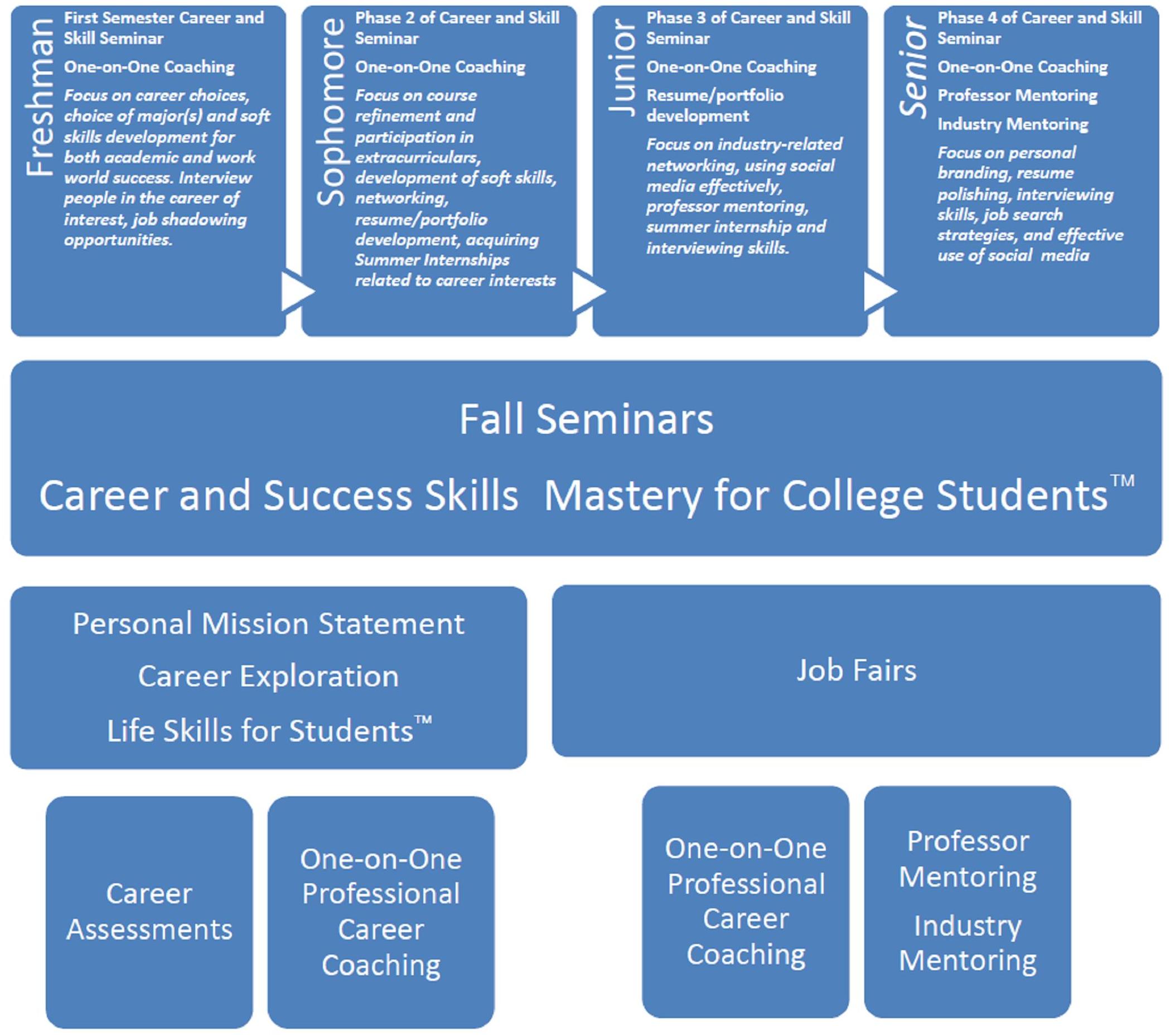
Higher Ed Career Development Strategy from DOC

Until higher ed catches up, the good news is that college students (and high school students) can receive a best-in-class program at Career Coaching for Students.
Carl Nielson is Chief Discovery Officer of Success Discoveries and Managing Principal of The Nielson Group, an organizational development consulting firm that provides executive development coaching, team development and assessments for hiring. As creator of the Career Coaching for Students program for high school students and Career and Success Skills Mastery for College Students and Recent Grads, Carl has helped thousands of students find a better way through the career exploration process that works.  Assessment and coaching packages start at $349 – checkout the Summer 2013 special offer – 30-days coaching support with the Home Study student career coaching package. Summer special ends August 31, 2013


I Want to Quit (My Career)


Talent Management MagazineThe July 2013 issue of Talent Management Magazine, a respected journal for human resources executives, highlighted some new statistics that reinforce what I’ve been trying to communicate to parents, high school administrators and college and university career centers for some time now – “what you are doing isn’t working!”

Here are excerpts from the article…you be the judge


First there was the Gallup survey that came out in early June 2013, which found the majority of American employees (70 percent) were either not engaged or actively disengaged with their work.

As if that wasn’t enough to raise red flags for employers who care about and are tracking employee engagement, a new Harris survey for the University of Phoenix in Arizona that was released July 8, 2013 showed that more than half of U.S. employees want to change not only their jobs, but their careers.

Apparently, only 14 percent of workers say they’re in their dream careers.

Some of you may not be surprised to learn this feeling is more pronounced among workers in their 20’s (80 percent), but it’s certainly not specific to this demographic alone: Sixty-four percent of those in their 30s want to change careers and 54 percent of those in their 40s reported the same.

Is this the classic “grass is greener on the other side” syndrome? Maybe. Or perhaps it’s the fact that the unstable economic environment coupled with debilitating student loan debt coerced many graduates to scrounge up any kind of employment they could secure just to have a steady cash inflow. Consider that nearly three-fourths of those surveyed (73 percent) said they didn’t end up with a job they had originally anticipated when they were younger.

And before you go on a rant about how flaky millennials are, you may be surprised to learn that those in the upper echelons of corporate America are among those who want to sign up for a different career. Nearly half (43 percent) of C-level executives said they were somewhat interested in switching careers, while 26 percent expressed a stronger desire to do so.

Offering lateral moves and defining a clear career path for employees might not be the silver bullet when it comes to engagement and retention problems, but it’s a start.


Employers can’t fix this. And then there are high schools and colleges continuing to do the same things they’ve been doing for the past 10+ years, only now the high schools have teacher productivity work flow tools in the cloud (Naviance, XAP, etc.) to help track high school student college readiness tasks.

This is a wake up call. Want to decrease student loan debt? Get smarter about planning career and educational strategies. You can delegate career exploration and career matching to an overworked high school counselor with outdated assessments or delay this work until college where students are going in undeclared, changing majors 3 or 4 times and taking 5 years to graduate at a cost of thousands of extra dollars. Or you can take a proactive approach and do something different.

Better Career Planning Better Lifehttp://www.careercoachingforstudents.net

Carl Nielson is Chief Discovery Officer of Success Discoveries and Managing Principal of The Nielson Group, an organizational development consulting firm that provides executive development coaching, team development and assessments for hiring. As creator of the Career Coaching for Students program for high school students and Career and Success Skills Mastery for College Students and Recent Grads, Carl has helped thousands of students find a better way through the career exploration process that works.  Assessment and coaching packages start at $349 – checkout the Summer 2013 special offer – 30-days coaching support with the Home Study student career coaching package.

7 Myths About Career Exploration in High School


5 Myths about Career Exploration blog picAround 2004, as a parent with kids approaching high school, I found myself curious about the “state-of-the-art” in career exploration and coaching that the students would receive. As a corporate organizational development consultant and executive coach, focusing mainly on adults either in career transition or executive/high-potential development, I had some insight into “talent” and success in life and work.

My adult clients would ask me to coach their “graduating senior in college” who hadn’t figured out what they wanted to do with their life. That was a warning sign to me – not about the person but about the system. How could a student go all through high school, choose a major, complete an undergraduate degree in college and not have a clue about what they wanted to do? What was the root cause of the failure? What was being done to help students and why was it not working?

Fast forward to 2013, and nothing has changed. Students continue to struggle with who they are and how their personal talent design connects to career choices and educational strategy. In some ways, it comes down to something even broader – learning how to make big decisions. But I am finding the same assessments used in 2004 are being used today. And schools are letting technology deliver career coaching.

Based on what I am seeing and hearing from school administrators, parents and students, I’ve put together a list of myths that are in desperate need of being corrected. These myths are prevalent with teachers, counselors, school boards and parents. See if you carry some of these myths as your own beliefs:

  • Myth #1 The high school has this covered. They’d like you to believe they’ve got career exploration covered. Even community colleges and universities want you to think they’ve got it covered. Be wary of the high school’s use of buzz words and descriptions of programs. For example, “all students take one or more career assessments to help them identify careers” may be technically true as a task they have the students complete. Ask your son or daughter what they thought of the assessment results. Ask them to show you the report. Ask them how the results are being used and what are they doing for career exploration. And for the bottom line question, ask them if they feel they are getting appropriate and tangible support for identifying and evaluating personal career options.
  • Myth #2 The assessments used by your high school are valid and insightful. The best way to check this myth is to take the assessments yourself and check your reaction to the report. As for technical information about the validity and reliability of the assessments, the school’s website will point you to the organization’s website that produces the assessments. With a little digging, you’ll find some kind of statement about validity and reliability. Some assessment companies will actually state “this type of assessment does not fit the criteria for validity and reliability studies”.  Taking the assessments yourself will surely enlighten you to the horribly designed assessment that is expected to “tell” your student which careers will be best for them. But even if you were to accept the quality of instrument as credible, what insights has it produced for the student?  What insights has the student learned about themselves after taking the assessment?
  • Myth #3 Counselors and teachers are focused on this. Ask a counselor about the amount of time they focus on coaching students in making career decisions and they will start explaining (after they stop laughing) how their day, week and semester is spent. It isn’t focused on coaching students in career decisions. Some counselors are leaving schools because their job isn’t about helping students, its about pushing paper.
  • Myth #4 The paid-with-tax-dollars school-site subscription to a cloud-based software program (Naviance, XAP, etc.)  is focused on helping the student find their path in life. Actually, many of these site-licensed “portals” are administrative tracking systems to help teachers be more productive. It is possible they also help students to be more productive with the college application process too. However, the primary focus isn’t on helping a student gain insight into who they are and what they want to become (even though the web-based marketing lingo sounds like they do focus on this). These systems are more focused on workflow management, specifically, “the process of getting students into college”. Who cares if the reason they are going to college is faulty or once they get there they change majors 3 times and graduate in 5 years. Put the ladder on the wrong building and you get to the top of a building with no purpose for being there.
  • Myth #5 High school students are too young and immature to focus much on career exploration or make any kind of career choice. This one is mostly on the parents. All I can tell you is if you think this, you are wrong. I am consistently amazed at the level of engagement and deep thinking that students put into developing a future direction, career exploration, choosing a major, choosing the right college for what they want to do and setting goals for themselves. Even those students that start the Career Coaching for Students program with less maturity quickly shed that cover and engage effectively. Watch for the colleges and universities to  empathize with the “high school is too early to know what you want to do with the rest of your life” thinking. The standard language at on-campus college visit presentations is to tell the student and parents it is perfectly fine to come in “undeclared” and take a year or two to decide what to study. Sure, you can start taking the “required Freshman classes” and a few electives to see what floats your boat. In the meantime, some students are figuring out a lot while still in high school and walking into college with a clear plan that may include double majoring, targeting specific companies for internships and obtaining summer jobs that will give them experience that makes them a top prospect upon graduation. In the meantime, being undeclared seems like a slow path to nowhere, and let’s not to mention the extra expense (thousands of dollars) for changing majors and extending the college stay by just one semester. Oops, I guess I did.
  • Myth #6 High achieving students don’t need as much career exploration support. One of the most challenging (and exciting) situations in coaching students is when the student is “All American” (or “All Canadian” for my Canadian readers). You know the type – very high GPA, active in sports, band, club officer, outside activities, loved by the teachers, respected by the administration, etc.).  The fact that these special individuals have so many capabilities, they have the most choices available to them. Many of these report feeling that they are expected to just know some how what they are going to do. The pressure to have a career direction figured out “on their own” is tremendous. From where I sit, there is no class of students that holds some special psychic ability to know what they want to do. All groups of students from under-achievers to over-achievers need professional career coaching.
  • Myth #7 Career exploration and planning is a “nice to have” but not the primary purpose of high school so it doesn’t deserve the funding or attention in high school. Many research studies have shown a clear connection between a student’s clarity about their future and their level of engagement in school. The result – higher academic achievement. If a student is under-performing academically, there is a good chance it is because they don’t see the potential in themselves and how that potential relates to a future. Many parents have reported back to me that their son/daughter raised their GPA the very next semester after going through the Career Coaching for Students program. But it doesn’t stop there. Students who were never on the academic honor roll in high school, and went through the Career Coaching for Students program their senior year were found two years later to have been on the Dean’s list at college every semester. The studies say this happens with credible career coaching at the high school level. Our experience is saying the same thing.

Carl Nielson is an organizational development consultant, executive development coach, career coach and author of the Career Coaching for Students program for high school students. For information about career direction and job search coaching for college students, check out Career and Success Skills Mastery for College Students and Recent Grads. Assessment and coaching packages start at $349 – checkout the Summer 2013 special offer.

Unpaid Internships Ruled Illegal – Is That a Good Thing for Students?


FoxSearchlightLogoAn article by Steven Greenhouse in the New York Times reports that Fox Searchlight Pictures had violated federal and New York minimum wage laws by not paying production interns, a case that could upend the long-held practice of the film industry and other businesses that rely heavily on unpaid internships.

The judge noted that these internships did not foster an educational environment and that the studio received the benefits of the work. The case could have broad implications. Young people have flocked to internships, especially against the backdrop of a weak job market.

Employment experts estimate that undergraduates work in more than one million internships a year, an estimated half of which are unpaid, according to Intern Bridge, a research firm.

On the Intern Bridge website, the firm makes a statement and provides additional information for companies  and students considering unpaid internships:

At Intern Bridge, we strongly believe that all internships should offer hourly monetary compensation. This best practices recommendation is based on countless hours of proprietary research utilizing survey responses from over 100,000 students, discussing the issues with our nationwide network of career center and human resources practitioners, and taking into account critical business and economic principles.

While we consistently advocate for paid opportunities for students, unpaid internships have built a strong presence in the internship space. Recently, the Department of Labor began an awareness campaign to share information regarding potential legal issues with hosting unpaid interns. This Unpaid Internship Resource Center has been designed to share as much up-to-date information as possible.

“Employers have already started to take a hard look at their internship programs,” said Rachel Bien, a lawyer for the plaintiffs. “I think this decision will go far to discourage private companies from having unpaid internship programs.”

busboybwUnpaid Internships: the corporate equivalent process for getting into a fraternity in college

Freshman in college choosing to go the social frat route have a couple of hurdles to overcome before being accepted. They must endure embarrassing acts (hazing) and subordinate themselves to the upperclassmen – all while trying to pursue academic standing and other extracurricular activities. And, they have to pay for the privilege to be hazed.

Unpaid company internships, commonly, are general sanitation, lunch order takers and delivery drivers, doing work that in no way enhances their skills and knowledge and prepares them for a professional job upon graduation from college. I consider it a form of hazing when it is a standard way of doing business in a specific industry, such as the film and television entertainment production industry.

This illegal process is so prevalent that students believe they have to do it in order to “break into the business”.

The power of LinkedIn to see the value of unpaid internships vs paid internships

With LinkedIn now the business world version of Facebook, you can find people in your career field that graduated two, four, six or more years ago, took an “unpaid” internship (their profile won’t say it was unpaid but based on what you know about company reputations around internships you can make some assumptions) and see where they ended up. In other words, did the unpaid internship lead to something bigger and better? For the film industry, most did not. Do the same with people that completed a paid internship. Not sure, “inmail” them asking for their insight about the value of their internship.

Are you considering taking an unpaid internship?

Don’t. Unless the following have been provided to you:

  • A specific job description or written objectives that assigns work that increases your skills and knowledge (taking lunch orders and emptying trash cans does not in any way add skill and knowledge of any benefit).
  • The names of the people you will be assigned to work for. Are they managers and/or senior experienced professionals with expertise you want to learn from? Have you met the people you will work for? Did they discuss their commitment to assigning you meaningful work and mentoring you?
  • A path for how the internship will lead to full time opportunities after graduation or after the internship is up. The benefit for the company should be one focus: to evaluate the internship for possible hiring upon graduation.
  • A specific period of time that the unpaid portion will last. Ideally, you are then converted to paid internship or full time.

The film and television entertainment industry including the dramatic arts (theatre) may be the worst industry that abuses the internship model. All companies in all industries that abuse the internship’s true purpose are broadcasting a message that they are a backward thinking, short term-focused and unethical company. Do you really want to work for that kind of company?

If you want to work for one of these companies, just apply for the open janitor position. At least then you’ll get paid.

Carl Nielson is a professional career coach and author of the Career Coaching for Students program. For information about career direction and job search coaching, check out Success Discoveries’ Career and Success Skills Mastery for College Students and Recent Grads. Assessment and coaching packages start at $349 – special Summer 2013 offer.

Are “soft skills” really that important?


Adapted from: Downing, Skip. (2005). On Course: Strategies for Creating Success in College and in Life. Originally posted on http://advising.wvu.edu

The key to success is in the connected mindCareer success or lack of it affects nearly every part of your life: family, income, self-esteem, who you associate with, where you live, your level of happiness, what you learn, your energy level, your health, and maybe even the length of your life.

Some students think, “All I need for success at work is the special knowledge of my chosen career.” All that nurses need, they believe, are good nursing skills. All that accountants need are good accounting skills. All that lawyers need are good legal skills. These skills are called hard skills, the knowledge needed to perform a particular job. Hard skills include knowing where to insert an intravenous feeding tube, how to write an effective business plan, and what the current inheritance laws are. These are the skills you’ll be taught in courses in your major field of study. They are essential to qualify for a job. Without them you won’t even get an interview.

But, most people who’ve been in the work world a while will tell you this: Hard skills are necessary to get a job but often insufficient to keep it or advance. That’s because nearly all employees have the hard skills necessary to do the job for which they’re hired. True, some may perform these skills a little better or a little worse than others, but one estimate suggests that only 15 percent of workers who lose their jobs are fired because they can’t do their job. That’s why career success is of ten determined by soft skills. As one career specialist put it, “Having hard skills gets you hired; lacking soft skills gets you fired.”

A United States government study agrees that soft skills are essential to job success. In the early 1990’s, the Secretary of Labor asked a blue-ribbon panel to determine what it takes to be successful in the modern employment world. This panel published a report called the Secretary’s Commission on Achieving Necessary Skills (SCANS). The SCANS report presents a set of foundation skills and workplace competencies deemed essential for work world success today.

No one familiar with today’s work world will find many surprises in the report, especially in the foundation skills.

The report calls for employees to develop the same soft skills that are asked for in employment ads, that employers look for in reference letters and job interviews, and that supervisors assess in periodic evaluations of their work force.

The SCANS report identifies the following soft skills as necessary for work and career success:

  • taking responsibility
  • making effective decisions
  • setting goals
  • managing time
  • prioritizing tasks
  • persevering
  • giving strong efforts
  • working well in teams
  • communicating effectively
  • having empathy
  • knowing how to learn
  • exhibiting self-control
  • believing in one’s own self worth

Learning these skills will help you succeed in your first career after college. And, because soft skills are portable (unlike most hard skills), you can take them with you in the likely event that you later change careers. Most career specialists say the average worker today can expect to change careers at least once during his or her lifetime. In fact, some 25 percent of workers in the United States today are in occupations that did not even exist a few decades ago. If a physical therapist decides to change careers and work for an internet company, he needs to master a whole new set of hard skills. But the soft skills he’s mastered are the same ones that will help him shine in his new career.

So, as you’re learning these soft skills, keep asking yourself, “How can I use these skills to stay on course to achieving my greatest potential at work as well as in college?” Be assured, (these soft skills) can make all the difference between success and failure in your career.

How to tackle development of soft skills

Self-directed work is possible using the Life Skills for Students program offered at Career Coaching for Students. However, using the same material and content, holding weekly focus groups with friends is much more meaningful and fun.

Carl Nielson is the creator of Career Coaching for Students and Student Resource Central, the most comprehensive one-stop resource for career exploration, major and education institution research and leading thought for students in high school and college.

Student Resource Central 10x more useful than ConnectEDU, Naviance, Kuder, Career Cruisin or XAP


The Career Coaching for Students™ program has so much to it. Independent career coaches, high school counselors and college career center counselors are finding the assessments and strategies creating significant breakthroughs. We call this disruptive technology.

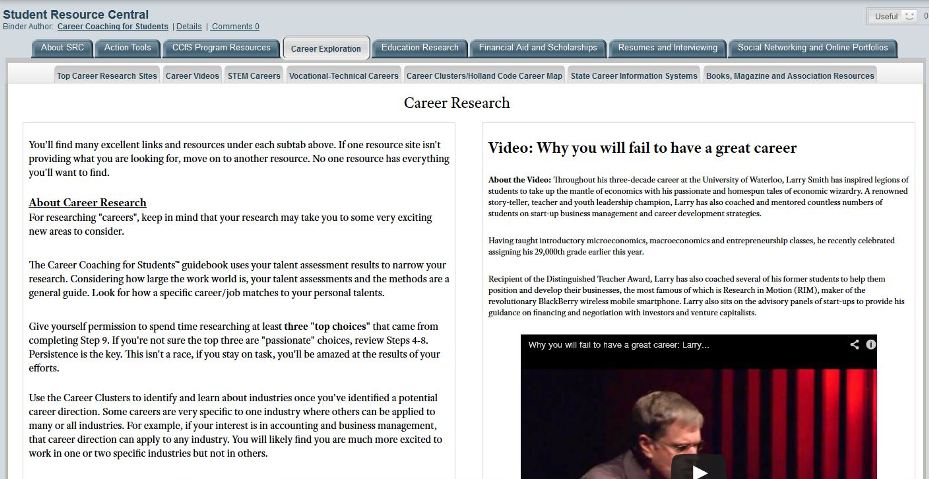
This article focuses on one part of the program that other programs minimize. Student Resources Central™ offers students and parents access to the best resources on the web. From career research, choosing a major, choosing a school, financial aid, scholarship research, college admissions and application process to the latest in resume portfolios, this portal to the vast unlimited resources on the web has it all. The website sprinkles advice throughout. The organizational layout enables the user to go exactly where they need to within two clicks.        SRC Welcome Page

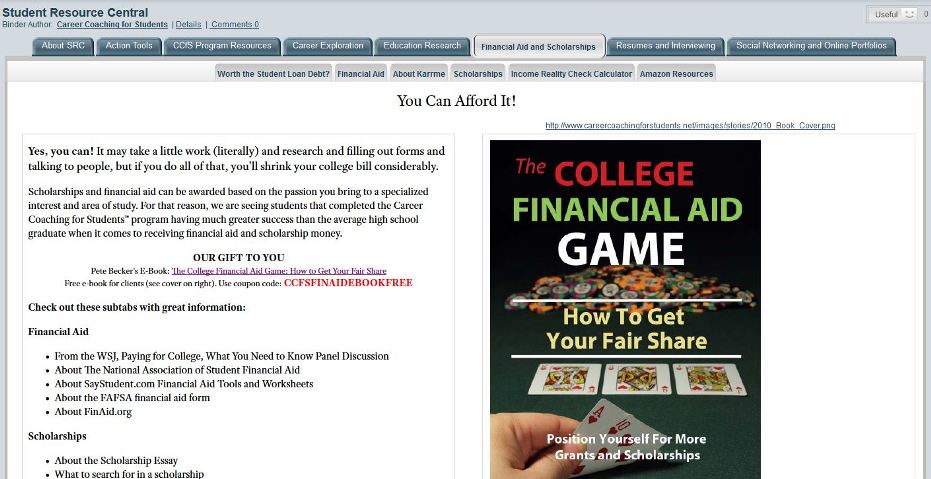
Below are screen shots of the main tabs. Each main tab has subtabs that offer carefully selected resources. Click on the screenshot to see a larger view to read the subtabs.

Criteria for a resource to be included in Student Resource Central:

Quality of information. Including the source, we don’t think it helps you to receive bad, biased, out-dated or partial information.

Agenda-free. The recommended resources are not operating a marketing data collection site that will use your personal information to market their sponsors.

Ease-of-use. There are plenty of web information pages. Just do a simple search on one topic and you’ll find millions of pages. Which are really worthy of your time? How much time will you have to spend shuffling through hundreds of pages before you get to the right pages of information? With SRC, you’ll quickly find your way through any webpage we direct you to.

Several great take-action recommendations

Several great take-action recommendations


Career Coaching for Students extensive library of worksheets, videos, and more

Career Coaching for Students extensive library of worksheets, videos, and more

The most extensive Career Research portal on the web - and easy to use

The most extensive Career Research portal on the web – and easy to use – including several extensive career video libraries.

Education Research that gives you what you need - like college freshman retention rates and graduation rates

Education Research that gives you what you need – like college freshman retention rates and graduation rates

Straight scoop, how to and information with integrity is what the Financial Aid and Scholarship resources are about. Most scholarship websites are nothing more than marketing websites. Not at SRC.

Straight scoop, how to and information with integrity is what the Financial Aid and Scholarship resources are about. Most scholarship websites are nothing more than marketing websites. Not at SRC.

Writing a resume and developing interview skills are just the beginning. So much for you to leverage including career advice videos.

Writing a resume and developing interview skills are just the beginning. So much for you to leverage including career advice videos.

Using social networking sites is key to career research, getting inside information about colleges and universities, finding internships and landing the first job out of college. The latest in using Portfolios is reviewed with a list of free cloud-based portfolio apps.

Using social networking sites is key to career research, getting inside information about colleges and universities, finding internships and landing the first job out of college. The latest in using Portfolios is reviewed with a list of free cloud-based portfolio apps.

If all of that isn’t enough, Student Resource Central is including the Life Skills for Students™ program too – for the one price.

The good news is that if you’ve purchased the Home Study Personal Edition of Career Coaching for Students or engage one of the licensed facilitators for a one-on-one service or workshop in your area, you receive Student Resource Central automatically. Purchasing the full package is the best way to go.

However, if you don’t want to buy the entire Career Coaching for Students program and receive the cool assessments and student binder, Student Resource Central is available, for a limited time, at a ridiculously cheap rate. The same rate applies for families or teachers wanting to use the resources for an entire class.

After comparing to other offerings, it becomes obvious that those other programs are trying to do the minimum while maximizing profits. Student Resource Central – well – is just simple, common sense that everyone can benefit from.


Warning: Campus Career Services NOT There to Help Students Choose a Career


B-Schools With Career Services That Rock—MaybeBusinessweek conducts a survey of college career centers each year. The way they wrote the article (see link), apparently college campus career services are not expected to assist students in choosing a career. So do you go to academic advising for help? Not really. They refer you over to the career center.

++++++++++++++++++++++++++++++
Excerpt from the Businessweek article:
One of the more perplexing things about business school career services is that student perceptions of how good a job their school is doing often bear no relation to the school’s real-world performance at placing students in high-paying jobs.

But wait, maybe there’s hope
Based on the survey data, students who took the Businessweek survey (summary article at http://www.businessweek.com/articles/2012-11-13/b-schools-with-career-services-that-rock-maybe) consider career services to be more than just placement and salaries.

In fact, the services include much more, from organizing career events on campus to connecting students with alumni who work in their targeted industries and providing help on job applications and résumés. Students who rate their school’s career services highly—notwithstanding mediocre success in the job market—are effectively giving them an “A” for effort. So if you’re looking for schools where you’ll get lots of help in your job search, consider those on our “best” list—you may not land your dream job, but it won’t be for lack of trying.
++++++++++++++++++++++++

Many career centers offer career counseling. Just keep in mind the “counselor” you are working with may be a grad student who has never had a job outside of the college. Or the counselor’s skill set may be stronger around how to write an effective resume than how to understand your talents and identify careers that are ideally suited to your talent makeup. Even if you are aiming for a business school education, there are many career paths that your education will support that you are less or more suited for talent-wise.

So where does a student go for assistance in choosing a career?

Countering College Student Objections to Joining LinkedIn


LinkedIn5 COLLEGE STUDENT Objections to Joining LinkedIn

While it is true that some college students may be beyond help, below are some excuses you can meet head on. To support students, my connections exceed over 2,000 which connect me to over 17 million on LinkedIn. I use my connections to help both high school and college students find people in their career of interest as part of the Career Coaching for Students program (high school program or college student program).

Your key to success1. “Creating a LinkedIn profile takes too much time” is a common complaint; however, creating a profile is actually a motivational exercise. Students can easily copy and paste their résumé to their LinkedIn profile and revise it from there. Once their profile starts to fill out, they begin to feel better about their developing profile.

2. “I don’t have time to add a LinkedIn update once a week?” Posting an update once a week is not that hard to do. With most students now on Facebook and Twitter, posting an update takes the same effort. It’s as simple as commenting on a topic such as something interesting being covered in a core course that aligns with your career direction, attaching an article, posting a great quote, letting people know what you are up to, etc.

3. “I don’t think people in my occupation use LinkedIn” might have been a valid point two or three years ago. Some occupations, namely the trades, were slower to jump on the LinkedIn wagon. Today, people in all industries and all types of work are on LinkedIn. With the number of connections I have, I love taking friendly bets on this false perception. I’ve won every bet.

4. “There’s no way I can get 50 connections” is an interesting challenge. LinkedIn allows users to download contacts from their e-mail account from the beginning of registering for membership. One just has to select the members they want to invite and soon acceptances and invites will come their way. An exercise I do with high school and college students is to have them write down on a worksheet everyone they know (friends, extended family, parents of friends, professional contacts). I then poll everyone to see how many they wrote down. In a 5 minute time limit, the average student writes down between 30 and 50 names. I then ask them if it is reasonable to expect each person they wrote down to have the same number of contacts. We then do the math. Using the least (30), the math looks like this: 30 x 30 = 900. Each of us can easily get something between our direct contact count and the 900 within one week. For college students, making this a competitive challenge with a reasonable $$ prize for the highest number of contacts after one week generates amazing results.

5. “I’m just a college student.” LinkedIn will most likely not offer immediate gratification. This isn’t a sprint; it is more like a marathon. The smartest students will invest in the time to begin their lifelong network. They’ll be ahead of their classmates and will most likely receive more interviews and offers when the time comes for the payout.

Carl Nielson is an organizational development consultant, professional career and executive/leadership coach and creator of the nationally recognized program Career Coaching for Students™ . Career Coaching for Students is available as a district-wide high school program, college program and in group and on-one-one offerings through certified career coaches throughout the United States, Canada and other countries. Contact Carl Nielson at carl@successdiscoveries.com or call 972-346-2892 to discuss specific needs. Or visit us at http://www.careercoachingforstudents.net

Freshman Year: The Big Picture by guest blogger Jennifer Karan, Executive Director, SAT Program, College Board


Happy TeensAs a former English teacher and Dean of Students (9th and 10th grade), I know that there are few things as daunting, mysterious and exciting to a teenager than freshman year of high school. It’s a whole new world: the hallways are foreign and at larger schools, students sometimes feel as though they need a GPS to get from class to class; the upperclassmen seem so much older and are brimming with a glowing confidence; teacher expectations and homework may require substantial adjustment. And college seems like a distant point on the horizon.

Part of the trepidation may be what adults would understand as not being able to see the forest for the trees. However, when a student is able to see how the various academic courses, opportunities in arts and athletics and programs that develop other interests (the school paper, community service or a part-time job) that form the Big Picture, he or she is able to navigate this terrain successfully, with greater purpose and enjoyment.

high school students see the big picture and plan carrersAn excellent first step towards realizing this Big Picture is to encourage a student to make an appointment with a school counselor early on. Where access to a counselor is difficult, students can approach a trusted teacher of a favorite subject. If a student is willing to share information with this new advisor, he or she can help that student make sure he taking the right classes to graduate on time and taking the types of classes colleges are looking for. Students should discuss favorite subjects to learn about additional opportunities as well as to get the necessary help with the more intimidating courses before it’s too late. Students can even share hobbies as well as aspirations; a counselor or advisor can help find extracurricular activities to help develop these interests.

Big Future, sponsored by the College Board, is an incredibly useful tool in helping students of all ages contemplate and understand what it takes to get to the college – or major – of their dreams. Starting early can help high school freshmen plan an academic path and start to understand the financial aid process, including scholarships and merit aid. It also provides information on how to make high school count, things to discuss with a counselor, planning college visits and other avenues to success.

Becoming aware of all the available resources and understanding how the decisions made now will offer benefits later on is one way to start the planning process. Actively utilizing those resources and building a unique and representative academic and extracurricular profile puts students on track for the Big Picture: showing colleges who they really are.

Career Coaching for Students is the solutionCareer Coaching for Students™ offers high school students the opportunity to develop a clear picture of self and their future that lifts self-esteem, increases academic performance and helps the family avoid unnecessary costs of changing majors and extending college due to changes in direction. Student Resource Central, the most comprehensive resource portal for career exploration and educational strategy research includes Big Future by College Board among its recommended resources. Freshman spring semester is the ideal time to take part in the Career Coaching for Students program. For more information, visit the website at http://www.careercoachingforstudents.net.

About the SAT Test

Informational Interviews are There for the Asking


For students contemplating career direction, it can be hard to know how happy you’ll be in a new job or industry. Find out more about the career you are interested in by finding three to five people who are doing the kind of work you’re interested in. Contact them to set up informational interviews. If you don’t know anyone, find people through your parent’s friends and your friend’s parents or use social media (LinkedIn is the largest networking site).

Don’t feel timid about contacting someone. People are usually flattered when you ask for their opinions, and most enjoy talking about what they do. For college students, you can always offer to take the contact to lunch to sweeten the pot. If you are a high school student, arrange to meet them at their office or place of work and be prompt.

Before the meeting, prepare a list of questions you’d like to ask the interviewee. These may range from “What do you like most about your work?” to “What’s an average day like for you?” to “What does someone have to do to get ahead in your field?”

In the Career Coaching for Students program, we have a set of 18 interview questions you can use. We prepare the students by having a “guest” come in to be interviewed by the students. Having the students see first hand how simple and enjoyable the dialogue can be with a complete stranger prepares and motivates students to leverage this strategy. The pay back for moving outside your comfort zone to pursue and do informational interviews will be significant. You might even be offered the opportunity to job shadow for a day or land a summer job. Wouldn’t that be worth it.

Carl Nielson is an organizational development consultant, professional career and executive/leadership coach and creator of the nationally recognized program Career Coaching for Students™ . Career Coaching for Students is available as a district-wide high school program and in group and on-one-one offerings through certified career coaches throughout the United States, Canada and other countries. Contact Carl Nielson at carl@successdiscoveries.com or call 972-346-2892 to discuss specific needs. Or visit us at http://www.careercoachingforstudents.net