Category Archives: Choose a major

Survey Identifies How Students Choose Their College or University


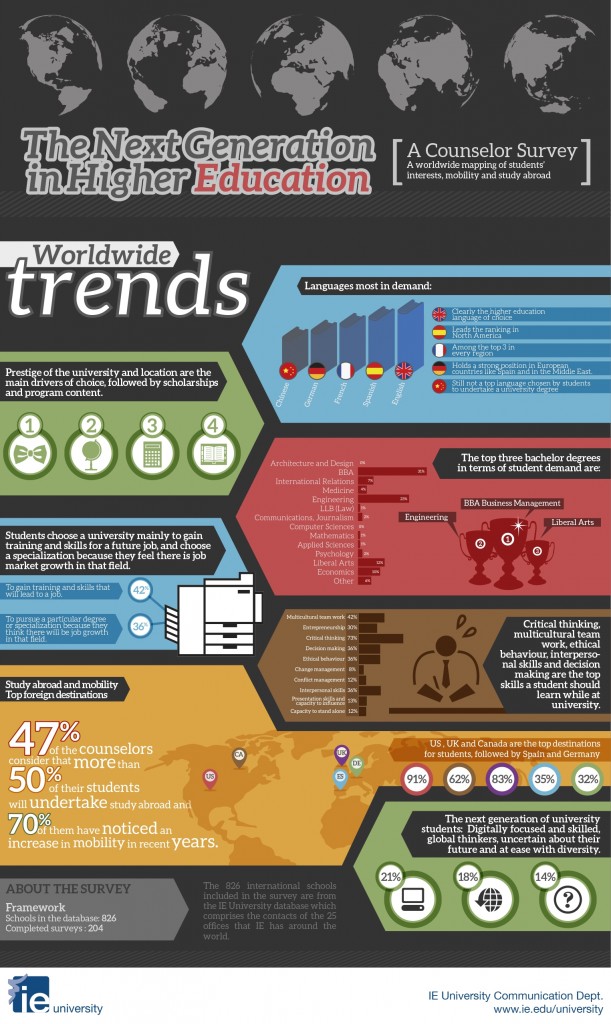
Infographic_TrendsinHigherEd204 university counselors in 33 countries took part in an IE University survey designed to pinpoint the interests and preferences of the upcoming generation of university students with regard to study abroad and most popular degree programs.

The survey shows students choose a university mainly to gain training and skills for a future job, and choose a specialization because they feel there is job market growth in that field. When asked about the main reasons for choosing a university, counselors cited:

Main drivers

  • Prestige
  • Location

Secondary consideration

  • Scholarships
  • Content

These findings suggest there is either a lack of appropriate guidance at the high school level or students are dismissing better advice for how to choose a college or university.

With the percent of students changing majors 2, 3 or 4 times, taking 5 years to complete a 4-year degree and student retention and graduation rates dropping, students need to take a smarter approach to choosing a college or university.

The fact that students list prestige as the #1 consideration creates immediate risk for the student. By not considering newer institutions, that may actually be way ahead of their more traditional and prestigious counterparts, students are missing out on some possibly better choices. But even if your needs are best served in one of the more traditional universities, the most prestigious option may not have the best program for your area of study. Prestige alone is not a good reason to choose a college or university.

The best order of consideration and prioritizing that has been shown to produce the best choice (high satisfaction with choice, retention, graduation in expected time frame) for the student is:

  • Determine career interest(s)
  • Determine education requirements for the career interest(s)
  • Create an education strategy (choice of majors, field of study)
  • Research and identify colleges/universities or vocational learning institutions that are leading in the chosen field(s) of study (a high level of prestige for the specific subject area)
  • Rank findings to create a short list of institutional choices
  • Conduct on-campus visits to all short-listed choices
  • Make the choice

With the cost of higher education so high, a one-semester course correction costs thousands of dollars. By following a smart strategy for decision-making, students can avoid that unnecessary added expense and be much happier with their choice. But it requires students to change the way they think about school choices.

Carl Nielson is an organizational development consultant, executive development coach, career coach and author of the Career Coaching for Students program for high school students and the  Career and Success Skills Mastery for College Students and Recent Grads. Assessment and coaching packages start at $349 – checkout the Summer 2013 special offer.


7 Myths About Career Exploration in High School


5 Myths about Career Exploration blog picAround 2004, as a parent with kids approaching high school, I found myself curious about the “state-of-the-art” in career exploration and coaching that the students would receive. As a corporate organizational development consultant and executive coach, focusing mainly on adults either in career transition or executive/high-potential development, I had some insight into “talent” and success in life and work.

My adult clients would ask me to coach their “graduating senior in college” who hadn’t figured out what they wanted to do with their life. That was a warning sign to me – not about the person but about the system. How could a student go all through high school, choose a major, complete an undergraduate degree in college and not have a clue about what they wanted to do? What was the root cause of the failure? What was being done to help students and why was it not working?

Fast forward to 2013, and nothing has changed. Students continue to struggle with who they are and how their personal talent design connects to career choices and educational strategy. In some ways, it comes down to something even broader – learning how to make big decisions. But I am finding the same assessments used in 2004 are being used today. And schools are letting technology deliver career coaching.

Based on what I am seeing and hearing from school administrators, parents and students, I’ve put together a list of myths that are in desperate need of being corrected. These myths are prevalent with teachers, counselors, school boards and parents. See if you carry some of these myths as your own beliefs:

  • Myth #1 The high school has this covered. They’d like you to believe they’ve got career exploration covered. Even community colleges and universities want you to think they’ve got it covered. Be wary of the high school’s use of buzz words and descriptions of programs. For example, “all students take one or more career assessments to help them identify careers” may be technically true as a task they have the students complete. Ask your son or daughter what they thought of the assessment results. Ask them to show you the report. Ask them how the results are being used and what are they doing for career exploration. And for the bottom line question, ask them if they feel they are getting appropriate and tangible support for identifying and evaluating personal career options.
  • Myth #2 The assessments used by your high school are valid and insightful. The best way to check this myth is to take the assessments yourself and check your reaction to the report. As for technical information about the validity and reliability of the assessments, the school’s website will point you to the organization’s website that produces the assessments. With a little digging, you’ll find some kind of statement about validity and reliability. Some assessment companies will actually state “this type of assessment does not fit the criteria for validity and reliability studies”.  Taking the assessments yourself will surely enlighten you to the horribly designed assessment that is expected to “tell” your student which careers will be best for them. But even if you were to accept the quality of instrument as credible, what insights has it produced for the student?  What insights has the student learned about themselves after taking the assessment?
  • Myth #3 Counselors and teachers are focused on this. Ask a counselor about the amount of time they focus on coaching students in making career decisions and they will start explaining (after they stop laughing) how their day, week and semester is spent. It isn’t focused on coaching students in career decisions. Some counselors are leaving schools because their job isn’t about helping students, its about pushing paper.
  • Myth #4 The paid-with-tax-dollars school-site subscription to a cloud-based software program (Naviance, XAP, etc.)  is focused on helping the student find their path in life. Actually, many of these site-licensed “portals” are administrative tracking systems to help teachers be more productive. It is possible they also help students to be more productive with the college application process too. However, the primary focus isn’t on helping a student gain insight into who they are and what they want to become (even though the web-based marketing lingo sounds like they do focus on this). These systems are more focused on workflow management, specifically, “the process of getting students into college”. Who cares if the reason they are going to college is faulty or once they get there they change majors 3 times and graduate in 5 years. Put the ladder on the wrong building and you get to the top of a building with no purpose for being there.
  • Myth #5 High school students are too young and immature to focus much on career exploration or make any kind of career choice. This one is mostly on the parents. All I can tell you is if you think this, you are wrong. I am consistently amazed at the level of engagement and deep thinking that students put into developing a future direction, career exploration, choosing a major, choosing the right college for what they want to do and setting goals for themselves. Even those students that start the Career Coaching for Students program with less maturity quickly shed that cover and engage effectively. Watch for the colleges and universities to  empathize with the “high school is too early to know what you want to do with the rest of your life” thinking. The standard language at on-campus college visit presentations is to tell the student and parents it is perfectly fine to come in “undeclared” and take a year or two to decide what to study. Sure, you can start taking the “required Freshman classes” and a few electives to see what floats your boat. In the meantime, some students are figuring out a lot while still in high school and walking into college with a clear plan that may include double majoring, targeting specific companies for internships and obtaining summer jobs that will give them experience that makes them a top prospect upon graduation. In the meantime, being undeclared seems like a slow path to nowhere, and let’s not to mention the extra expense (thousands of dollars) for changing majors and extending the college stay by just one semester. Oops, I guess I did.
  • Myth #6 High achieving students don’t need as much career exploration support. One of the most challenging (and exciting) situations in coaching students is when the student is “All American” (or “All Canadian” for my Canadian readers). You know the type – very high GPA, active in sports, band, club officer, outside activities, loved by the teachers, respected by the administration, etc.).  The fact that these special individuals have so many capabilities, they have the most choices available to them. Many of these report feeling that they are expected to just know some how what they are going to do. The pressure to have a career direction figured out “on their own” is tremendous. From where I sit, there is no class of students that holds some special psychic ability to know what they want to do. All groups of students from under-achievers to over-achievers need professional career coaching.
  • Myth #7 Career exploration and planning is a “nice to have” but not the primary purpose of high school so it doesn’t deserve the funding or attention in high school. Many research studies have shown a clear connection between a student’s clarity about their future and their level of engagement in school. The result – higher academic achievement. If a student is under-performing academically, there is a good chance it is because they don’t see the potential in themselves and how that potential relates to a future. Many parents have reported back to me that their son/daughter raised their GPA the very next semester after going through the Career Coaching for Students program. But it doesn’t stop there. Students who were never on the academic honor roll in high school, and went through the Career Coaching for Students program their senior year were found two years later to have been on the Dean’s list at college every semester. The studies say this happens with credible career coaching at the high school level. Our experience is saying the same thing.

Carl Nielson is an organizational development consultant, executive development coach, career coach and author of the Career Coaching for Students program for high school students. For information about career direction and job search coaching for college students, check out Career and Success Skills Mastery for College Students and Recent Grads. Assessment and coaching packages start at $349 – checkout the Summer 2013 special offer.

Student Resource Central 10x more useful than ConnectEDU, Naviance, Kuder, Career Cruisin or XAP


The Career Coaching for Students™ program has so much to it. Independent career coaches, high school counselors and college career center counselors are finding the assessments and strategies creating significant breakthroughs. We call this disruptive technology.

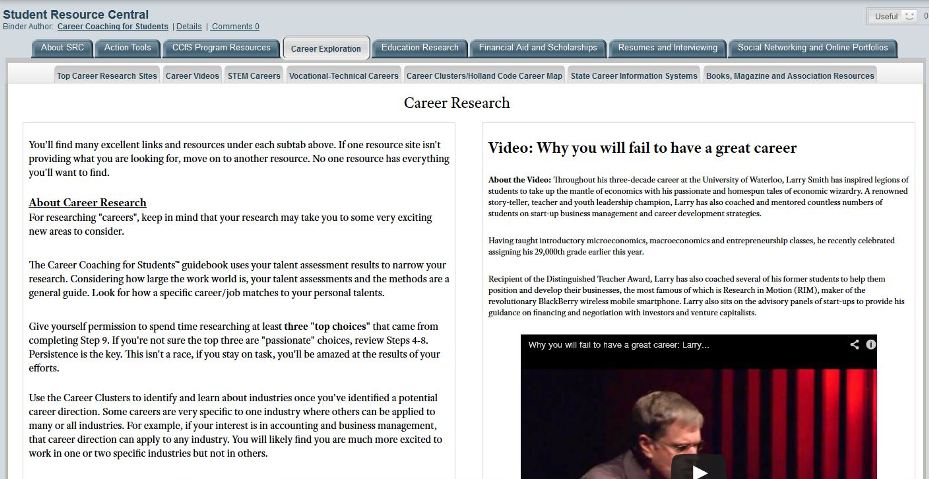
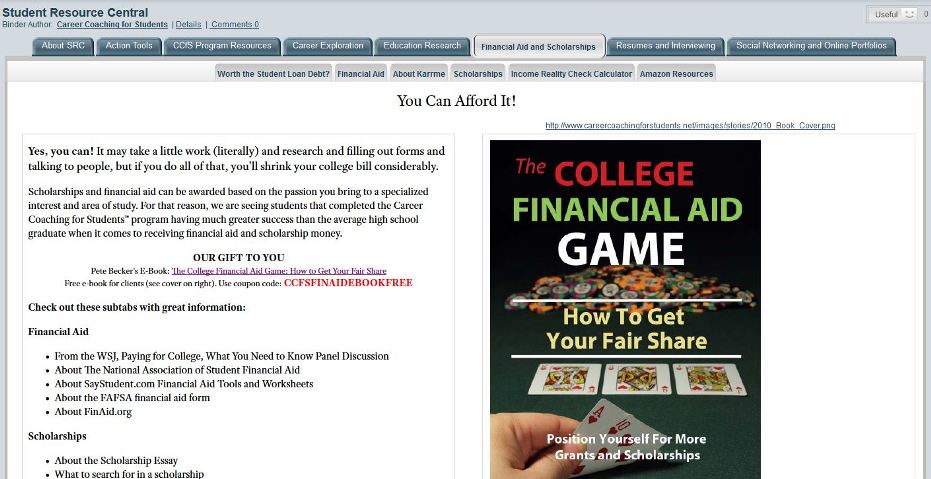
This article focuses on one part of the program that other programs minimize. Student Resources Central™ offers students and parents access to the best resources on the web. From career research, choosing a major, choosing a school, financial aid, scholarship research, college admissions and application process to the latest in resume portfolios, this portal to the vast unlimited resources on the web has it all. The website sprinkles advice throughout. The organizational layout enables the user to go exactly where they need to within two clicks.        SRC Welcome Page

Below are screen shots of the main tabs. Each main tab has subtabs that offer carefully selected resources. Click on the screenshot to see a larger view to read the subtabs.

Criteria for a resource to be included in Student Resource Central:

Quality of information. Including the source, we don’t think it helps you to receive bad, biased, out-dated or partial information.

Agenda-free. The recommended resources are not operating a marketing data collection site that will use your personal information to market their sponsors.

Ease-of-use. There are plenty of web information pages. Just do a simple search on one topic and you’ll find millions of pages. Which are really worthy of your time? How much time will you have to spend shuffling through hundreds of pages before you get to the right pages of information? With SRC, you’ll quickly find your way through any webpage we direct you to.

Several great take-action recommendations

Several great take-action recommendations


Career Coaching for Students extensive library of worksheets, videos, and more

Career Coaching for Students extensive library of worksheets, videos, and more

The most extensive Career Research portal on the web - and easy to use

The most extensive Career Research portal on the web – and easy to use – including several extensive career video libraries.

Education Research that gives you what you need - like college freshman retention rates and graduation rates

Education Research that gives you what you need – like college freshman retention rates and graduation rates

Straight scoop, how to and information with integrity is what the Financial Aid and Scholarship resources are about. Most scholarship websites are nothing more than marketing websites. Not at SRC.

Straight scoop, how to and information with integrity is what the Financial Aid and Scholarship resources are about. Most scholarship websites are nothing more than marketing websites. Not at SRC.

Writing a resume and developing interview skills are just the beginning. So much for you to leverage including career advice videos.

Writing a resume and developing interview skills are just the beginning. So much for you to leverage including career advice videos.

Using social networking sites is key to career research, getting inside information about colleges and universities, finding internships and landing the first job out of college. The latest in using Portfolios is reviewed with a list of free cloud-based portfolio apps.

Using social networking sites is key to career research, getting inside information about colleges and universities, finding internships and landing the first job out of college. The latest in using Portfolios is reviewed with a list of free cloud-based portfolio apps.

If all of that isn’t enough, Student Resource Central is including the Life Skills for Students™ program too – for the one price.

The good news is that if you’ve purchased the Home Study Personal Edition of Career Coaching for Students or engage one of the licensed facilitators for a one-on-one service or workshop in your area, you receive Student Resource Central automatically. Purchasing the full package is the best way to go.

However, if you don’t want to buy the entire Career Coaching for Students program and receive the cool assessments and student binder, Student Resource Central is available, for a limited time, at a ridiculously cheap rate. The same rate applies for families or teachers wanting to use the resources for an entire class.

After comparing to other offerings, it becomes obvious that those other programs are trying to do the minimum while maximizing profits. Student Resource Central – well – is just simple, common sense that everyone can benefit from.


Warning: Campus Career Services NOT There to Help Students Choose a Career


B-Schools With Career Services That Rock—MaybeBusinessweek conducts a survey of college career centers each year. The way they wrote the article (see link), apparently college campus career services are not expected to assist students in choosing a career. So do you go to academic advising for help? Not really. They refer you over to the career center.

++++++++++++++++++++++++++++++
Excerpt from the Businessweek article:
One of the more perplexing things about business school career services is that student perceptions of how good a job their school is doing often bear no relation to the school’s real-world performance at placing students in high-paying jobs.

But wait, maybe there’s hope
Based on the survey data, students who took the Businessweek survey (summary article at http://www.businessweek.com/articles/2012-11-13/b-schools-with-career-services-that-rock-maybe) consider career services to be more than just placement and salaries.

In fact, the services include much more, from organizing career events on campus to connecting students with alumni who work in their targeted industries and providing help on job applications and résumés. Students who rate their school’s career services highly—notwithstanding mediocre success in the job market—are effectively giving them an “A” for effort. So if you’re looking for schools where you’ll get lots of help in your job search, consider those on our “best” list—you may not land your dream job, but it won’t be for lack of trying.
++++++++++++++++++++++++

Many career centers offer career counseling. Just keep in mind the “counselor” you are working with may be a grad student who has never had a job outside of the college. Or the counselor’s skill set may be stronger around how to write an effective resume than how to understand your talents and identify careers that are ideally suited to your talent makeup. Even if you are aiming for a business school education, there are many career paths that your education will support that you are less or more suited for talent-wise.

So where does a student go for assistance in choosing a career?

Countering College Student Objections to Joining LinkedIn


LinkedIn5 COLLEGE STUDENT Objections to Joining LinkedIn

While it is true that some college students may be beyond help, below are some excuses you can meet head on. To support students, my connections exceed over 2,000 which connect me to over 17 million on LinkedIn. I use my connections to help both high school and college students find people in their career of interest as part of the Career Coaching for Students program (high school program or college student program).

Your key to success1. “Creating a LinkedIn profile takes too much time” is a common complaint; however, creating a profile is actually a motivational exercise. Students can easily copy and paste their résumé to their LinkedIn profile and revise it from there. Once their profile starts to fill out, they begin to feel better about their developing profile.

2. “I don’t have time to add a LinkedIn update once a week?” Posting an update once a week is not that hard to do. With most students now on Facebook and Twitter, posting an update takes the same effort. It’s as simple as commenting on a topic such as something interesting being covered in a core course that aligns with your career direction, attaching an article, posting a great quote, letting people know what you are up to, etc.

3. “I don’t think people in my occupation use LinkedIn” might have been a valid point two or three years ago. Some occupations, namely the trades, were slower to jump on the LinkedIn wagon. Today, people in all industries and all types of work are on LinkedIn. With the number of connections I have, I love taking friendly bets on this false perception. I’ve won every bet.

4. “There’s no way I can get 50 connections” is an interesting challenge. LinkedIn allows users to download contacts from their e-mail account from the beginning of registering for membership. One just has to select the members they want to invite and soon acceptances and invites will come their way. An exercise I do with high school and college students is to have them write down on a worksheet everyone they know (friends, extended family, parents of friends, professional contacts). I then poll everyone to see how many they wrote down. In a 5 minute time limit, the average student writes down between 30 and 50 names. I then ask them if it is reasonable to expect each person they wrote down to have the same number of contacts. We then do the math. Using the least (30), the math looks like this: 30 x 30 = 900. Each of us can easily get something between our direct contact count and the 900 within one week. For college students, making this a competitive challenge with a reasonable $$ prize for the highest number of contacts after one week generates amazing results.

5. “I’m just a college student.” LinkedIn will most likely not offer immediate gratification. This isn’t a sprint; it is more like a marathon. The smartest students will invest in the time to begin their lifelong network. They’ll be ahead of their classmates and will most likely receive more interviews and offers when the time comes for the payout.

Carl Nielson is an organizational development consultant, professional career and executive/leadership coach and creator of the nationally recognized program Career Coaching for Students™ . Career Coaching for Students is available as a district-wide high school program, college program and in group and on-one-one offerings through certified career coaches throughout the United States, Canada and other countries. Contact Carl Nielson at carl@successdiscoveries.com or call 972-346-2892 to discuss specific needs. Or visit us at http://www.careercoachingforstudents.net

College Admissions Pet Peeves


Highlight from U.S. News & World Report’s Best Colleges 2013 guidebook: 10 college admissions officers share their pet peeves

Choosing a college that is best for youWhile the “best colleges to attend” isn’t the “best way” to choose a college, attending a highly ranked college over a local junior college will add dollars to your starting salary. But getting accepted is the first hurdle. Choosing a college only happens after you are accepted. Here are excerpts from the article based on college admissions decision-makers:

  • Be yourself: “I’ve been jaded by years of reading captivating pieces only to meet the student and realize that he or she could not possibly have used the vocabulary relayed in the writing,” reports Tom Delahunt of Drake University.  “Students should submit their strongest work, not someone else’s.”
  • Passions, not laundry lists: “I become leery about a candidate when I notice his or her list of extracurricular activities increase significantly during senior year,” reports Delahunt. “Instead of a laundry list of commitments, we admissions officers want to know which one (or two) of these activities is truly a passion.”
  • Avoid slang: “While there is a time and place for shortcuts, emoticons, and other symbols of contemporary communication, your application should reflect formal standards that would make your English teacher proud,” advises Bruce Latta of the U.S. Naval Academy.
  • Watch what you post: “Many of our applicants tag themselves in photos after they have visited our campus, so it’s not hard for us to see what profiles are open to the entire world,” Latta notes. “My best advice is to remember that if your grandmother wouldn’t be proud to see what you’re posting online, it probably shouldn’t be public.”
  • Know who we are: Too many students ask questions about what majors are offered and other information “that is plainly stated on our website.” says Suzi Nam of Swarthmore College. “We want you to display, through your application, that you have a meaningful understanding of our institution and how and why you see yourself as being a good match. This kind of authentic, thoughtful engagement with the admissions office is what all colleges value most.”

Excerpted from “What Not to Do When You Apply” in U.S.News & World Report’s Best Colleges 2013. Available at usnews.com/college13. Copyright © 2012 U.S.News & World Report, L.P. Used by permission of U.S.News & World Report, L.P. All rights reserved. U.S. News allows republication of this excerpt without specific written permission or payment of royalties, provided that the excerpt is republished in its entirety without any modifications and includes this notice. Please contact permissions@usnews.com with any questions.

Carl Nielson is an organizational development consultant, professional career and executive/leadership coach and creator of the nationally recognized program Career Coaching for Students™ . Career Coaching for Students is available as a district-wide high school program, college program and in group and on-one-one offerings through certified career coaches throughout the United States, Canada and other countries. Contact Carl Nielson at carl@successdiscoveries.com or call 972-346-2892 to discuss specific needs. Or visit us at http://www.careercoachingforstudents.net

Freshman Year: The Big Picture by guest blogger Jennifer Karan, Executive Director, SAT Program, College Board


Happy TeensAs a former English teacher and Dean of Students (9th and 10th grade), I know that there are few things as daunting, mysterious and exciting to a teenager than freshman year of high school. It’s a whole new world: the hallways are foreign and at larger schools, students sometimes feel as though they need a GPS to get from class to class; the upperclassmen seem so much older and are brimming with a glowing confidence; teacher expectations and homework may require substantial adjustment. And college seems like a distant point on the horizon.

Part of the trepidation may be what adults would understand as not being able to see the forest for the trees. However, when a student is able to see how the various academic courses, opportunities in arts and athletics and programs that develop other interests (the school paper, community service or a part-time job) that form the Big Picture, he or she is able to navigate this terrain successfully, with greater purpose and enjoyment.

high school students see the big picture and plan carrersAn excellent first step towards realizing this Big Picture is to encourage a student to make an appointment with a school counselor early on. Where access to a counselor is difficult, students can approach a trusted teacher of a favorite subject. If a student is willing to share information with this new advisor, he or she can help that student make sure he taking the right classes to graduate on time and taking the types of classes colleges are looking for. Students should discuss favorite subjects to learn about additional opportunities as well as to get the necessary help with the more intimidating courses before it’s too late. Students can even share hobbies as well as aspirations; a counselor or advisor can help find extracurricular activities to help develop these interests.

Big Future, sponsored by the College Board, is an incredibly useful tool in helping students of all ages contemplate and understand what it takes to get to the college – or major – of their dreams. Starting early can help high school freshmen plan an academic path and start to understand the financial aid process, including scholarships and merit aid. It also provides information on how to make high school count, things to discuss with a counselor, planning college visits and other avenues to success.

Becoming aware of all the available resources and understanding how the decisions made now will offer benefits later on is one way to start the planning process. Actively utilizing those resources and building a unique and representative academic and extracurricular profile puts students on track for the Big Picture: showing colleges who they really are.

Career Coaching for Students is the solutionCareer Coaching for Students™ offers high school students the opportunity to develop a clear picture of self and their future that lifts self-esteem, increases academic performance and helps the family avoid unnecessary costs of changing majors and extending college due to changes in direction. Student Resource Central, the most comprehensive resource portal for career exploration and educational strategy research includes Big Future by College Board among its recommended resources. Freshman spring semester is the ideal time to take part in the Career Coaching for Students program. For more information, visit the website at http://www.careercoachingforstudents.net.

About the SAT Test

Choosing and Changing Majors: Status Quo or A New Standard?


The following graphic is from The College Board. We’ll start the discussion here.Is Changing Majors OK?

From the quote in the green bubble, “It’s okay to change your plans even if it means changing your major.” Well, yes, if you find yourself going in the wrong direction, change direction. But The College Board position, and that of most colleges and universities, is that changing majors multiple times to “find yourself” is okay. It isn’t. What it tells me is that the student didn’t do the work to determine a career path prior to showing up at college.

Many colleges and universities report the statistics that support the 2005 article by MSNBC.com that indecision about what major to choose can prove very expensive.  According to Dr. Fritz Grupe, founder of majors.com, eighty percent of college-bound graduating high school students have yet to choose a major before arriving on campus.

With tuition averaging $18,000 or higher in 2012-2013 at public universities, and much higher at private universities, indecisiveness can drain college savings accounts as students restart course sequences or transfer schools – losing credits in the process. Ultimately the result is that the student extends their college days beyond the four years parents planned to finance.

According to College Board, five- and  six-year students are not uncommon. Roughly 40% of those who start a four-year degree program still have not earned one after year six!

There are a variety of good reasons for dragging a college career into its fifth and sixth years—from taking time off for foreign study, to taking advantage of internships and co-ops or needing to balance academics with part-time employment to pay tuition. But changing majors is the one thing that drives up an education’s cost while potentially driving down a student’s self-esteem. It is also the easiest to avoid.

Bad Advice?

There are many (too many) assessments that aren’t valid and reliable. There are also “exercises” that professional counselors recommend if you don’t have access to professional tools such as valid and reliable assessments.

Kate Brooks, director of liberal arts career services at the University of Texas at Austin, thinks surveys can help focus a student’s attention on potential courses of study but she warns about the the students tendency to apply the results too inflexibly. “Often a student will say, ‘the test says I should be a florist, so that’s what I have to be,’” she says. A valid and reliable assessment and process doesn’t result in one career choice. A student that has that belief wasn’t counseled properly and was most likely not using a valid and reliable assessment instrument.

“Nationally, we see statistics quoted that as many as 80% of all college students change their major or that the average college student changes his/her major an average of 3-5 times. If you were able to count how many times students change their mind about what they want to do after graduation, it would be much higher. “
University of Missouri • MU Career Center, 2010
Student Success Center

Rather than properly designed, validated and reliable assessments, Brooks favors an exercise to help undecideds identify and translate interests into majors and eventually careers they will succeed in and enjoy.

She sends students to the nearest Barnes & Noble to browse the magazine racks. They are instructed to buy the three magazines they find most interesting. “We then discuss what prompted them to buy those magazines. It may be they chose Newsweek because they are interested in current events and politics. Or possibly there was an article in ESPN about nutritional sports bars. We talk about how pursuing chemistry could lead them to create a better bar or sports drink. Or maybe it is the marketing aspect that appeals to them — the ads. The point is to help them understand what things excite them and what careers are connected to those things, and which majors would lead them to those careers,” explains Brooks.

That exercise is wonderful but too simplistic. Choosing a career and the best major for that career direction is a little more complicated than that.

Tips for helping your student choose major

What can parents do to help their children get through college in a timely fashion while staying passionate about their choice of major? Here are some suggestions I think are worthy of considering:

  • Refrain from pressuring children into making quick choices or pursuing majors associated with high income professions. Not everyone should or can be a doctor or a lawyer.
  • Focus attention on pursuing courses of interest based on a career direction, even if the immediate relationship to a major or career is not obvious.
  • Double-majoring is a great way to keep opportunities open. With good planning in high school, double-majoring is not only very doable, it may very well be more interesting and provide an extra level of motivation and self esteem.
  • Encourage participation in job shadowing — going to work with people to see what their jobs actually entail and asking people they meet how they got into their careers. While in high school, interview people in the career of interest that are passionate and successful. Parents can help set this up.
  • If they do enter school undecided, engage in a career coaching program that provides professional-grade (highly valid and reliable) assessments and a process that leads to clarity and good decisions. It doesn’t hurt that the program will also assist in a broader sense of creating success across the bigger picture of life.
  • Refrain from giving advice based on the job market of twenty-some years ago or the “parent ego”. Today’s employers need a different kind of worker and favor different degrees. Many parents see their own career as a great direction for their son or daughter. Genetics may have played a part in creating that awesome son or daughter but choosing a career is a highly individualized event.
  • Urge them to take full advantage of campus advisory services to avoid floundering, shifting from one course of study to the next, and prolonging their dissatisfaction and their academic careers. While I am generally strongly negative in my bias about college advisory competencies when it comes to assisting students in choosing a career direction and then matching potentials majors for that career, if you are taking any of the other advice above, this may not be necessary but it is usually the first option. students rely on and is the one option with the greatest gap between expectation of value and actual value. Just keep in mind, you might be told to go to the local magazine store to find your career.
  • Help them understand that a major is not a career. There are multiple paths to most careers, just as there are multiple careers that can be had from a single major. Encourage them to explore their options. Having a career direction is much more powerful than choosing a major.
  • Help them prepare academically before arriving at college to avoid spending their high-priced time on remedial or review classes.
  • If a child is undecided, consider seeking out a college with the resources to acquaint them with all the options to make a well-founded decision. Not all schools have or emphasize such programs.
  • Understand that the student-to-counselor ratio averages 450-to-1 nationally at the high school level. Do not rely on high school counselors to guide children through the exercise of choosing a major.

However they get there, encouraging children to think through their career interests before choosing a school or program can help them avoid future frustration, academic let-down or feelings of failure. It is also key to helping them graduate in four years and move into their ‘real’ lives before they out-spend their college savings accounts.

A more up-to-date and informative article is available.

2015 national webinar to be held in July for career exploration and planning that leads to choosing a major

Parents Guide to Career Exploration and Planning


It isn’t possible for every high school student to benefit from the Career Coaching for Student program (maybe some day). If it were, you’d be sure to receive assistance in all of the areas listed in this article and your teen would be on solid footing for the path ahead. Short of that honorable goal of serving every student, the following ideas are for parents of incoming high school students and any teen ready to consider and explore their future.Happy Teens

Parents are a teens primary counselor. As much as teachers, school counselors and other professionals try, parents play a crucial role in drawing a study plan and shaping the career direction and future of their children. Entry into high school is the time parents need to acquire knowledge about educational options, objectively understand their teens interests and skill sets and “parent” them through the exploration and decision-making process. Decision making doesn’t have to mean “choose” a career while in high school. Decision making needs to be focused on strategic direction. That may result in a career decision or it may set the student on an informed path to explore and evaluate the best potential opportunities that lead to happiness and success.  Either way, a good career choice will be made.

Why parents’ guidance is important for student career exploration

  1. Because parents have rich knowledge and experience. The teen’s interests and talents may be very different from a parents, however, the parent has the knowledge and experience to bring greater wisdom to the process.
  2. Many students choose their school or college of study after a brief, mostly subjective look at a few choices, without research and due diligence, often times going by just the hearsay. In this situation, parents can encourage their teen to gather all relevant information to make a more informed choice, considering both the short- and long-term benefits and prospects.

How parents can help in career selection

  1. A parent’s attitude matters a great deal! Stay positive and focused on a future of success. The work place today is always changing and may seem scary. Don’t make the past seem perfect and the future terrifying. Encourage your teen to develop a positive attitude and learn about a variety of industries. Many career choices can be applied in diverse industries which present very different experiences.
  2. Do not shoot down ideas that your children may come up with on their educational and career choices. If you react negatively, it will likely shut down or reduce the communication process. Keep the lines open as you encourage information gathering and informed choices rather than “your” choices.
  3. Jump on opportunities. Informal discussions about the world of work with your teen can be productive. Current news and websites like www.ted.com can be a catalyst to a rich discussion.
  4. Provide guidance and blind encouragement. Do not impose your ideas against theirs. Your goal is to help your children find their own way based on their interests and skills and not follow your ideas and interests, which could prove counter-productive. By discussing interests, dreams and goals, you can get to know your children better, which will help you guide them.
  5. Encourage your teen to set goals. By starting early with goal setting and action planning, simple and rewarding goals will lead to extremely valuable skills for life and more consistent achievement of goals as an adult.
  6. Be practical and realistic in your approach but don’t assume something isn’t possible. Examine and find out whether their interests are genuine, or mere aspirations influenced by external forces.
  7. Encourage your child to explore their options through work experience and by talking to people in occupations that interest them. Visits to relevant businesses will help. Putting your teen in contact with those in a career of interest is extremely valuable. Meeting multiple people to gain “inside” career information can be more valuable than a summer job.
  8. Let your teen identify and select their area of interest. Parents can help students to identify the broad area of work that interests them, what sort of environment they would like to work in and then link it to their skills, interests, abilities and values. Be wary of popular assessments used for students. Many are not effective and can create confusion. Their validity and reliability may also be questionable.

How to begin

1. The best way to begin career exploration with your children is by talking about your own career. What do you do in your job. What decisions did you make that led you to this point in your career. Teens aren’t always overly interested when parents begin to share their wisdom with them. Be patient. When it comes to “telling”, asking questions more often is a better strategy for opening the door to rich discussions. Discuss a variety of occupations that you observe in everyday life and what those jobs may involve.

2. Emphasize personal accountability and self management. These are two critical skills consistently found in highly successful people – regardless of what career they choose to follow.

THE ACTION PLAN

The career decision-making process described below includes activities that can begin pre-high school and go through high school and post-secondary education.

Action 1 – Enable self-awareness through valid and reliable assessments. When it comes to assessments, start with yourself. Evaluate the assessment administration experience and the results.

Action 2 – You and your teen may also want to consider lifestyle implications and the overall impact that lifestyle preferences will have on career choice. For instance, will the job require irregular hours? Will the salary support the lifestyle your child wants? How much education does the occupation require vs the desire for continuing education? It’s important for your child to understand the relationship between lifestyle, personal preferences, occupational choice, and educational pursuits. Help your children understand and balance the difference between wants and needs.

Action 3 – Help your teen stay focused on career exploration.
Help your child to explore a variety of options with the goal of narrowing those options to a manageable few. Most students want to look at college choices first, major second and career third. Help them avoid that mistake.

Action 4 – Evaluate educational strategies that support a career direction. Evaluate educational options before looking at college choices. Schools vary greatly in their reputation for different areas of study. The best employers know which schools are at the top for a subject and which are not.

Action 5 – Research school choices based on career direction and desired post-secondary education. No school has everything for everyone. Even the most prestigious schools such as Harvard might not be the best school for what your teen is interested in. Choosing a college or university takes a little work.

Action 6 – Make choices based on quality information. Encourage your child to explore a variety of career areas, before making a choice. The economy, demographics, and technology will continue to change the workplace. Some jobs become obsolete while other new jobs emerge. Some occupations may maintain the same title, but they may change or evolve so drastically that they no longer resemble what they were a decade earlier. As the workplace continues to change, it will be more important to focus on personal soft skills and how they can be applied. Some soft skills are more important than others depending on the career. Decision making has been identified as one of the most important soft skills required for career success. It has also been identified as the weakest of soft skills of incoming Freshmen in college.

Action 7 – Create an action plan

Planning is much easier to do when a passionate future view exists. The passionate future view serves to motivate your teen to take challenging courses.

Action 8 – Begin planning for the expense of college. Motivation goes up when a teen sees that excellent grades will pay off in significant scholarship money and improved odds of being accepted to their first school of choice. Don’t think you can afford the most expensive colleges and universities? Explore all options available to get scholarships, financial aid, fellowships and interest free students loans. Why? Many of the scholarships will be based on achievement and required courses through the high school years. Many students of lower income families are provided significant financial support.

Action 9 – Take action. Encourage your child to stick with a rigorous school curriculum to build a strong foundation in math, reading, writing, computer skills, and science. The stronger the foundation, the more career options will be available later in life.

Action 10 – Review and revise. As your child matures and gains more knowledge and experience, his/her interests may change.

Course selection in high school will determine what opportunities are presented and the available course of action after graduation. For instance, if your child wants to go to college and she/he hasn’t taken the required advanced level courses, remedial courses may be necessary.

Help your child to stay on target by taking the necessary courses. Remember that all plans should be flexible in case your child wants to change some of the goals she/he set earlier on.

It is your child’s future, not yours! It is your role to separate your innermost desires and wishes from that of your child. Help them reach their own dreams.

Carl Nielson is an organizational development consultant, professional career and executive/leadership coach and creator of the nationally recognized program Career Coaching for Students™ . Career Coaching for Students is available as a district-wide high school program and in group and on-one-one offerings through certified career coaches throughout the United States, Canada and other countries. Contact Carl Nielson at carl@successdiscoveries.com or call 972-346-2892 to discuss specific needs. Or visit us at http://www.careercoachingforstudents.net

Choosing a College


There are many variables that go into choosing the right post-secondary college or vocational school. Before a student considers which school to focus on for their short list, it is important to first consider the career path and the educational requirements to be successful in that career path. The next step is to shorten the list of schools that carry a strong reputation for the major/subject and for placing graduating students into a first job upon graduation in that career.  With all of that said, this article assumes you’ve done that work and you are now focused on the short list.

To compare schools, try using a four box chart that allows you to compare two variables. The variables that you might consider need to be relevant to your needs. By combining the two variables, make a determination about what it means for a school to be in any of the four quadrants. The following examples are just a few of the variables to consider:

  • Retention Rate
  • Cost
  • Average Starting Salary of Graduating Students at that School (available at the school’s placement office)

Example 4 Box Chart
Using the link in the second paragraph above, you can download, print and create your own comparison chart for Retention Rate vs Cost. Here is what it might look like when you are finished (Legend of Colleges would be the names of the schools represented by the corresponding letter):

About Retention Rate

Retention rates at colleges varies widely and is a hidden metric that some schools would prefer you didn’t know about. The “retention and graduation rate” can be analyzed for 4-year undergraduate, 5 yrs, masters, all students, etc.

About the Cost of college

The cost becomes complicated when you consider all of the variables such as scholarships, grants, financial aid, etc. To keep an analysis simple, you can use the “Estimated Student Expenses (before Aid)” or the “Net Cost”.

Where to find College Retention Rate and Cost

The Career Coaching for Students™ program has an extensive and comprehensive research portal called Student Resource Central™ with the best of the best links to information on the Web for both college search and career exploration. One of the most informative sites that provides you with retention rates and cost data is the U.S. Department of Education sponsored site called College Navigator.

With College Navigator, you can search for and select colleges based on many variables that are important to you. Once you have a list of schools from the search, add those schools you consider to be “Favorites” to the Favorites List. From the Favorites list, you can “Compare” up to four schools at a time.

Carl Nielson is an organizational development consultant, professional career and executive/leadership coach and creator of the nationally recognized program Career Coaching for Students™ . Career Coaching for Students is available as a district-wide high school program and in group and on-one-one offerings through certified career coaches throughout the United States, Canada and other countries. Contact Carl Nielson at carl@successdiscoveries.com or call 972-346-2892 to discuss specific needs.