Tag Archives: career exploration

This Is Your Time


dream-job-nextexitThe world of work is Darwin at its’ best…survival of the fittest. Ask any recent college grad or professionals that have lost their job within the last 6 or 7 years. As a student career coach (and in adult coaching sometimes as well), most high school students and many college students are challenged to engage in researching and planning for their future. For some, lack of confidence or fear makes the entire idea of investigating and planning for a future to be very intimidating. I use the following questions when I see a person struggling to engage or seems to have a lack of confidence:

Low level of confidence/lack of engagement

  1. What makes you think this isn’t the best time to do career exploration and planning?
  2. What makes you think that you have a low confidence level?
  3. What do you want to do about it? Something? Nothing?
  4. If you are not going to do something about it, who will?
  5. If you are going to do something about it, how will that help you reach your goal?
  6. What are your goals?

Help for those that don’t know what they want to do

  1. Know that a goal without a plan is merely a dream. Dreams rarely become reality. Plans almost always become reality.
  2. What DON’T you want to do? There may be options or a “plan B” that others are suggesting you pursue. Think with integrity about what you don’t want to do. Own it. Move on.
  3. Examine the current job market supply-and-demand ratios. Within Student Resource Central, we offer several excellent career research sites that provide quick information about high growth jobs and industries.
  4. How does your current interests and background fit with these ratios. Use assessments (for high school students or for college students) to provide a more structured and valid approach to examining your interests and “fit” to different career possibilities.
  5. Choose a career field to research – research it thoroughly. You aren’t making a decision here, just research.
  6. How can you gain more insight (talk to people in the career) and experience (internships) to further investigate the career of interest?

It should be reinforced that even if a student does everything above (as well as much more) there is no guarantee of employment today or tomorrow. Be prepared to reexamine and reinvent as you walk the path.

Carl Nielson is Chief Discovery Officer of Success Discoveries and Managing Principal of The Nielson Group, an organizational development consulting firm that provides executive development coaching, team development and assessments for hiring. As creator of the Career Coaching for Students program for high school students and Career and Success Skills Mastery for College Students and Recent Grads, Carl and his team of licensed facilitators across North America have helped thousands of students find a better way through a career exploration process that works.  Assessment and coaching packages start at $399. Local public workshops, distance-coaching and in-school programs available. Call for more information at 972.346.2892.

Look Past the Now to Understand What You Should Be Doing Now


Advice for both high school and college students

Students who can see the future will be more successful doing things nowAs a student, it is absolutely normal to be focused on the here and now. You may even think you have no capacity for anything else. If you have clear academic goals for yourself, achieving a good GPA, active in a few extracurricular activities, etc. you are certainly on the right track. Things may seem to be going very well.

One of the areas we focus on in the Career Coaching for Students™ program is networking. In the high school version, we introduce the concept of networking to find people in the career of interest. Students are assisted in finding and holding informational interviews to learn about a particular career. In the college version, we go much deeper. Career informational interviews are still important but just the beginning. Networking has a much bigger role to play in your success, perhaps as much as the high GPA you are working so hard to get. If career centers are bringing in employers hungry for your skills and knowledge you may see networking as unnecessary and time consuming. If you take that approach, you are most likely cutting off 80% of job opportunities, including internships that may be within reach if you were to take networking seriously.

For high school students, use career exploration as a reason to do the networking. Adults in careers that you are interested in are very willing to talk about what they do. Once you get to college it won’t be so easy to get that interview. Many will think you are just trying to get a job.

Look Past the Now

J. T. O’Donnell, Founder and CEO of CAREERREALISM.com and nationally syndicated career expert posted a blog on LinkedIn titled No Job Posted…Send Resume Anyway?  She is speaking directly to people in the work world who are actively looking for a job. The question a reader presents is fixated on the resume and how to submit it. Ms. O’Donnell tries to educate you to the barriers that will stop your resume from getting seen. She recommends a different approach that most don’t follow. Look at what she is saying and see how you can be doing the “planting of networking seeds” now so you have a high-quality network later when you need it.

She starts her article with a quote from a reader:

In one of your webinars recently you said go straight to the companies and avoid the postings. My question is: Do you make sure that a company is hiring or do you just send your letter and resume and hope for the best? Some companies do not accept resumes if they don’t have a specific job opening.

The answer is “no.” You shouldn’t blindly submit your materials. But, not because a company won’t accept them. They will. However…

Here’s Why Your Resume Won’t Get Seen…

When I tell people to go straight to the company, what I mean is there’s no point in applying online unless you have someone you know in the company who can walk your credentials into the hiring manager and ask them to pull your resume from the thousands they’ve received online and take a closer look. Yep, I said THOUSANDS. Today, applying via job boards is the easiest way to look for a work – so, everyone is doing it. Yet, it also happens to be the least effective method for getting noticed. Why? The ATS (applicant tracking system) employers use to gather applications automatically screen you out for not being an exact keyword and experience match for the job. Still, people continue to waste hours upon hours filling out online applications only to be shocked and disappointed when they never hear back from the employers. They say to me, “But J.T., I was perfect for the job.” I respond, “Yes, you and hundreds of other people.” The reality is your chances of making it through the online process and into the hands of a human being are only slightly better than you winning the lottery.

Effective Job Seeker Rule #1: Submit Resumes to Actual People

Want to improve your odds of getting noticed by employers? Only submit your resume and cover letter to human beings. How? Network and connect with employees of the companies you desire to work at. Then, when a job gets posted you are a match for, instead of going into the ATS blackhole, you can reach out to your contacts and see if they can help you get your credentials in the hiring manager’s hands. There’s a reason 80%+ of jobs today are gotten via referral – it works!

No Job Posted? Even More Reason to Network

When there’s a company you’d like to work for but they’ve no jobs posted, you’ve got an opportunity to prepare for the day they finally hire for your skill set. You can start the networking process now with employees and get to know first-hand what it will take to eventually earn a position at their company. Better still, you may learn about the “hidden” jobs at the company. The ones that are open but not posted anywhere online. While sending a resume to HR will likely end up in the circular file. (a.k.a. trash can), connecting and having meaningful conversations with employees will result in you being fully prepared to fast-track your resume to the right hiring manager.

Carl Nielson is Chief Discovery Officer of Success Discoveries and Managing Principal of The Nielson Group, an organizational development consulting firm that provides executive development coaching, team development and assessments for hiring. As creator of the Career Coaching for Students program for high school students and Career and Success Skills Mastery for College Students and Recent Grads, Carl has helped thousands of students find a better way through the career exploration process that works.  Assessment and coaching packages start at $399. Local public workshops, distance-coaching and in-school programs available. Call for more information at 972.346.2892.

3-D Printing to Energize Student Pursuit of STEM Careers


3D Race Car Microscopic SizeIn March 2013, Harvard Business Review published an article, 3-D Printing Will Change the World. The author, Richard D’Aveni states, “It is a small evolutionary step from spraying toner on paper to putting down layers of something more substantial (such as plastic resin) until the layers add up to an object. And yet, by enabling a machine to produce objects of any shape, on the spot and as needed, 3-D printing really is ushering in a new era.” His article focuses on world markets, the balance of trade among countries and the impact that 3-D printing will have on the China-USA trade imbalance. It certainly looks like many good things will come from the invention of 3-D printing.

The most exciting part of the 3-D printer revolution for me is the impact it will have in our schools, especially in the STEM fields. Students will be able to learn and create new things with the help of 3D printers – at a much faster pace that is more aligned with the speed of information gathering in the Internet era. Using physics, math, and engineering, students can use 3D printers as high-speed feedback tools for their learning. Not only will it help them grasp the fundamental principles of the sciences with greater speed, it will engage the creativity of students like nothing before.

A 3-D printed Jumbo jet? TEDTALK

3D printers appear to have great potential for changing how students can experiment with creating things. Jason Krueger, blogger and founder of StratoStar, a site dedicated to STEM projects for students, states [With 3-D printing,] “today’s students are in a prime stage in scientific and technological development.”

The Motley Fool Report about 3D Printing

Stay tuned on this one. The 3D printer revolution will draw more students into STEM-related fields which is sure to be a great thing. This is where the Apple marketing model of making the product affordable for schools to purchase will be critical in giving U.S. students a competitive edge.

Carl Nielson is Chief Discovery Officer of Success Discoveries and Managing Principal of The Nielson Group, an organizational development consulting firm that provides executive development coaching, team development and assessments for hiring. As creator of the Career Coaching for Students program for high school students and Career and Success Skills Mastery for College Students and Recent Grads, Carl has helped thousands of students find a better way through the career exploration process that works.  Assessment and coaching packages start at $349 – checkout the Summer 2013 special offer – 30-days coaching support with the Home Study student career coaching package. Summer special ends August 31, 2013.

I Want to Quit (My Career)


Talent Management MagazineThe July 2013 issue of Talent Management Magazine, a respected journal for human resources executives, highlighted some new statistics that reinforce what I’ve been trying to communicate to parents, high school administrators and college and university career centers for some time now – “what you are doing isn’t working!”

Here are excerpts from the article…you be the judge


First there was the Gallup survey that came out in early June 2013, which found the majority of American employees (70 percent) were either not engaged or actively disengaged with their work.

As if that wasn’t enough to raise red flags for employers who care about and are tracking employee engagement, a new Harris survey for the University of Phoenix in Arizona that was released July 8, 2013 showed that more than half of U.S. employees want to change not only their jobs, but their careers.

Apparently, only 14 percent of workers say they’re in their dream careers.

Some of you may not be surprised to learn this feeling is more pronounced among workers in their 20’s (80 percent), but it’s certainly not specific to this demographic alone: Sixty-four percent of those in their 30s want to change careers and 54 percent of those in their 40s reported the same.

Is this the classic “grass is greener on the other side” syndrome? Maybe. Or perhaps it’s the fact that the unstable economic environment coupled with debilitating student loan debt coerced many graduates to scrounge up any kind of employment they could secure just to have a steady cash inflow. Consider that nearly three-fourths of those surveyed (73 percent) said they didn’t end up with a job they had originally anticipated when they were younger.

And before you go on a rant about how flaky millennials are, you may be surprised to learn that those in the upper echelons of corporate America are among those who want to sign up for a different career. Nearly half (43 percent) of C-level executives said they were somewhat interested in switching careers, while 26 percent expressed a stronger desire to do so.

Offering lateral moves and defining a clear career path for employees might not be the silver bullet when it comes to engagement and retention problems, but it’s a start.


Employers can’t fix this. And then there are high schools and colleges continuing to do the same things they’ve been doing for the past 10+ years, only now the high schools have teacher productivity work flow tools in the cloud (Naviance, XAP, etc.) to help track high school student college readiness tasks.

This is a wake up call. Want to decrease student loan debt? Get smarter about planning career and educational strategies. You can delegate career exploration and career matching to an overworked high school counselor with outdated assessments or delay this work until college where students are going in undeclared, changing majors 3 or 4 times and taking 5 years to graduate at a cost of thousands of extra dollars. Or you can take a proactive approach and do something different.

Better Career Planning Better Lifehttp://www.careercoachingforstudents.net

Carl Nielson is Chief Discovery Officer of Success Discoveries and Managing Principal of The Nielson Group, an organizational development consulting firm that provides executive development coaching, team development and assessments for hiring. As creator of the Career Coaching for Students program for high school students and Career and Success Skills Mastery for College Students and Recent Grads, Carl has helped thousands of students find a better way through the career exploration process that works.  Assessment and coaching packages start at $349 – checkout the Summer 2013 special offer – 30-days coaching support with the Home Study student career coaching package.

How to Have an Effect on Student Achievement


visible-learning-infographic-whatworksinschoolsFirst, let’s put this in context. I am a career coach. I designed a career coaching program, Career Coaching for Students, that I hope is provided to every high school freshmen or sophomore student in the future (I’m not over shooting here am I?).  I am not one to think my hammer is the tool needed for all situations. Student academic achievement is a very complex issue. And ironically, many students would excel if everyone and everything got out of their way.

This article is trying to find why Career Coaching for Students is more effective than what is now offered in high schools and why it has a positive impact on student engagement and achievement.

A very high percentage of students that go through the Career Coaching for Students increase their academic achievement after completing the program. Besides the anecdotal evidence (common sense) that a person who really understands themselves, has identified a potential career that matches their talent design (found a passion) and has developed their own plan for their future tends to be much more engaged – are there more predictive specifics related to why this program works better than other programs?

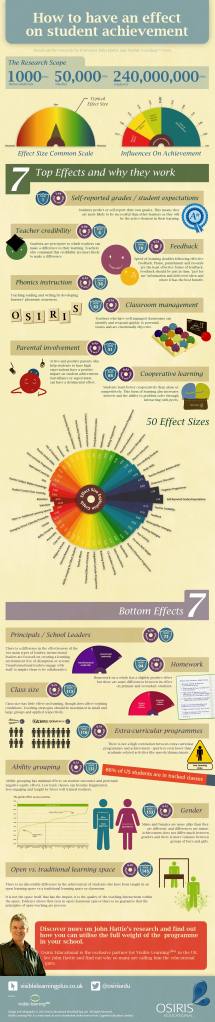
Osiris Educational in the UK produced an info graphic that reports many statistical findings about what has a positive and negative effect on student achievement. As I examined their data, I became very excited to see many of the strategic pieces in the structure of the Career Coaching for Students program were matching up to the top effects. The authors of the info graphic gave their short explanation of why the top effects work to increase student achievement. I will use their explanations (posted in italics) to form the basis for my comments here.

Top Effects and Why They Work for Career Coaching for Students

1. Self-reported grades/student expectations. This means they are more likely to be successful than other learners as they will be the active element in their learning. Students experience the Career Coaching for Students program like a journey. A coach is not a teacher or parent. We co-create success in examining post-secondary education and career options based on the student’s personal interests. The coach has the methods and tools for the student to quickly identify and learn about high-potential career ideas and engage in research. We don’t leave it to a career assessment listing of job titles found in many assessments. We find the student quickly feels in control and is able to set their own expectations at every step. We just make it easy – it’s all about the student.

2. Teacher credibility. Students are perceptive to which teachers can make a difference to their learning. Teachers who command this credibility are more likely to make a difference. There are two areas of credibility that are crucial to student career coaching. First is the coach’s credibility. It is very difficult for a teacher or counselor whose career has been entirely in the academic world to have a full perspective. Those career coaches that have the greatest credibility tend to have experience in human resource management and/or business management across diverse industries. The second is the assessment’s credibility. Students are perceptive when it comes to reading the different assessments offered through schools. If the assessment produces garbage – or the student perceives the information as less than helpful, you’ve lost the student. Our assessments provide over 40 pages of insights about the student. Our most common comment from students – “This is incredibly accurate.

3. Feedback. Speed of learning doubles following effective feedback. Praise, punishment and rewards are the least effective forms of feedback. Feedback should be just in time, ‘just for me’ information and delivered when and where it has the best benefit. I couldn’t write a better statement to describe the design of the Career Coaching for Students program. Our feedback comes in many forms. First there are the assessment reports (about 40 pages of feedback about who you are). Then there is how to use that information. We unfold the information and integrate it strategically so that the student can connect the dots quickly and easily. ‘Just for me’ is a perfect description of the feedback at every step.

4. Classroom management. Teachers who have well managed classrooms can identify and respond quickly to potential issues and are emotionally objective. Whether we are delivering the Career Coaching for Students program in a classroom or workshop environment or in a more personalized one-on-one setting, the structured approach to “peeling the career exploration onion” with the student enables us as coaches to identify and respond quickly to questions and issues. Remaining emotionally objective has more to do with being non-judgmental about the student’s aspirations. Our approach leaves very little room for subjective reactions to career ideas. We ask great questions that make the student think for themselves. We don’t tell them anything.

5. Parental involvement. Active and positive parents who help students to have high expectations have a positive impact on student achievement. Surveillance or supervision can have a detrimental effect. The Career Coaching for Students program encourages the student to welcome parental involvement and encourages parents to be involved at the right level. Parental involvement is a two-way street that can be more like a slippery climb up an icy road sometimes. Parents who quickly react negatively to career ideas will kill the student’s engagement. We’ve seen it happen more than a few times. Helping the student recover from that slows down their progress. Career exploration is a journey. The student needs to know they are free to explore and will be encouraged throughout the process. With that said, parents have a huge impact on student self esteem and healthy development of responsible independent thinking. We refer often to the program as a “How to make big Decisions” skill development program. It just happens to be focused on career exploration. Parents play a big role here.

6. Cooperative Learning. Students learn better cooperatively than alone or competitively. This form of learning also increases interest and the ability to problem solve through interacting with peers. This one explains why I like the workshop venue. But I’m getting ahead of myself. The student-coach relationship exists to co-create success for the student. Alone doesn’t work – we’ve seen that with the web portal (XAP, Naviance, others) solutions that many high schools subscribe to (see earlier blog article for more about this). In the workshop venue, we see many students with friends in the same workshop. They sit next to each other. Given that career exploration is a very personal exercise, the relationships with fellow attendees in the workshop is very supportive.

The six effects above help to explain why the Career Coaching for Students program is highly effective with all types of students. When it comes to improving academic achievement, I still think the anecdotal evidence is the most valid – that a person who really understands themselves, has identified a potential career that matches their talent design (found a passion) and has a plan for their future tends to be much more engaged – and therefore, much more interested in their own academic achievement.

One of the most frequent comments we hear from parents is “Wow! I wish I had this when I was in high school.

Carl Nielson is Chief Discovery Officer of Success Discoveries and Career Coaching for Students. He is also an organizational development consultant, executive development coach, and creator of the Career Coaching for Students program for high school students and Career and Success Skills Mastery for College Students and Recent Grads.  Assessment and coaching packages start at $349 – checkout the Summer 2013 special offer – 30-days coaching support with the Home Study coaching package.


7 Myths About Career Exploration in High School


5 Myths about Career Exploration blog picAround 2004, as a parent with kids approaching high school, I found myself curious about the “state-of-the-art” in career exploration and coaching that the students would receive. As a corporate organizational development consultant and executive coach, focusing mainly on adults either in career transition or executive/high-potential development, I had some insight into “talent” and success in life and work.

My adult clients would ask me to coach their “graduating senior in college” who hadn’t figured out what they wanted to do with their life. That was a warning sign to me – not about the person but about the system. How could a student go all through high school, choose a major, complete an undergraduate degree in college and not have a clue about what they wanted to do? What was the root cause of the failure? What was being done to help students and why was it not working?

Fast forward to 2013, and nothing has changed. Students continue to struggle with who they are and how their personal talent design connects to career choices and educational strategy. In some ways, it comes down to something even broader – learning how to make big decisions. But I am finding the same assessments used in 2004 are being used today. And schools are letting technology deliver career coaching.

Based on what I am seeing and hearing from school administrators, parents and students, I’ve put together a list of myths that are in desperate need of being corrected. These myths are prevalent with teachers, counselors, school boards and parents. See if you carry some of these myths as your own beliefs:

  • Myth #1 The high school has this covered. They’d like you to believe they’ve got career exploration covered. Even community colleges and universities want you to think they’ve got it covered. Be wary of the high school’s use of buzz words and descriptions of programs. For example, “all students take one or more career assessments to help them identify careers” may be technically true as a task they have the students complete. Ask your son or daughter what they thought of the assessment results. Ask them to show you the report. Ask them how the results are being used and what are they doing for career exploration. And for the bottom line question, ask them if they feel they are getting appropriate and tangible support for identifying and evaluating personal career options.
  • Myth #2 The assessments used by your high school are valid and insightful. The best way to check this myth is to take the assessments yourself and check your reaction to the report. As for technical information about the validity and reliability of the assessments, the school’s website will point you to the organization’s website that produces the assessments. With a little digging, you’ll find some kind of statement about validity and reliability. Some assessment companies will actually state “this type of assessment does not fit the criteria for validity and reliability studies”.  Taking the assessments yourself will surely enlighten you to the horribly designed assessment that is expected to “tell” your student which careers will be best for them. But even if you were to accept the quality of instrument as credible, what insights has it produced for the student?  What insights has the student learned about themselves after taking the assessment?
  • Myth #3 Counselors and teachers are focused on this. Ask a counselor about the amount of time they focus on coaching students in making career decisions and they will start explaining (after they stop laughing) how their day, week and semester is spent. It isn’t focused on coaching students in career decisions. Some counselors are leaving schools because their job isn’t about helping students, its about pushing paper.
  • Myth #4 The paid-with-tax-dollars school-site subscription to a cloud-based software program (Naviance, XAP, etc.)  is focused on helping the student find their path in life. Actually, many of these site-licensed “portals” are administrative tracking systems to help teachers be more productive. It is possible they also help students to be more productive with the college application process too. However, the primary focus isn’t on helping a student gain insight into who they are and what they want to become (even though the web-based marketing lingo sounds like they do focus on this). These systems are more focused on workflow management, specifically, “the process of getting students into college”. Who cares if the reason they are going to college is faulty or once they get there they change majors 3 times and graduate in 5 years. Put the ladder on the wrong building and you get to the top of a building with no purpose for being there.
  • Myth #5 High school students are too young and immature to focus much on career exploration or make any kind of career choice. This one is mostly on the parents. All I can tell you is if you think this, you are wrong. I am consistently amazed at the level of engagement and deep thinking that students put into developing a future direction, career exploration, choosing a major, choosing the right college for what they want to do and setting goals for themselves. Even those students that start the Career Coaching for Students program with less maturity quickly shed that cover and engage effectively. Watch for the colleges and universities to  empathize with the “high school is too early to know what you want to do with the rest of your life” thinking. The standard language at on-campus college visit presentations is to tell the student and parents it is perfectly fine to come in “undeclared” and take a year or two to decide what to study. Sure, you can start taking the “required Freshman classes” and a few electives to see what floats your boat. In the meantime, some students are figuring out a lot while still in high school and walking into college with a clear plan that may include double majoring, targeting specific companies for internships and obtaining summer jobs that will give them experience that makes them a top prospect upon graduation. In the meantime, being undeclared seems like a slow path to nowhere, and let’s not to mention the extra expense (thousands of dollars) for changing majors and extending the college stay by just one semester. Oops, I guess I did.
  • Myth #6 High achieving students don’t need as much career exploration support. One of the most challenging (and exciting) situations in coaching students is when the student is “All American” (or “All Canadian” for my Canadian readers). You know the type – very high GPA, active in sports, band, club officer, outside activities, loved by the teachers, respected by the administration, etc.).  The fact that these special individuals have so many capabilities, they have the most choices available to them. Many of these report feeling that they are expected to just know some how what they are going to do. The pressure to have a career direction figured out “on their own” is tremendous. From where I sit, there is no class of students that holds some special psychic ability to know what they want to do. All groups of students from under-achievers to over-achievers need professional career coaching.
  • Myth #7 Career exploration and planning is a “nice to have” but not the primary purpose of high school so it doesn’t deserve the funding or attention in high school. Many research studies have shown a clear connection between a student’s clarity about their future and their level of engagement in school. The result – higher academic achievement. If a student is under-performing academically, there is a good chance it is because they don’t see the potential in themselves and how that potential relates to a future. Many parents have reported back to me that their son/daughter raised their GPA the very next semester after going through the Career Coaching for Students program. But it doesn’t stop there. Students who were never on the academic honor roll in high school, and went through the Career Coaching for Students program their senior year were found two years later to have been on the Dean’s list at college every semester. The studies say this happens with credible career coaching at the high school level. Our experience is saying the same thing.

Carl Nielson is an organizational development consultant, executive development coach, career coach and author of the Career Coaching for Students program for high school students. For information about career direction and job search coaching for college students, check out Career and Success Skills Mastery for College Students and Recent Grads. Assessment and coaching packages start at $349 – checkout the Summer 2013 special offer.

Student Resource Central 10x more useful than ConnectEDU, Naviance, Kuder, Career Cruisin or XAP


The Career Coaching for Students™ program has so much to it. Independent career coaches, high school counselors and college career center counselors are finding the assessments and strategies creating significant breakthroughs. We call this disruptive technology.

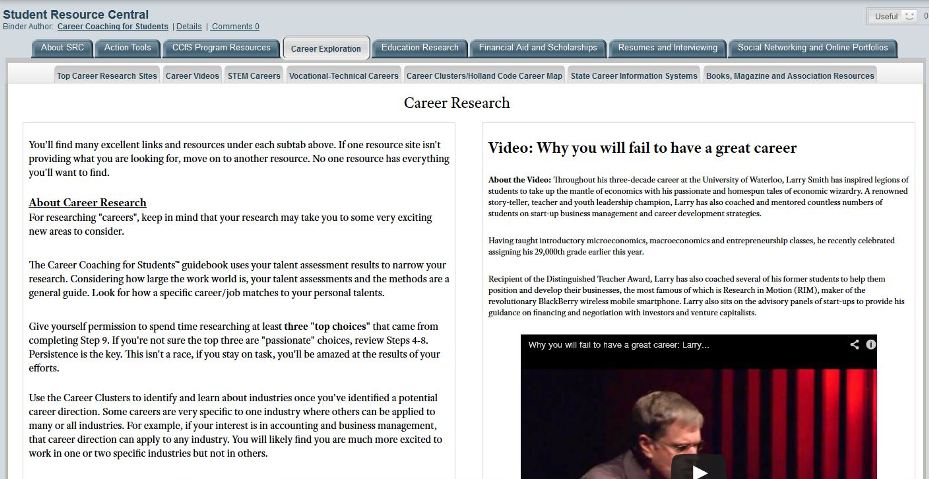
This article focuses on one part of the program that other programs minimize. Student Resources Central™ offers students and parents access to the best resources on the web. From career research, choosing a major, choosing a school, financial aid, scholarship research, college admissions and application process to the latest in resume portfolios, this portal to the vast unlimited resources on the web has it all. The website sprinkles advice throughout. The organizational layout enables the user to go exactly where they need to within two clicks.        SRC Welcome Page

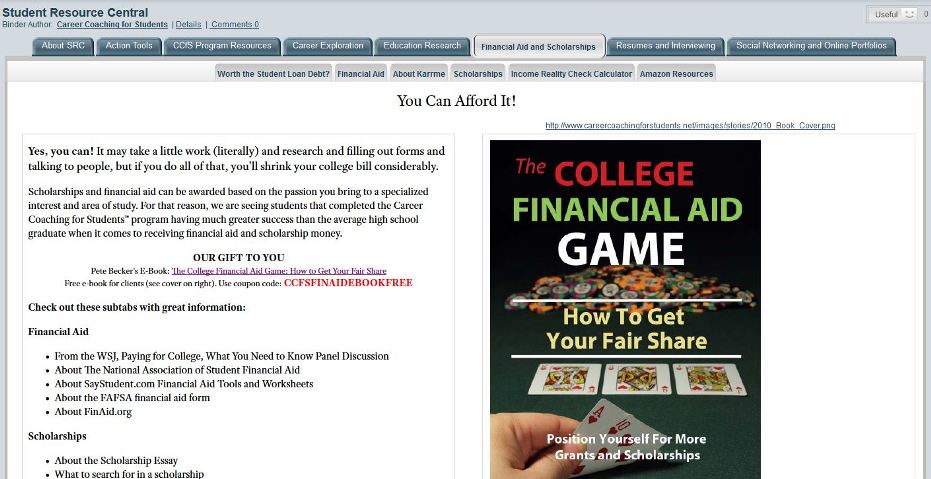
Below are screen shots of the main tabs. Each main tab has subtabs that offer carefully selected resources. Click on the screenshot to see a larger view to read the subtabs.

Criteria for a resource to be included in Student Resource Central:

Quality of information. Including the source, we don’t think it helps you to receive bad, biased, out-dated or partial information.

Agenda-free. The recommended resources are not operating a marketing data collection site that will use your personal information to market their sponsors.

Ease-of-use. There are plenty of web information pages. Just do a simple search on one topic and you’ll find millions of pages. Which are really worthy of your time? How much time will you have to spend shuffling through hundreds of pages before you get to the right pages of information? With SRC, you’ll quickly find your way through any webpage we direct you to.

Several great take-action recommendations

Several great take-action recommendations


Career Coaching for Students extensive library of worksheets, videos, and more

Career Coaching for Students extensive library of worksheets, videos, and more

The most extensive Career Research portal on the web - and easy to use

The most extensive Career Research portal on the web – and easy to use – including several extensive career video libraries.

Education Research that gives you what you need - like college freshman retention rates and graduation rates

Education Research that gives you what you need – like college freshman retention rates and graduation rates

Straight scoop, how to and information with integrity is what the Financial Aid and Scholarship resources are about. Most scholarship websites are nothing more than marketing websites. Not at SRC.

Straight scoop, how to and information with integrity is what the Financial Aid and Scholarship resources are about. Most scholarship websites are nothing more than marketing websites. Not at SRC.

Writing a resume and developing interview skills are just the beginning. So much for you to leverage including career advice videos.

Writing a resume and developing interview skills are just the beginning. So much for you to leverage including career advice videos.

Using social networking sites is key to career research, getting inside information about colleges and universities, finding internships and landing the first job out of college. The latest in using Portfolios is reviewed with a list of free cloud-based portfolio apps.

Using social networking sites is key to career research, getting inside information about colleges and universities, finding internships and landing the first job out of college. The latest in using Portfolios is reviewed with a list of free cloud-based portfolio apps.

If all of that isn’t enough, Student Resource Central is including the Life Skills for Students™ program too – for the one price.

The good news is that if you’ve purchased the Home Study Personal Edition of Career Coaching for Students or engage one of the licensed facilitators for a one-on-one service or workshop in your area, you receive Student Resource Central automatically. Purchasing the full package is the best way to go.

However, if you don’t want to buy the entire Career Coaching for Students program and receive the cool assessments and student binder, Student Resource Central is available, for a limited time, at a ridiculously cheap rate. The same rate applies for families or teachers wanting to use the resources for an entire class.

After comparing to other offerings, it becomes obvious that those other programs are trying to do the minimum while maximizing profits. Student Resource Central – well – is just simple, common sense that everyone can benefit from.


Warning: Campus Career Services NOT There to Help Students Choose a Career


B-Schools With Career Services That Rock—MaybeBusinessweek conducts a survey of college career centers each year. The way they wrote the article (see link), apparently college campus career services are not expected to assist students in choosing a career. So do you go to academic advising for help? Not really. They refer you over to the career center.

++++++++++++++++++++++++++++++
Excerpt from the Businessweek article:
One of the more perplexing things about business school career services is that student perceptions of how good a job their school is doing often bear no relation to the school’s real-world performance at placing students in high-paying jobs.

But wait, maybe there’s hope
Based on the survey data, students who took the Businessweek survey (summary article at http://www.businessweek.com/articles/2012-11-13/b-schools-with-career-services-that-rock-maybe) consider career services to be more than just placement and salaries.

In fact, the services include much more, from organizing career events on campus to connecting students with alumni who work in their targeted industries and providing help on job applications and résumés. Students who rate their school’s career services highly—notwithstanding mediocre success in the job market—are effectively giving them an “A” for effort. So if you’re looking for schools where you’ll get lots of help in your job search, consider those on our “best” list—you may not land your dream job, but it won’t be for lack of trying.
++++++++++++++++++++++++

Many career centers offer career counseling. Just keep in mind the “counselor” you are working with may be a grad student who has never had a job outside of the college. Or the counselor’s skill set may be stronger around how to write an effective resume than how to understand your talents and identify careers that are ideally suited to your talent makeup. Even if you are aiming for a business school education, there are many career paths that your education will support that you are less or more suited for talent-wise.

So where does a student go for assistance in choosing a career?

Countering College Student Objections to Joining LinkedIn


LinkedIn5 COLLEGE STUDENT Objections to Joining LinkedIn

While it is true that some college students may be beyond help, below are some excuses you can meet head on. To support students, my connections exceed over 2,000 which connect me to over 17 million on LinkedIn. I use my connections to help both high school and college students find people in their career of interest as part of the Career Coaching for Students program (high school program or college student program).

Your key to success1. “Creating a LinkedIn profile takes too much time” is a common complaint; however, creating a profile is actually a motivational exercise. Students can easily copy and paste their résumé to their LinkedIn profile and revise it from there. Once their profile starts to fill out, they begin to feel better about their developing profile.

2. “I don’t have time to add a LinkedIn update once a week?” Posting an update once a week is not that hard to do. With most students now on Facebook and Twitter, posting an update takes the same effort. It’s as simple as commenting on a topic such as something interesting being covered in a core course that aligns with your career direction, attaching an article, posting a great quote, letting people know what you are up to, etc.

3. “I don’t think people in my occupation use LinkedIn” might have been a valid point two or three years ago. Some occupations, namely the trades, were slower to jump on the LinkedIn wagon. Today, people in all industries and all types of work are on LinkedIn. With the number of connections I have, I love taking friendly bets on this false perception. I’ve won every bet.

4. “There’s no way I can get 50 connections” is an interesting challenge. LinkedIn allows users to download contacts from their e-mail account from the beginning of registering for membership. One just has to select the members they want to invite and soon acceptances and invites will come their way. An exercise I do with high school and college students is to have them write down on a worksheet everyone they know (friends, extended family, parents of friends, professional contacts). I then poll everyone to see how many they wrote down. In a 5 minute time limit, the average student writes down between 30 and 50 names. I then ask them if it is reasonable to expect each person they wrote down to have the same number of contacts. We then do the math. Using the least (30), the math looks like this: 30 x 30 = 900. Each of us can easily get something between our direct contact count and the 900 within one week. For college students, making this a competitive challenge with a reasonable $$ prize for the highest number of contacts after one week generates amazing results.

5. “I’m just a college student.” LinkedIn will most likely not offer immediate gratification. This isn’t a sprint; it is more like a marathon. The smartest students will invest in the time to begin their lifelong network. They’ll be ahead of their classmates and will most likely receive more interviews and offers when the time comes for the payout.

Carl Nielson is an organizational development consultant, professional career and executive/leadership coach and creator of the nationally recognized program Career Coaching for Students™ . Career Coaching for Students is available as a district-wide high school program, college program and in group and on-one-one offerings through certified career coaches throughout the United States, Canada and other countries. Contact Carl Nielson at carl@successdiscoveries.com or call 972-346-2892 to discuss specific needs. Or visit us at http://www.careercoachingforstudents.net

Freshman Year: The Big Picture by guest blogger Jennifer Karan, Executive Director, SAT Program, College Board


Happy TeensAs a former English teacher and Dean of Students (9th and 10th grade), I know that there are few things as daunting, mysterious and exciting to a teenager than freshman year of high school. It’s a whole new world: the hallways are foreign and at larger schools, students sometimes feel as though they need a GPS to get from class to class; the upperclassmen seem so much older and are brimming with a glowing confidence; teacher expectations and homework may require substantial adjustment. And college seems like a distant point on the horizon.

Part of the trepidation may be what adults would understand as not being able to see the forest for the trees. However, when a student is able to see how the various academic courses, opportunities in arts and athletics and programs that develop other interests (the school paper, community service or a part-time job) that form the Big Picture, he or she is able to navigate this terrain successfully, with greater purpose and enjoyment.

high school students see the big picture and plan carrersAn excellent first step towards realizing this Big Picture is to encourage a student to make an appointment with a school counselor early on. Where access to a counselor is difficult, students can approach a trusted teacher of a favorite subject. If a student is willing to share information with this new advisor, he or she can help that student make sure he taking the right classes to graduate on time and taking the types of classes colleges are looking for. Students should discuss favorite subjects to learn about additional opportunities as well as to get the necessary help with the more intimidating courses before it’s too late. Students can even share hobbies as well as aspirations; a counselor or advisor can help find extracurricular activities to help develop these interests.

Big Future, sponsored by the College Board, is an incredibly useful tool in helping students of all ages contemplate and understand what it takes to get to the college – or major – of their dreams. Starting early can help high school freshmen plan an academic path and start to understand the financial aid process, including scholarships and merit aid. It also provides information on how to make high school count, things to discuss with a counselor, planning college visits and other avenues to success.

Becoming aware of all the available resources and understanding how the decisions made now will offer benefits later on is one way to start the planning process. Actively utilizing those resources and building a unique and representative academic and extracurricular profile puts students on track for the Big Picture: showing colleges who they really are.

Career Coaching for Students is the solutionCareer Coaching for Students™ offers high school students the opportunity to develop a clear picture of self and their future that lifts self-esteem, increases academic performance and helps the family avoid unnecessary costs of changing majors and extending college due to changes in direction. Student Resource Central, the most comprehensive resource portal for career exploration and educational strategy research includes Big Future by College Board among its recommended resources. Freshman spring semester is the ideal time to take part in the Career Coaching for Students program. For more information, visit the website at http://www.careercoachingforstudents.net.

About the SAT Test