Tag Archives: student career choices

Student Resource Central is Fast Becoming THE Career and College Research Go-To Site


Student Resource Central™, the secure-access part of the Career Coaching for Students™ website is fast becoming THE Career and College Research Go-To Site for students: Incredibly rich with high-quality, high-value and validated content that saves incredible amounts of time for students (and parents).

The Career Coaching for Students™ program is the pride and joy for Success Discoveries (other programs will be coming in time). Because of the depth and quality of the program, the Home Study Personal Edition is $349 (current price) and workshops being offered in various areas of the U.S. range from $500 to $850 per student. While it is worth the price of admission, many families won’t be signing up. Yet, we have an incredibly rich amount of web content for students to use for career exploration exercises, search for colleges that match their educational goals, learn about financial aid, budgeting for college and scholarships and much more. Until now, you had to sign up for the one-on-one coaching or one of the workshop programs to have access to the Student Resource Central site.

We are now offering a $19.95 family license to access Student Resource Central™, the premier career and college exploration resource site. This one-time fee provides access with no expiration. Have more than one child approaching high school? Your username and password will still work next year and the year after. And we provide a 100% satisfaction guarantee or your money back.

We wish every student could take advantage of the full Career Coaching for Students™ program. For those that can’t, access to Student Resource Central™ can be the next best thing.

For-Profit Colleges Mislead Students


SPECIAL OFFER AT BOTTOM OF ARTICLE
On May 4, 2010, we posted an article on this blog and at the home page of Career Coaching for Students™ entitled PBS Frontline Exposes Fraud at For-Profit Schools. Obviously we have to give PBS credit for the story. Now it seems the General Accounting Office (GAO, United States Agency) has published their findings which are both confirming the PBS story and very damning for the “For-Profit Educational Industry”. These “for profits” offer “extensive career planning and placement programs” which has been the enabler for the “for-profit college industry” to secure significant market share in the higher education industry.

According to the United States Government Accountability Office (GAO), nearly two million students attend for-profit colleges, pursuing bachelor’s and associate’s degrees in disciplines that range from cosmetology to nursing and engineering. In 2009, for-profit colleges received more than $20 billion in federal loans and grants. These are powerful institutions that students, the government, and employers have trusted with a significant part of our society’s future. Knowing this information, you can imagine the outrage and shock that accompanied today’s GAO report that implicated 15 for-profit colleges in deceptive recruiting & career planning practices.

Of the 15 colleges tested, four institutions were guilty of fraud in their aggressive and misleading marketing techniques. As part of the GAO’s undercover investigation, four agents posed as prospective students and met with admissions staff for financial aid, tuition, and career planning information. The test revealed the following questionable marketing practices:

  • One for-profit college encouraged an applicant to hide $250,000 worth of assets on a federal financial aid application
  • According to The New York Times, another college encouraged a student to lie about dependents on a financial aid application 
  • Admissions representatives misrepresented tuition costs, quoting the price of classes for nine months instead of one full year
  • Students were provided with false career planning advice. For example, one program mentioned that barbers could earn up to $250,000 annually. According to the Bureau of Labor Statistics, 90 percent of barbers earn $43,000 per year.
  • One admissions representative undermined the financial burden of student loans, implying that defaulters cannot be held accountable for missed payments
  • Admissions representatives engaged in aggressive marketing strategies, pressuring the undercover agents to sign contracts even if they weren’t ready to make a decision.

Although the names of the 15 for-profit colleges remain confidential, the surveyed programs were in a number of disciplines, offering both associate’s and bachelor’s degrees in subjects ranging from business to cosmetology. This information coincides with an education record.

According to the Bureau of Labor Statistics, 70 percent of high school graduates from the class of 2009 were enrolled in a two-year or four-year program when surveyed in October ’09 — the highest number in United States history. While this is a figure worth celebrating, it is also indicative of a growing issue – proper career exploration and planning.

How many of these students are making informed career decisions when choosing a program to attend? How many of these students will position themselves to guarantee a return on investment, and how many will drown in debt upon graduation, falling victim to aggressive marketing practices, false career planning advice, and unrealistic expectations about career prospects? Whether or not students have fair access to objective information, they are still responsible for the costs and consequences of their education and career planning strategy.

Of all the concerning questions, how many students, by taking the bait at these fraudulent institutions, are missing out on a career that would have been much more fulfilling and resulted in greater success?

Students have to make adult decisions with real consequences at a very young age. The issue isn’t whether students are mature enough to choose and plan their careers. The issue is around access to solid, credible career coaching for students. As a society, as parents, as teachers, and as students, it is more important than ever that career coaching be provided to all students.

If you’re not investing a substantial sum of money, you are investing a substantial amount of time, so be an educated consumer when shopping for a college. Just as you would compare the economic implications of buying a car, you should compare the economic implications of your degree, college, and program relative to career interests. In addition to looking at rankings, prestige, and marketing materials — regardless of whether you are looking at a nonprofit or for-profit college — weigh the economic and educational return on investment. Our students are our future’s most valuable asset, so let’s position them to be successful.

A GREAT OFFER TO READERS OF THIS BLOG – UNLIMITED ACCESS TO STUDENT RESOURCE CENTRAL™ FOR ONLY $19.95: The Career Coaching for Students™ website has an extensive private area for career and educational research that is normally reserved for our individual and workshop clients. Each resource has been evaluated for its quality, value and ethical representation of information. We call it Student Resources Central™. Due to the new, alarming information about corrupt “for-profit” institutional practices, we are offering the full Student Resources Central site to parents** and students for $19.95 per access license. This is a unique offer and the access has no expiration. If you are a high school administrator or teacher and would like to gain access to the site for all of your students we offer the same price to you also. This one-time purchase provides access with no expiration. To buy an access license go here. Aren’t sure it is worth it? We guarantee your satisfaction* or we’ll give you a full refund and we’ll eat the credit card fees.

*Guarantee will be honored for 30 days. After 30 days we figure you found the site helpful.
**This offer is not available to professionals or organizations that offer career guidance services, tools or products. For more information on becoming a Career Coaching for Students™ Licensed Facilitator which includes full rights to use Student Resource Central  with all of your customers contact Carl Nielson at 972.346.2892 or visit our Coach Facilitator information page on the website.

Insights for Parents: The Pressure of Choosing a Career


As a parent of a college student and a teenager in high school, one of my biggest questions in my mind is “Am I helping my children with the right information and career guidance?”  Am I helping them understand their unique talents, skills, behaviors and motivators and translate these into identifying a career path that is motivating and fulfilling for them?  

I’ve worked with many teenagers, high school and college students for several years and have gained a few insights. As a full time management consultant, executive coach and executive & student career coach and as a parent, I’m sharing “insights” that I hope are useful to parents. The focus of these insights is specific to parents of teenagers (or college students) who are struggling with helping their son or daughter with career guidance.  So instead of this being advice, please consider these, at best, my insights. 

Here are a few points to consider to reduce the pressure of Career Guidance: 

  1. Be a good listener. Listening with open ears and an open mind is one of the most powerful ways you can help your son or daughter. Listening means “not talking, telling or judging”. Listening means asking open ended questions to learn what is in the mind of your son or daughter?
  2. Observe and create an awareness of their talents and skills. Become very observant of your teenagers skills and talents in their day to day activities at home, schools and in social gatherings. Open ended discussion around these observations creates a heightened awareness among the teenager. This new awareness also motivates them to explore and learn more about these talents and skills on their own.
  3. Be understanding. Choosing a career is a process of exploration and takes time and effort. When helping your son or daughter explore their own talents and the potential careers that will be a good fit, don’t push for an immediate decision, it has to evolve over time in the mind of your child. Choosing a career is not a healthy objective in the short term. A better “parental objective” is to support your son or daughter in exploring their interests, attitudes, motivators (self awareness) and the careers, industries, companies and people that might help them “find” their place in the world. Developing a strategy that ensures they are positioned to pursue the best career for them is an admiral goal and a less frustrating proposition for you and your child.
  4. Approach career exploration as a fun journey. The journey is as certain as life itself. To make career exploration fun means eliminating all of the things that makes it not fun. We parents are very good at telling. Please don’t tell when it comes to career exploration. Parents are very good at sharing their opinions. Please avoid sharing your opinion until your teenager asks for it. Offer support in whatever way your son or daughter wants that support. Remind yourself often how intimidating an exercise this is for son or daughter. Remind them that you were totally blind about careers, that you had no idea how to go about exploring and choosing a career when you were their age and that you were intimidated by the thought of “choosing a career”. Help them create an environment that puts them in control. Within that general guideline, do not allow your son or daughter to put it off (a natural occurrence when we feel intimidation, fear, and incompetent). With little effort, they can learn a lot during the high school years that will put them way ahead of most college students.

You’ll end up turning your frustration into fun and excitement when you watch your son or daughter talk, act and succeed with passion because they own their career choices. This way they not only find their career choices, but are very excited about it and motivated to go the extra mile to succeed. 


Carl Nielson is the developer of Career Coaching for Students™, the premier career exploration program for high school and college students. Nielson is the founder of Success Discoveries (www.successdiscoveries.com) and The Nielson Group (www.nielsongroup.com), an international corporate organizational management consulting firm. Prior to consulting, he served over 20 years in corporate human resources management. He holds a degree in organizational psychology from Texas A&M University. Find Carl on LinkedIn.   Carl speaks to groups on request and offers parent webinars and seminars for communities. 

If you are looking for true career guidance for a student, check out http://www.careercoachingforstudents.net. Are you past the high school and college years? Check out resources and services at Success Discoveries. Professional career coaching services offered.    

Copyright © 2010 Success Discoveries, LLC
Career Coaching for Students™ is a trademark of Success Discoveries, LLC
Life Skills for Students™ is a trademark of Success Discoveries, LLC

Is it time to revamp career guidance in schools?


As a corporate management and organizational development consultant with over 25 years of hiring, firing, training, coaching and development, I find a mixed population when it comes to people with clear, passionate career direction and those without that clarity and passion. My observations and various academic, corporate and government surveys suggest more people fall into the latter category. Yet those in positions of authority within the secondary and higher education career guidance field seem satisfied with the status quo.Is it time to revamp career guidance in schools?

What has changed over the past 30+ years in career counseling in most schools can be summed up in three letters: WWW. Schools are now offering students an online portal to career information. Most of these programs offer personality assessments that point the student to Holland codes.  So if that is an appropriate assessment for students, how many employers use Holland code type assessments to match people to jobs? My informal scan came up with zero. 

Why revamp career guidance in schools?
I’ve listed some reasons (goals and rewards) that support an effort to revamp career guidance in schools.

  • Higher student self-esteem
  • Higher academic achievement across all student populations
  • Better choices for higher education
  • Shorter time in higher-ed (a change in majors delays a student by at least one semester)
  • Lower student loan debt
  • Higher quality workforce
  • Greater job satisfaction
  • Improved society
  • Higher personal income
  • Higher quality of life
  • and greater employability in a passionate career

Career Guidance redefined.

Career guidance starts with bringing self-awareness to the student. This is minimized by schools, or, if attempted, counselors use personality assessments with relatively low validity and reliability. The typical public school administrator thinks they do not have the budget to consider highly reliable, valid assessments and properly conduct counseling or coaching with each student. As one administrator explained, “we need to leave something for the parents to do”. Colleges and universities are found to have very few resources as well. Many continue to use the Myers Briggs Type Indicator as the tool of choice for expanding students’ self-awareness.   

With solid self-awareness, a valid connection needs to be made to career possibilities. Most students get off the train at this point. They didn’t find the “personality assessments” valid (face validity is critical) and found the career suggestions from the assessment report made no sense. The reality is that making the talent-to-career connection requires the help of a professional career coach or a well-developed career coaching program that guides the student through the process.

From initial investigative research to in-depth career analysis, the ability to research careers has been improved drastically thanks to the Internet. However, left on their own, students find the Internet is a rather large, disorganized information bank that has the potential to get the researcher distracted or totally lost and confused. Students don’t need a Google list of Internet resources or school marketing website disguised as a career guidance site. Internet resources need to be found, evaluated, vetted and categorized in a way that allows the student to stay focused with their research and avoid chasing links to questionable or low-value content.

Career research can’t be defined by Internet resources. At some point, the student must meet people in careers of interest, interview these people, go on job shadowing ventures and get internships working for companies that employ people in his career of interest.  There are several other strategies students can take to learn and identify career choices. Most students don’t complete any of these steps. A very few might do some of this.

Researching ideal careers is half the battle. Today’s students lack skills such as decision-making. Life skills that are learned early support students as they go to college or enter the work world. Life skills are just that, skills learned by experiencing life. However, our culture has changed significantly in the past 30 years. Students do not live in an environment that enables them to develop these life skills the way kids did 50 or 100 years ago. Yet school administrators and parents seem unaware of programs they can use to introduce students to key skills required for success. What are the key skills found in highly successful people? Here is a short list of 18 skills. Which of these aren’t needed to be highly successful? 

  1. Continuous Learning (try this one!)
  2. Personal Accountability
  3. Self Management
  4. Decision Making (Conceptual Thinking, Theoretical Problem Solving, Role Confidence, Balanced Decision Making)
  5. Goal Orientation
  6. Proactive Thinking
  7. Initiative
  8. Project and Goal Focus
  9. Planning and Organizing
  10. Flexibility
  11. Problem Solving
  12. Persistence 
  13. Creativity Innovation
  14. Futuristic Thinking
  15. Influencing Others (Conveying Role Value, Gaining Commitment, Understanding Motivational Needs)
  16. Interpersonal Skills (Evaluating Others, Personal Relationships, Persuading Others)
  17. Written Communication
  18. Personal Drive

What are the chances the typical high school student is being developed in these skill areas? I think it is time to revamp career guidance in schools? Please leave your thoughts in the comment box.

Carl Nielson is the developer of Career Coaching for Students™, the premier career exploration program for high school and college students. Nielson is the founder of Success Discoveries (www.successdiscoveries.com) and The Nielson Group (www.nielsongroup.com), an international corporate organizational management consulting firm. Prior to consulting, he served over 20 years in corporate human resources management. He holds a degree in organizational psychology from Texas A&M University. Find Carl on LinkedIn.   Carl speaks to groups on request and offers parent webinars and seminars for communities.

If you are looking for true career guidance for a student, check out http://www.careercoachingforstudents.net. Are you past the high school and college years? Check out resources and services at Success Discoveries. Professional career coaching services offered.   

Copyright © 2010 Success Discoveries, LLC
Career Coaching for Students™ is a trademark of Success Discoveries, LLC
Life Skills for Students™ is a trademark of Success Discoveries, LLC

Career Talk for Students with Dr. Bruce McLaughlin webinar series starts July 7, 2010: New, Emerging and High Demand Jobs for Students


I am very honored to be Bruce’s first “guest” for Career Talk, a free program for students and parents available by registering at http://tinyurl.com/yk7nfw9.

My topic is New and Emerging Careers for Students. Please forward the info to any parent or student interested in the future (that should cover just about everyone).

Career Talk is a series of free conference calls hosted by Dr. Bruce McLaughlin. Topics cover a wide range of issues important to students and parents of students in high school and college.

Career Talk Series One (July through September 2010)

Format: Interactive conference call (phone) with online screen sharing.
Call in instructions:
1. Call the conference line (one-time register at http://tinyurl.com/yk7nfw9) to connect to the call using your unique PIN
2. At beginning of call go to http;//www.successdiscoveries.glance.net. A session key will be provided at the beginning of the call. Follow the online instructions to connect to the presentation screen.

Interactive Q and A with guest experts will be included on each call.

Wednesday 7/7/10 (7:00 P.M. central) – New and Emerging Careers with Carl Nielson
What careers are going to be in demand in the future? How can you prepare yourself to move into the new job market? This session will address careers and their requirements that are relatively new (non-traditional) or anticipated to be developing over the next ten years. We will discuss the differences between ‘New Occupations’, ‘Emerging Occupations’, and ‘Evolving Occupations’. Carl Nielson is founder of Success Discoveries and the Developer of the Career Coaching for Students program.

Wednesday 7/29/10 (7:00 P.M. central) – College Costs & Funding Strategies Part One
Your family’s security depends upon careful planning for college expenses. A typical education can cost over $100,000 and leave the young student in debt for years. Prepare in advance for one of the most important events of your life. Dr. McLaughlin will be joined by Susan Young, CPA to cover this important topic.

Monday 8/30/10 (6:00 P.M. central) – Know the Score on Standardized Testing
Learn about the role standardized testing plays in the college process and gain simple tips to assist you in preparing for the SAT/ACT.

Monday 9/27/10 (8:00 P.M. central) – College Costs & Funding Strategies Part Two
Your family’s security depends upon careful planning for college expenses. A typical education can cost over $100,000 and leave the young student in debt for years. Prepare in advance for one of the most important events of your life. Dr. McLaughlin will be joined by Susan Young, CPA to discuss and share valuable information.

At the end of each call, Bruce will answer questions and explain some of the specifics about the upcoming St. Louis-area career workshops specifically tailored for students in high school or college.

Bonus: As a Registered Call Participant, we’re providing you access to the Life Skills for Students Continuous Learning module (one of the 16 Life Skills for Students modules included in the workshop).

Bonus #2 for Students: Complimentary “Parent User Manual” assessment. Students are being “assessed” and “tested” constantly. Let’s turn the tables and have the parent take an assessment. Participating parents on the call will be invited to take a complimentary behavioral style assessment. The report will be enlightening for the parent and the entire family. Instructions will be e-mailed after the call.

To learn more about upcoming workshops http://www.careercoachingforstudents.net/career-coaching-for-students-events/30-st-louis-student-career-workshop.html

Career Coaching for Students workshop is highly recommended for high school students:

Incoming Freshmen
Sophomores
Juniors*
Seniors*

*This workshop is critical for Juniors and Seniors if they are making college and major choices without a clear career plan., Talent Development: Hire,Train & Retain the Best. Executive Coaching, Team Development, Student Career CoachingTriMetrix, CPVA, CPBABy Carl Nielson,

Free Career Counseling is the Most Expensive Option


Yes, we’ve all had that experience where “free” turned out to be the most expensive option. When the risk is low, it is a great first strategy. When the stakes are really high, taking the free approach may not be the best way to go. When it comes to student career exploration, that free career counseling received in high school and college has generated some interesting statistics for those adults now trying to reap the benefits of that career counseling. To be certain, while these offerings may be free to the student and parents, there is a cost for the time and resources assigned. In addition, student feedback and national data suggest traditional career counseling strategies used by most high schools and colleges are not effective.     

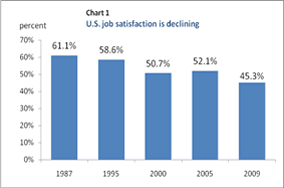
US Job Satisfaction Trend

US Job Satisfaction Trend


According to The Conference Board, as reported January 5, 2010, of 5,000 households, finds only 45 percent of those surveyed say they are satisfied with their jobs, down from 61.1 percent in 1987, the first year in which the survey was conducted. “While one in 10 Americans is now unemployed, their working compatriots of all ages and incomes continue to grow increasingly unhappy,” says Lynn Franco, director of the Consumer Research Center of The Conference Board. “Through both economic boom and bust during the past two decades, our job satisfaction numbers have shown a consistent downward trend.”     

The drop in job satisfaction between 1987 and 2009 covers all categories in the survey, from interest in work (down 18.9 percentage points) to job security (down 17.5 percentage points) and crosses all four of the key drivers of employee engagement: job design, organizational health, managerial quality, and extrinsic rewards. 
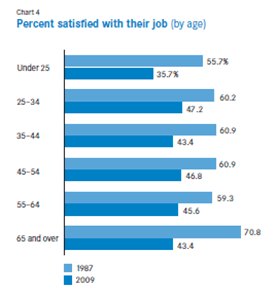
Trend Percent by AGE of US Satisfied in Job

Satisfaction Trend by Age


“Challenging and meaningful work is vitally important to engaging American workers,” adds John Gibbons, program director of employee engagement research and services at The Conference Board. “Widespread job dissatisfaction negatively affects employee behavior and retention, which can impact enterprise-level success.” In fact, 22 percent of respondents said they don’t expect to be in their current job in a year. “This data throws up a big, red flag because the increasing dissatisfaction is not just a ‘survivor syndrome’ artifact of having co-workers and neighbors laid off in the recession,” says Gibbons.     

Chart 4 on the left makes a strong statement. Those in the workforce under age 25 (group most recently having received career counseling as a student) are the most dissatisfied with their job. That was the case in 1987 as well but the amount of dissatisfaction has changed dramatically. Is there a correlation between job dissatisfaction of the younger adults and career counseling strategies being used by high schools and colleges? All age categories show drastic shifts downward in job satisfaction. Yet, we can assume that within all age groups it is likely there are people that are experiencing very high job satisfaction. Is there a common denominator for those that are experiencing high job satisfaction? The short answer is “YES”. Everyone with high job satisfaction have found the job and career that matches to their passions and talent.     

Is the economy to blame or is the cause more stealth?     

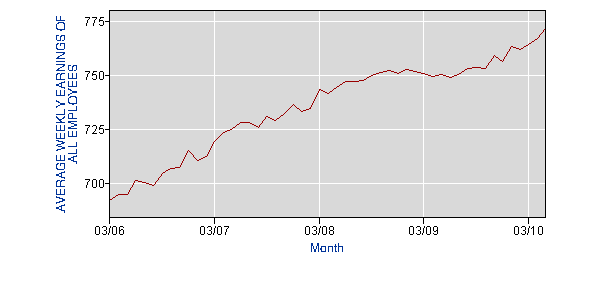
The Stealth Bomber from the movie StealthLooking at the different Bureau of Labor Statistics’ data, earnings were flat for most of 2009. That might explain a dip in job satisfaction in 2009 but not in 1987 – 2008 (Chart 1 above).  A closer look at hourly compensation, manufacturing output and business output do not show a correlation between economic indicators and job satisfaction.     

Real Hourly Comp Business 1987 - 2010 BLS

Real Hourly Comp Business 1987 - 2010 BLS


While the 2009 recession could be “predicted” by some of the previous year data, it doesn’t seem to matter what is going on economically. Job satisfaction is dropping. The only data that might give some correlation to the economy is Real Hourly Compensation. From 1987 to 1998 there were wide swings both up and down. Those wide swings could explain a level of job dissatisfaction. From 1998 to 2009 the Real Hourly Compensation shows a steady drop.    

We could easily make a correlation between dropping compensation and job satisfaction. In 2005, we see a high point    

Output per Hour Mfg 1988 - 2010 BLS

Output per Hour Mfg 1988 - 2010 BLS


for job satisfaction in the first decade of the 21st century that contradicts the correlation between compensation and job satisfaction. We also see a spike in manufacturing output in 2005 that might suggest that is “the” driver of job satisfaction.    

So with contradictions in the data, we are left searching for better explanations. Those of us working in the organizational development and human capital management field like to point to the intangibles of work. Within that realm, there is a body of knowledge and hard data that suggests “job fit” is the real “controlling factor” for job satisfaction. This implicates high school and college career counseling programs as not only being ineffective but perhaps detrimental to future job satisfaction.    

Output per Hour Business 1987 - 2010 BLS
Output per Hour Business 1987 – 2010 BLS

So back to the point about “free is the most expensive option”.  When  it comes to career exploration, there are three possible ways to receive free career coaching as a student:    

  • in high school
  • through the government’s military recruitment program
  • at college/post secondary school 

The first  free opportunity comes in high school.
High Schools are signing “career Internet portal site licenses” with companies like Kuder, Bridges by XAP or Naviance to meet state graduation requirements related to career exploration and career planning. Teachers or counselors are providing guidance to the students that ranges from a PowerPoint presentation on how to use the career portal to one-on-one meetings to “guide” the student in choosing AP classes and taking the SAT or ACT exams. English teachers may assign a writing assignment to focus on career exploration. Some high schools like Eugene Oregon’s school district have a comprehensive suite of tangible offerings and a career coordinator to coordinate the offerings. For most high schools, the counselors will say the last thing they have time for is to provide quality individualized (or even group) career coaching. Carol Christen, coauthor of What Color Is Your Parachute? For Teens: Discovering Yourself, Defining Your Future states, “Academia seems to be stuck in the 19th century. They have polarized the discussion into parts that are nearly irrelevant. Research shows that all students do better when they have a plan. A detailed and well vetted plan is as necessary as good grades for success, and that students with a plan go on to and graduate from higher education in greater numbers.”    

ASVAB Wants YOU

ASVAB is the Dept of Defense's Military Entrance Exam


The second free opportunity is the Department of Defense ASVAB Career Exploration program.
The Armed Services Vocational Aptitude Battery (ASVAB) is a timed multi-aptitude test, which is given at over 14,000 schools and Military Entrance Processing Stations (MEPS) nationwide and is developed and maintained by the Department of Defense. The military is offering free career exploration that includes the ASVAB assessment and a full personal debriefing of the ASVAB assessment results. The people providing the assessment debriefing are not career coaches. They are Recruiters working for the military. If you are already considering or want to look at careers in the military, take advantage of this free offer. To access a wider student population (top students), the military has dressed this program up as a “taxpayer benefit that everyone should use”.    

 The third free opportunity is the college career placement and counseling office.
College Placement and Counseling OfficeEvery college or university has an office of Career Placement and Counseling. Trade schools and “for profit” institutions also have a similar office. The “for profit” organizations use the name to cover their true purpose to use the “career counseling” for recruiting new students.    

Like high school, universities and colleges have more of an advisory system in place that is offered to students. Unfortunately, most of these institutions use similar assessments used by high schools – not the kind of assessments used by companies to match people to jobs. Advisors in colleges and universities rely on the student to come to them. Based on college staffing of career advisors, less than 5% of the student population actually utilize the services. The services utilized look much more like a high school offering than actual career coaching. But lately, colleges are introducing classes like those listed at Cleveland State University. An example of a Law School career counseling services video go here. Watch the Career and Job Fair video to see the typical college student admit they did no career planning before choosing a college  major or delayed thinking about career and jobs until their graduation year.    

The best advice I can offer to teens or parents is “find and enroll in a credible career exploration program that takes a career coaching approach”. Do this before you leave high school. Do this before you choose a college. Do this before you choose a college major. Pay for it unless you know someone that will provide it to you for free. If you can’t find a local program, consider Career Coaching for Students™ Home Study Personal Edition. With parent assistance, students who seriously pursue career planning using credible methods can gain an advantage that impacts academics now and avoids missteps down the road.    

The second piece of advice is for students. Take your high school “career” writing assignments seriously. Take full advantage of any career counseling that is offered if you feel it is credible and helpful.  

Carl Nielson is the developer of Career Coaching for Students™, the premier career exploration program for high school and college students. Nielson is the founder of Success Discoveries (www.successdiscoveries.com) and The Nielson Group (www.nielsongroup.com), an international corporate organizational management consulting firm. Prior to consulting, he served over 20 years in corporate human resources management. He holds a degree in organizational psychology from Texas A&M University. Find Carl on LinkedIn.    

If you are looking for true career coaching for students, look at http://www.careercoachingforstudents.net. Are you past the high school and college years? Check out free resources at Success Discoveries. Professional career coaching services offered. See what a real career coach looks like.    

Copyright © 2010 Success Discoveries, LLC
Career Coaching for Students™ is a trademark of Success Discoveries, LLC
Life Skills for Students™ is a trademark of Success Discoveries, LLC

Adora Svitak: What Adults Can Learn from Kids


Adora Svitak is a young teenager (teen, tween?). To watch her give a speech to a TED audience gives any parent a moment of wonderment. In her speech she talks about what kids bring to the world and how adults can learn a few things that, perhaps, we’ve forgotten. It is a great speech, great presentation, very polished. Well done Adora!

Now for the most interesting part. Read the comments that are coming in (watch the video at the link above first, the comments are listed below the video). If you are an adult, teacher or parent, some of the comments are extremely positive, perhaps even helpful toward Adora’s points, others not so much, even making Adora’s points even more valid. For example, Dani wrote “Adora, thank you. I’m an educator and as the school year nears it’s end you have reminded me to trust my students, to allow them to express themselves and to provide them with an environment where they can thrive.”  A very positive statement. Very helpful in reminding us that children are “diamonds in the rough” and that, if given the opportunity, children can be brilliant. Of course the key here is “given the opportunity”.

Most kids do not grow up in a perfect environment (home, school, social). This imperfection in the environment takes its toll on the “self view” of “potential” that each person has as they grow. For most, once the self view is tarnished, motivation decreases. A negative bias on one’s self view does not have to be cause for decreased individual motivation.

Based on data coming from an extremely valid and reliable assessment, a negative bias for self view is found in 85% of the population. It turns out that a negative bias for self view is what gives most of us a “continuous learning” attitude. Otherwise, we become so egotistical in our own abilities that we would be intolerable in relationships (personal, work, etc.). So a negative bias for self view is important to understand and put to use.

Many students develop the negative self bias and fail to see themselves as worthwhile, deserving of a great future and “high potential”. Some teachers, with their own imperfect self, make the situation worse. We see these students in high school acting out in many different ways but they all seem to have one common theme – under achievement academically and a preference to play to an extreme that results in avoidance of intellectual development).  

Now fast-forward to high school. I recall having “moments” of brilliance but not getting much recognition. Those moments of brilliance were camouflaged with an abundance of mediocrity. Knowing what I now know, mediocrity is the air that everyone breaths. There are two components or “ingredients” that, when added to our air, change things dramatically. The first is something called life skills. The second is career exploration.

These two components, specific life skills and clear career match to talents, were consistently found in highly successful people. To see what life skills were identified in highly successful people go here. To see what a real student career coaching program looks like go here.

So, based on the 12 key life skills identified in highly successful people, which of those does Adora display as she takes her audience on the journey to “learn from kids”?

Commencement Speeches are Coming Too Late, Let’s Aim for Incoming Freshmen …in High School


Tony Balis of humanity.org posted a great article on commencement speeches that culminated from work he began in 1989. He listed speeches from 1936 to 2009. Balis states, “The commencement ceremony affirms each student’s search for knowledge. It often includes a graduation speech which seeks to put their recent hard (or not so hard) work into the context of their future. Yet — as we graduate from one year to another, one relationship to another, one experience to another — we always are learning.”

This article highlights some of the “better” points made by various commencement speakers and provides a commencement speech for incoming high school freshmen.

It isn’t about being a doctor, lawyer, President of the United States, accountant or CEO. It is about passion for what you do. What the world needs is more people who are passionate about what they do.

Whether the remarks above were given decades ago or just a year ago, they are as relevant and important, perhaps increasingly so, as the state of our world evolves. Ask yourself, have you found your passion? Are you equipped for life’s challenges? The links are to solutions for each question. Enjoy.

Sting (born Gordon Sumner), Berklee College of Music, Boston, MA, May 24, 1994
“There’s always something more to learn.”

Michael Josephson, http://www.CharacterCounts.org
“Listen to both your heart and your head. Pursue your passions, but don’t confuse feelings with facts. Almost nothing is as good or as bad as it first appears, and all things change. By all means, set goals and go after your dreams, but know that your ultimate happiness will depend not on your plans but your ability to cope with unexpected turns and unavoidable ups and downs. You may not get what you thought you wanted, but if you’re willing to adapt, you can get something even better.”

Paul HawkenPaul Hawken, “The Earth is Hiring”, Univ. of Portland, May 3, 2009
The living world is not “out there” somewhere, but in your heart. Life is creating the conditions that are conducive to life inside you. You are Brilliant, and the Earth is Hiring. This is your century. Take it and run as if your life depends on it.”

Barack ObamaBarack Obama, “Make Us Believe Again”, Commencement address at Wesleyan University, Middletown, Connecticut, USA, May 28, 2008
“…And at first we didn’t get very far…It wasn’t easy, but eventually, we made progress…Through service, I discovered how my own improbable story fit into the larger story of America…You can take your diploma, walk off this stage, and chase only after the big house and the nice suits and the other things that our money culture says you should buy. …But I hope you don’t. …It’s because you have an obligation to yourself. …There are so many ways to serve and so much that needs to be done at this defining moment in our history. You don’t have to be a community organizer or do something crazy like run for President. …know that you’ll experience the occasional frustrations and the occasional failures. Even your successes will be marked by imperfections and unintended consequences. I guarantee you, there will be times when friends or family urge you to pursue more sensible endeavors with more tangible rewards. And there will be times where you will be tempted to take such advice. …But I hope you’ll remember, during those times of doubt and frustration, that there is nothing naïve about your impulse to change the world. …I can still remember a conversation I had with an older man all those years ago right before I was headed for my new job in Chicago. He said, “Barack, I’ll give you a bit of advice. Forget this community organizing business and do something that’s gonna make you some money. You can’t change the world, and people won’t appreciate you trying. But you’ve got a nice voice, so you should think about going into television broadcasting. I’m telling you, you have a future there.” Now, I’ve wondered, he might have been right about that TV thing, but he was wrong about everything else.”

Barbara KinsolverBarbara Kingsolver, “Your Money or Your Life”, Commencement address at Duke University, Durham, North Carolina, USA, May 11, 2008
“The very least you can do in your life is to figure out what you hope for. The most you can do is live inside that hope, running down its hallways, touching the walls on both sides. …The happiest people are the ones with the most community. … The hardest part will be to convince yourself of the possibilities, and hang on. If you run out of hope at the end of the day, to rise in the morning and put it on again with your shoes. Hope is the only reason you won’t give in.”
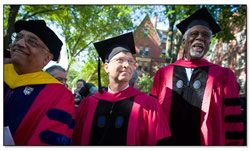
Bill GatesBill Gates, “Great Expectations”, Commencement address at Harvard University, Cambridge, Massachusetts USA, June 7, 2007
“…Radcliffe (residential college at Harvard) was a great place to live. There were more women up there, and most of the guys were science-math types. That combination offered me the best odds, if you know what I mean. This is where I learned the sad lesson that improving your odds doesn’t guarantee success. …One of my biggest memories of Harvard came in January 1975, when I made a call from Currier House to a company in Albuquerque that had begun making the world’s first personal computers. I offered to sell them software. I worried that they would realize I was just a student in a dorm and hang up on me. Instead they said: “We’re not quite ready, come see us in a month,” which was a good thing, because we hadn’t written the software yet. From that moment, I worked day and night on this little extra credit project that marked the end of my college education and the beginning of a remarkable journey with Microsoft. …Cutting through complexity to find a solution runs through four predictable stages: determine a goal, find the highest-leverage approach, discover the ideal technology for that approach, and in the meantime, make the smartest application of the technology that you already have-whether it’s something sophisticated, like a drug, or something simpler, like a bednet.”

Ken Burns, “A Vanguard Against this New Separatism”, Commencement address at Georgetown University
Washington D.C., USA, May 20, 2006

“…I am now absolutely convinced that he was right and that your future lies behind you. In your past, personal and collective. In the last thirty years of filmmaking, I have learned many things, but that the past is our greatest teacher is perhaps the most important lesson. …But for the most part we live, today, in a culture so dedicated to an all-consuming present, where people can name you ten brands of blue jeans or perfume or handbags, but can’t name you that many presidents, that we are all, I suppose, complicit in helping to eradicate our past and its valuable lessons. …As you pursue your goals in life, that is to say your future, pursue your past. Let it be your guide. Insist on having a past and then you will have a future. Do not descend too deeply into specialism in your work. Educate all your parts. You will be healthier. Replace cynicism with its old-fashioned antidote, skepticism.

William Allen White, Commencement Address at Northwestern University
Evanston, Illinois, June 1936

“Our American Constitution, for instance, is a national compact of our individual and of our social duties. It has worked in this country after a fashion. Yet the same Constitution, or nearly the same, has been adopted in a dozen other lands and has failed. Why has it held us to an essential unity? I am satisfied that our Constitution has stood up because Americans actually have established here a sort of code of duties. That has been the crystallizing principle that has held us together – duty of man to man, of region to region, of class to class, of race to race, of faith to faith. That duty has bred something more than neighborly tolerance. It has engendered a profound desire in very American’s heart to make life as pleasant as it may be made – not merely for himself, indeed not chiefly for himself, but for others. Thus we have found and cherished true liberty. …Now, as an ancestor, let me caution you, my heirs and assigns, that “new” political attitudes are symptoms of greed for power. They will fool you if you channel your thinking into narrow dialectics. Don’t take your logical premise from your class self-interest. Don’t build your logic upon a purely selfish structure. Don’t think as plutocrats. Don’t reason as members of the middle class or as proletarians. Such thinking is too sure of its own syllogisms ever to be just. Such thinking rejects the possibility that there is truth and that there may be reason in the contention of another class of society. This same discord that has torn as under so many peoples in Europe, where fifty years ago democracy seemed to be taking root, today is seeding in our land. …You must reorganize life in your America and point your achievement toward a fairer distributive system. Abundance is here for the taking. don’t bemoan your lost frontier. It is even now flashing on our horizon. A gorgeous land lies before you fair and more beautiful than man before has ever known. Out of the laboratory will come new processes to multiply material things for your America, to multiply them almost infinitely; but only if you will hold open the channels of free science, unfettered thought, and the right of a man to use his talents to the utmost provided he gives honest social returns for the rewards he takes. And now, in closing, on behalf of your fathers who are bequeathing to you their choicest gifts, let me say that your heritage is not in these great lovely cities, not this wide and fertile land, not the mountains full of undreamed of riches. These you may find in other continents. What we leave you that is precious are the few simple virtues which have stood us in good stead in the struggle of our generation. We will and bequeath to you our enthusiasm, our diligence, our zeal for a better world, that were the lode stars of our fathers. As our legatees we assign you our tolerance, our patience, our kindness, our faith, hope, and love, which make for the self-respect of man. These qualities of heart and mind grow out of a conviction that the democratic philosophy as mode of thinking will lead mankind into a nobler way of life…”
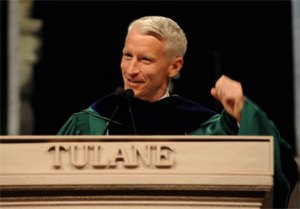
Anderson CooperAnderson Cooper, Tulane University, 2010 Commencement Keynote
“I do hope at some point this weekend, if you haven’t already, you’ll look your parents in the eyes, hold them close, and thank them for their sacrifices. As hard as you’ve worked to get here, they have worked even harder. So parents if your kids haven’t said it, let me just say it for them, thank you. …I must admit I always find it odd to hear myself introduced as a TV anchor.. I never set out to be one and am always suspicious when of anyone who tells me that’s what they want to be. …its like a kid who tells me they want to be a politician. I think you should be a real person before you become a fake one. …After months of waiting, I decided if no one would give me a chance as a reporter, I should take a chance. If no one would give me an opportunity, I would have to make my own opportunity. …I wanted to be a war correspondent, so I decided to just start going to wars. As you can imagine, my mom was thrilled about the plan. I had a friend make a fake press pass for me on a mac, and I borrowed a home video camera… and I snuck into Burma and hooked up with some students fighting the Burmese government… then I moved onto Somalia in the early days of the famine and fighting there. …I figured if I went to places that were dangerous, I wouldn’t have as much competition, and because I was willing to sleep on the roofs of buildings, and live on just a few dollars a day, I was able to charge very little for my stories. As ridiculous as it sounds, my plan worked, and after two years on my own shooting stories in war zones, I was hired by ABC news as a correspondent. I was the youngest correspondent they had hired in many years. Had I gotten the entry-level job I’d wanted, I would have never become a network correspondent so quickly, I probably would never have even become one at all. The things which seem like heartbreaking setbacks, sometimes turn out to be lucky breaks. …While I don’t remember commencement, I do remember my senior year of college feeling paralyzed, because I thought I had to figure out my future all at once. Pick a career, start down a path I’d be on for the rest of my life. I now know it doesn’t work that way. Everyone I know who is successful, and by successful I mean happy in their professional or personal life, every successful person I know could never have predicted when they graduated from college where they’d actually end up. …I’m not saying you should take it easy and just see what happens. You need to outwork everyone around you. You need to arrive early, stay late, you need to make yourself indispensable – you should also probably get rid of those Facebook photos of you passed out on bourbon street. …But as you consider what to do now, you shouldn’t necessarily feel that your next step is the most important one you’ll ever take. It’s not. You will go down many paths that go nowhere. Especially you English majors. You will try things on and realize they don’t fit. And that’s how it should be. Learning what you don’t want to do, is the next best thing to figuring out what you do want to do. …Anyway, I’m not much for giving advice. Especially after reading some other people’s speeches. I’ve quoted this before, but I think it’s one worth repeating. This is what Goldie Hawn told graduates several years ago. “while you are continuing to walk down that sometimes-bumpy road of life, develop the art of laughter and joy. Keep in your backpack of treasures the whole you, the best you. The “you” that won’t fear failure, because lessons learned are the only way to grow.” I know. I just threw up in my mouth a little bit too.”

All of these commencement speeches, and many more I read for this posting, have inspired me to give my own, very short speech. But my commencement speech isn’t for college graduates. My commencement speech is for junior high graduates – those entering into high school – and for any high school class, freshman, sophomore, juniors or seniors. So here goes:

Carl Nielson, Commencement Speech for Incoming Freshmen…in High School

http://www.careercoachingforstudents.net  http://www.nielsongroup.com  http://www.successdiscoveries.com
“Your past is a part of your future. Your first kiss (if that has happened already), your favorite book, favorite TV show, favorite movie. Your parents. Your teachers. All of this is going to impact your future. If it is a strong positive past, it will serve you well as a foundation for the future. If your past was less than ideal, it can serve you well as a motivator for creating that better future for yourself. Either way, the future is totally in your control – others do not have control of your future – only you do.

Even though you’ve taken several history classes already, you can only see and feel your own past clearly right now – your own past is like a drop of water in all the oceans of our great world. What that means is, don’t let your personal experiences overwhelm you. Don’t let your current self perception dictate what you do tomorrow. The majority of teenagers feel inadequate and insecure. Some show their insecurity through shyness. Others through egotistical behaviors. The insecurity comes partially from being intelligent and partially from giving too much power to the concern for others’ perceptions. The intelligent part refers to the fact that you recognize your current ignorance about yourself and the world around you – that’s smart. Giving too much power to others comes from a lack of self-confidence. A lack of self-confidence is coming from the fact that you haven’t walked through the fire much, say, relative to your parents. The more you do…that is, the more activities you engage in – especially outside your comfort zone, and the more you do for others, will give you fire-walking experiences…without much of the fire that can burn you. If you choose to disengage or to follow others rather than lead yourself, you’ll still get experiences. They will come along slower and they will probably include the kind of fire-walking that tends to burn.

Give yourself permission to study and enjoy history. To give you an idea of how important history is, place yourself into the future, let’s say about 30 years. Today becomes the past. Your entire high school experience is part of your past. Now let’s say you are extremely successful 30 years into the future. How did that happen? How did you become extremely successful? Was what you did in high school a part of why you are so successful 30 years out? Did any world events during your school years frame your thinking and shape your motivators? Now that you are successful, how do you define success?

As you emerge into adulthood, life experiences will be overwhelming at times. For some of you that time has already happened. You will continue to experience overwhelming events through your entire life. It isn’t a matter of “if” you have a hard life. You will have a hard life. The real question is “how will you lead your life?”. Will you see your life with happiness and gratitude? To answer the question for myself, my life has been a journey. Not an easy journey. I’ve come to realize that that isn’t good or bad. I’ve chosen my view of acceptance of life’s hard work and have developed an appreciation for myself and for so many people that have been in my life.

There was a time I thought I wasn’t too intelligent. It was during junior/senior high school. I learned many years later that I had many intelligences and in fact some were much higher than average. Instead of being egotistical about my abilities, I am humbled by my abilities. I also see everyone else with the same colored glasses…each of you are extremely talented and above average.  You see, I’ve been running a quasi-experiment for 30 years without really knowing it. In my work as a consultant to corporations, I help CEOs and managers select the best person for a particular job or position in those companies. In all of my work, I never measure IQ or “intelligence quotient” to  predict how well a particular candidate will perform. What I measure has more to do with something you already have right now. Your talent.

Your talents are already established. All you need to do is add a little ingredient called Life Skills and use your moral compass. Together, your talent and a solid foundation in specific life skills guided by a moral compass will take you to a successful future – I guarantee it! Don’t let anyone convince you that you aren’t smart enough. You are smart enough – regardless of your grades today. What will count most is that you find what excites you. Because what the world needs is more people who have come alive. For success to find you requires finding what excites you. There are many paths. You will take several of them to find your success in life. You can do it by chance or you can take control. Either way you’ll get there. One path is much slower than the other path. But in the end it is your choice.”

In closing, remember the words stated by many including Drew Brees at the Loyola University New Orleans, 2010 Commencement: “Love what you do. You will know it when you find it. Enjoy the journey.” But be sure to include quality research at the beginning of your journey and you’ll find your journey to be awesome.” Link to Drew Brees’ speech: http://www.loyno.edu/news/story/2010/5/3/2115

I hope you found this entire article helpful including the links to the full commencement speeches. More 2010 commencement speeches are available at http://www.forbes.com/2010/05/03/commencement-graduation-speakers-2010-leadership-speech.html

Carl Nielson is the developer of Career Coaching for Students™, the premier career exploration program for high school and college students. Nielson is the founder of Success Discoveries (www.successdiscoveries.com) and The Nielson Group (www.nielsongroup.com), an international corporate organizational management consulting firm. Prior to consulting, he served over 20 years in corporate human resources management. He holds a degree in organizational psychology from Texas A&M University. Find Carl on LinkedIn.

If you are looking for true career coaching for students, look at http://www.careercoachingforstudents.net. Are you past the high school and college years? Check out free resources at Success Discoveries. Professional career coaching services offered. See what a real career coach looks like.

Copyright © 2010 Success Discoveries, LLC
Career Coaching for Students™ is a trademark of Success Discoveries, LLC
Life Skills for Students™ is a trademark of Success Discoveries, LLC

2 Ways Students Get Mentoring without a Mentor


A mentor is a great resource for career advice, feedback, and help in building your skills and capabilities. However, it’s not always possible to find one person who has the time or expertise to help you with all of the above. Try these two approaches to getting the mentoring you need: 

  1. Ask adults within your personal network (friends’ parents, teachers, parents’ friends)  for advice. Reach out to a person who you respect for advice or coaching on a specific challenge. Busy people are more likely to have an hour to spend with you than to be able to commit to a long-term mentoring relationship.
  2. Create a personal board of advisors. Line up a group of adults who are willing to give you periodic feedback on things like career options, choosing a major based on a career interest, college choices, etc. This type of quick, periodic input can be especially valuable when it comes from several adults with diverse backgrounds and perspectives.

The Career Coaching for Students™ program includes building a board of advisors and leveraging a network of contacts that has long-term benefits for the student.

Copyright © 2010 Success Discoveries, LLC
Career Coaching for Students™ is a trademark of Success Discoveries, LLC

Preliminary Study Shows Critical Skill Missing in College Freshman


One of the most valuable relationships I have is being part of a professional family called TTI Performance Systems Ltd (TTI). TTI is the worldwide leader in personal and professional assessment tools. With years of research and validation, TTI assessments are time-tested and proven to provide timely solutions for today’s personal talent and business challenges. TTI tools are utilized in over 50 countries and 26 languages to help individuals, businesses and organizations. TTI assessments are used in my Career Coaching for Students™ program for high school and college students. I’ve been a member of TTI’s Chairman’s Club for several years now. This has enabled me to learn about different studies and stay in touch with one of the true thought leaders in personal talent measurement,  Bill Bonnstetter.

Bill Bonnstetter, Founder and Chairman, TTI Performance Systems, Ltd.Bill Bonnstetter, Founder and Chairman of TTI keeps his finger on the pulse by doing research. This not only keeps TTI in the leader position but gives me the ability to apply and share critically significant findings.  Bonnstetter recently conducted a preliminary study of incoming Freshman students in college that showed among other things a significant lack of competency in a particular skill – “Decision Making“.

Why is this skill important for students?
One characteristic that “successful people” share is the ability to make sound and timely decisions. The best student decision makers are able to synthesize a variety of factors, such as personal opinion, group needs and professor instructions, and make decisions that at least come close to satisfying the major requirements of all involved parties.

People who are good at Decision Making do not suffer from an imbalance in the amount of focus they place on any one factor. They will most likely make decisions that place equal emphasis on all involved parties or concerns, therefore, making decisions that are more likely to satisfy all needs.

People whose Decision Making skills need work typically don’t place equal importance on all aspects of a situation and don’t utilize proven processes. Instead, they make decisions that satisfy some, but not all, of the factors or people involved.

Let’s say that a college professor has assigned a research paper that is due in two weeks. A student who is a strong decision maker considers the scope of the professor’s assignment, total class work load, other projects, what part-time work schedule is coming up and next weekend’s social events to decide that it is best to start immediately on the paper and to cancel one of their social plans for the upcoming weekend.  A student who is weak in decision-making may ignore the assignment altogether for the first week and then ignore critical elements of the assignment as they write the paper. Which student is likely to get the better grade on their paper, the one with good decision-making skills or the one with weak decision-making skills?

What skills are associated with Decision Making?

Someone who has mastered skills associated with Decision Making:

• Demonstrates an ability to make difficult decisions in a timely manner.

• Gathers relevant input and develops a rationale for making decisions.

• Evaluates the impact or consequences of decisions before making them.

• Acts decisively despite obstacles, resistance or opposition.

• Accepts consequences of decisions.

• Is willing to correct incorrect decisions when necessary.

• Defends rationale for decisions when necessary.

How do students develop their own skills in Decision Making?

• Don’t make hasty decisions unless the situation requires some type of immediate reaction.

• If the situation requires you to make a quick decision, consider implementing a temporary solution and revisit the issue, incorporating all relevant factors and individuals, when the immediate crisis has passed.

• Don’t always get bogged down in details. Force yourself to look at the situation from a big-picture perspective.

• Practice being a good communicator. Share information as often as possible and be open to suggestions, comments and opinions from others.

• Be sure that everyone who will be affected by the decision you are trying to make has an opportunity to state an opinion about it.

• If you determine that a decision should be made with the help of others, create formal opportunities for the decision-making group to discuss and analyze options.

• Brainstorm to create a variety of potential solutions for each problem you face.

• Don’t be afraid to change your decisions if new information clarifies issues or presents new options.

• Look for creative ways to approach the situation by determining how others have handled similar situations in the past.

• Carefully evaluate the options you have identified based on relevant criteria. How well does each option address the issue at hand? What resources does each option require to be successful? Which options can be completed within the relevant time frame? Is each option a realistic, workable solution?

• Be sure to create potential solutions that are easily put into place. The solution or decision should make things easier, not harder!

• Be educated about the consequences of your decisions. Try to determine how each option you have identified affects others, the budget, the goal of the program or company, and even people outside the organization such as clients or suppliers.

• If you don’t feel that you have enough information, determine what is the worst possible thing that could happen if you made a decision right now without getting any new information. This may help you feel better about making a decision, or it may strengthen your resolve to gather more data.

• If a course of action is unclear and you cannot make a truly informed decision, choose what seems to be the best solution and implement it temporarily. The temporary solution may work well, or it may help you determine an alternate course of action.

• If you make an erroneous decision, be willing to improve it or take corrective action to solve the problem in a more effective manner.

• If others are affected by your decision, not only involve them in the planning process, but also keep them informed of your final decision as well as the results of your decision.

• Always behave ethically. Don’t let stress, time pressures or other people convince you to make decisions that don’t fit within your value system.

Decision Making is one of the Life Skills for Students™ e-learning modules, a highly effective self-directed 12-week program that includes 16 critically important skill learning modules. Each module was selected based on studies of highly successful people and includes simple exercises to develop each skill. Life Skills for Students™ is also included in the Career Coaching for Students™ program. Click on this link for more information about Life Skills for Students™.

Copyright © 2010 Success Discoveries, LLC
Career Coaching for Students™ is a trademark of Success Discoveries, LLC
Life Skills for Students™ is a trademark of Success Discoveries, LLC