Tag Archives: Student Career Exploration

Survey Identifies How Students Choose Their College or University


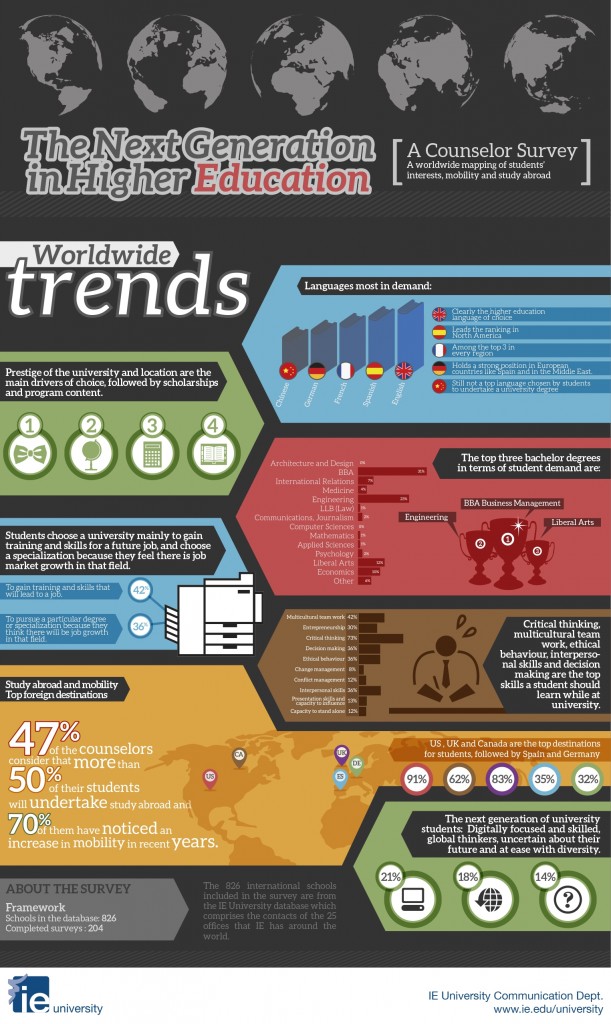
Infographic_TrendsinHigherEd204 university counselors in 33 countries took part in an IE University survey designed to pinpoint the interests and preferences of the upcoming generation of university students with regard to study abroad and most popular degree programs.

The survey shows students choose a university mainly to gain training and skills for a future job, and choose a specialization because they feel there is job market growth in that field. When asked about the main reasons for choosing a university, counselors cited:

Main drivers

  • Prestige
  • Location

Secondary consideration

  • Scholarships
  • Content

These findings suggest there is either a lack of appropriate guidance at the high school level or students are dismissing better advice for how to choose a college or university.

With the percent of students changing majors 2, 3 or 4 times, taking 5 years to complete a 4-year degree and student retention and graduation rates dropping, students need to take a smarter approach to choosing a college or university.

The fact that students list prestige as the #1 consideration creates immediate risk for the student. By not considering newer institutions, that may actually be way ahead of their more traditional and prestigious counterparts, students are missing out on some possibly better choices. But even if your needs are best served in one of the more traditional universities, the most prestigious option may not have the best program for your area of study. Prestige alone is not a good reason to choose a college or university.

The best order of consideration and prioritizing that has been shown to produce the best choice (high satisfaction with choice, retention, graduation in expected time frame) for the student is:

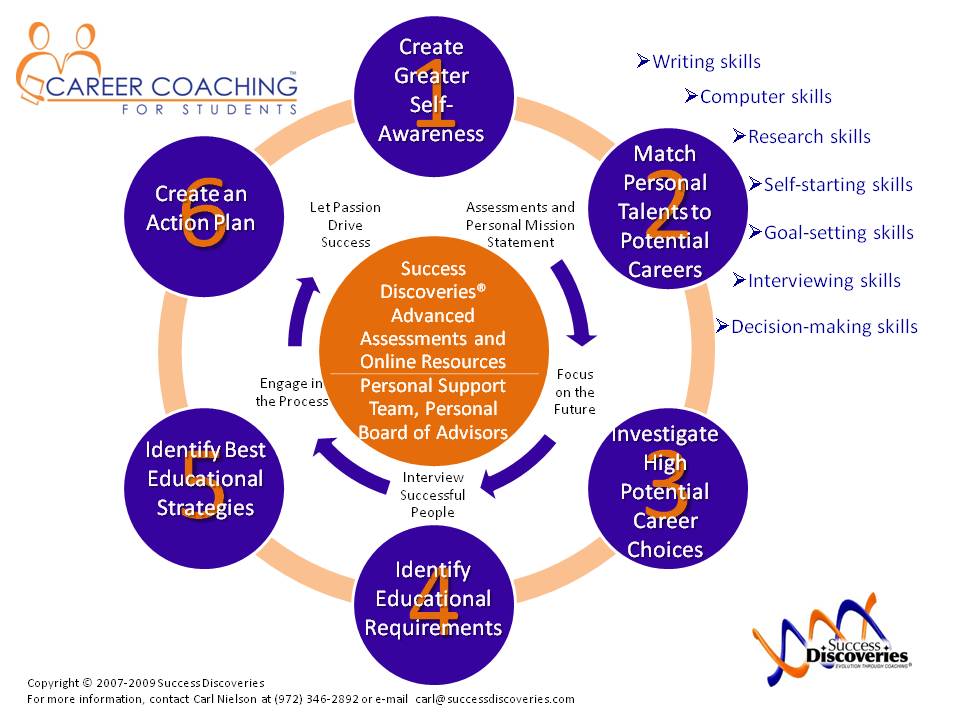
  • Determine career interest(s)
  • Determine education requirements for the career interest(s)
  • Create an education strategy (choice of majors, field of study)
  • Research and identify colleges/universities or vocational learning institutions that are leading in the chosen field(s) of study (a high level of prestige for the specific subject area)
  • Rank findings to create a short list of institutional choices
  • Conduct on-campus visits to all short-listed choices
  • Make the choice

With the cost of higher education so high, a one-semester course correction costs thousands of dollars. By following a smart strategy for decision-making, students can avoid that unnecessary added expense and be much happier with their choice. But it requires students to change the way they think about school choices.

Carl Nielson is an organizational development consultant, executive development coach, career coach and author of the Career Coaching for Students program for high school students and the  Career and Success Skills Mastery for College Students and Recent Grads. Assessment and coaching packages start at $349 – checkout the Summer 2013 special offer.


Countering College Student Objections to Joining LinkedIn


LinkedIn5 COLLEGE STUDENT Objections to Joining LinkedIn

While it is true that some college students may be beyond help, below are some excuses you can meet head on. To support students, my connections exceed over 2,000 which connect me to over 17 million on LinkedIn. I use my connections to help both high school and college students find people in their career of interest as part of the Career Coaching for Students program (high school program or college student program).

Your key to success1. “Creating a LinkedIn profile takes too much time” is a common complaint; however, creating a profile is actually a motivational exercise. Students can easily copy and paste their résumé to their LinkedIn profile and revise it from there. Once their profile starts to fill out, they begin to feel better about their developing profile.

2. “I don’t have time to add a LinkedIn update once a week?” Posting an update once a week is not that hard to do. With most students now on Facebook and Twitter, posting an update takes the same effort. It’s as simple as commenting on a topic such as something interesting being covered in a core course that aligns with your career direction, attaching an article, posting a great quote, letting people know what you are up to, etc.

3. “I don’t think people in my occupation use LinkedIn” might have been a valid point two or three years ago. Some occupations, namely the trades, were slower to jump on the LinkedIn wagon. Today, people in all industries and all types of work are on LinkedIn. With the number of connections I have, I love taking friendly bets on this false perception. I’ve won every bet.

4. “There’s no way I can get 50 connections” is an interesting challenge. LinkedIn allows users to download contacts from their e-mail account from the beginning of registering for membership. One just has to select the members they want to invite and soon acceptances and invites will come their way. An exercise I do with high school and college students is to have them write down on a worksheet everyone they know (friends, extended family, parents of friends, professional contacts). I then poll everyone to see how many they wrote down. In a 5 minute time limit, the average student writes down between 30 and 50 names. I then ask them if it is reasonable to expect each person they wrote down to have the same number of contacts. We then do the math. Using the least (30), the math looks like this: 30 x 30 = 900. Each of us can easily get something between our direct contact count and the 900 within one week. For college students, making this a competitive challenge with a reasonable $$ prize for the highest number of contacts after one week generates amazing results.

5. “I’m just a college student.” LinkedIn will most likely not offer immediate gratification. This isn’t a sprint; it is more like a marathon. The smartest students will invest in the time to begin their lifelong network. They’ll be ahead of their classmates and will most likely receive more interviews and offers when the time comes for the payout.

Carl Nielson is an organizational development consultant, professional career and executive/leadership coach and creator of the nationally recognized program Career Coaching for Students™ . Career Coaching for Students is available as a district-wide high school program, college program and in group and on-one-one offerings through certified career coaches throughout the United States, Canada and other countries. Contact Carl Nielson at carl@successdiscoveries.com or call 972-346-2892 to discuss specific needs. Or visit us at http://www.careercoachingforstudents.net

Informational Interviews are There for the Asking


For students contemplating career direction, it can be hard to know how happy you’ll be in a new job or industry. Find out more about the career you are interested in by finding three to five people who are doing the kind of work you’re interested in. Contact them to set up informational interviews. If you don’t know anyone, find people through your parent’s friends and your friend’s parents or use social media (LinkedIn is the largest networking site).

Don’t feel timid about contacting someone. People are usually flattered when you ask for their opinions, and most enjoy talking about what they do. For college students, you can always offer to take the contact to lunch to sweeten the pot. If you are a high school student, arrange to meet them at their office or place of work and be prompt.

Before the meeting, prepare a list of questions you’d like to ask the interviewee. These may range from “What do you like most about your work?” to “What’s an average day like for you?” to “What does someone have to do to get ahead in your field?”

In the Career Coaching for Students program, we have a set of 18 interview questions you can use. We prepare the students by having a “guest” come in to be interviewed by the students. Having the students see first hand how simple and enjoyable the dialogue can be with a complete stranger prepares and motivates students to leverage this strategy. The pay back for moving outside your comfort zone to pursue and do informational interviews will be significant. You might even be offered the opportunity to job shadow for a day or land a summer job. Wouldn’t that be worth it.

Carl Nielson is an organizational development consultant, professional career and executive/leadership coach and creator of the nationally recognized program Career Coaching for Students™ . Career Coaching for Students is available as a district-wide high school program and in group and on-one-one offerings through certified career coaches throughout the United States, Canada and other countries. Contact Carl Nielson at carl@successdiscoveries.com or call 972-346-2892 to discuss specific needs. Or visit us at http://www.careercoachingforstudents.net

High Schools Recognize Online Student Career Planning Solutions Aren’t Making the Grade


According to an article in Education Week, more and more schools are recognizing that career and education planning for secondary students is essential to producing self-sufficient graduates ready for the workforce of today. With post-secondary education receiving an increasing amount of attention nationwide, many high schools are finding that helping students choose a career goal encourages improvement in academic performance and achieves significant results for their students.

Any increase in planning is welcomed, but many planning programs focus solely on admissions test prep and non-directed career exploration, relying on a series of questionable online inventories and surveys that do not allow for the introspection and guidance needed for such a consequential decision. In contrast, the American School Counselor Association’s National Standards for Students and The George Washington University Freshman Transition Initiative’s Standards for Freshman Transition find three areas of development are key to effective guidance and planning: academic, career, and personal/social development.

Online solutions may seem adequate but are poorly suited for promoting personal/social development, creating intentional student engagement in academics and achieving the results that will make a measurable difference for students. Many high school programs often settle for (and demand) the creation of a 4-year plans starting with the freshman year. Choosing a track is great if it is based on an informed decision by the student. Most high school freshmen are not given the opportunity to do quality research and introspection to make an informed decision – yet the chosen track will impact them for years to come. And these plans only focus on taking the student through a “chosen track” through the end of high school and neglect planning for post-secondary completion and workforce entry, unlike the 10-year career and educations plans recommended in the Standards for Freshman Transition.

There is one alternative – Career Coaching for Students™. To learn about the Career Coaching for Students program, which meets all the Standards for Freshman Transition recommendations, check out the information at http://www.careercoachingforstudents.net.

Carl Nielson is a professional career and executive/leadership coach and creator of the nationally recognized program Career Coaching for Students™ . Career Coaching for Students is available as a district-wide high school program and through certified career coaches throughout the United States and other countries. Call Carl Nielson at 972-346-2892 to discuss specific needs.

The Worst and Best Paying College Majors – Are we asking the right question?


Are you driven by high earning potential? I mean real money. Payscale.com recently published their 2011/2012 salary survey by college major. I guess when you have data you can do anything with it.

For some college majors, for some people, the Payscale.com survey data is meaningful. For it to be useful, it has to be a specialized major that connects (strong correlation) to a specific type of work. For example, it is likely that those who complete an undergraduate degree in Elementary Education are teaching elementary education. In that scenario, the Payscale survey is meaningful and helpful. If you are fully self-aware, understand what a career in elementary education entails (what soft skills, continuing education, etc. are required)  and see yourself as a good fit to the job/career, then you can expect to earn right around the median (geographic differences will explain most of the higher or lower pay range). Money won’t be a personal motivator for that career. However, helping others is a personal motivator for the Elementary Education Teacher career path. What that means is that the job of Elementary Education Teacher rewards “work” that helps others.

If you look at the survey list of college majors, there is one fundamental flaw. The data does not take into account what the person is doing job- and career-wise. Isn’t that the better (more valid) question? How you get there is insightful but not predictive of your potential income as much as “what” you do in your career.

I had a boss back in the ’80s by the name of Don J. Redlinger. He was actually my bosses’ boss. Don was business unit VP, Human Resources. His income, including stock options, put him on a trajectory to being a millionaire. He later was promoted to SVP, Human Resources for the entire multi-national Allied Signal corporation. He was in his 30’s at the time. What degree did Don have? A B.A. in History. Looking at the listing of college majors based on mid-career median income, Don should have been at about $69,000. If he had received a degree in Human Resources, his salary might have been around $62,600. Both are wrong. His degree was a strategic choice along with the college he went to. “What” he was doing was most important and relevant to his income. The industry he was in, and the career path he pursued are much greater predictors of income. How he got to the VP position early in his career has a lot to do with the “total package” which includes your “talent” as well as what you did back in high school, college, internships and early jobs out of college.  My learning – a B.A. degree in History can be extremely valuable across a broad range of careers. Your talent and your strategy determine how well you leverage the degree.

Let’s look at another example – a long-time colleague and client of mine, Freddye Silverman. Freddye has a B.A. degree in  Spanish and M.Ed in Spanish and Education. So what is she doing today, 20+ years since her completion of her education? She is Vice President, Eastern Region at Jeitosa Group International. She is a respected and recognized leader in the HR technology solutions field who has more than 25 years experience as a practitioner and consultant in HR IT.  Freddye also has a teaching background in foreign languages which “enhances her global view”. Prior to Jeitosa she was VP, HR Technology Solutions for Cendant Corporation.

Because she has been a long-time client of The Nielson Group (corporate consulting where we use assessments to coach professionals and executives and assist with evaluating candidates during the hiring process using assessments), Freddye has been assessed using the same assessments used in the Career Coaching for Students program. When she reads her assessment results, she quickly says, “this is who I’ve been all my life“.

We know a great deal more than we did 20+ years ago about measuring personal talent and job matching. In Freddye’s case, what we now know, if used back then, might have suggested she look at a double major, Spanish (foreign language is a passion of hers) and Business Management, specializing in IT project management. Instead of starting her career in teaching (she is “behaviorally” a good fit for teaching/training as well) she might have gone directly into a corporate environment where her income in those early years might have been higher and she would have experienced much greater passion for what she was doing.
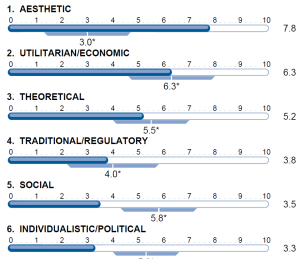
Hierarchy of Personal Motivators

Freddye's Personal Motivators

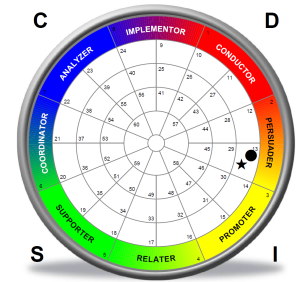
Behavior Insights Wheel

Freddye's Behavioral Style

For Freddye to have remained in teaching (lower pay, help others), her Social motivator (see chart above) would have needed to be much higher and her Utilitarian much lower. While Freddye may not have recognized the forces at work, she has the kind of behavioral style that “easily recognizes and accepts the need for change”. She isn’t one to stay in a situation that doesn’t excite her. She made a career shift early on. Over 50% of the population (including student populations) do not have a behavioral style that can shift as easily and dramatically as Freddye’s.

Many adults are in roles they chose while in college – by default. For those where the choice was a good one (the job’s talent demands fit the person’s talent make-up) it worked out well. For those that weren’t so lucky (around 50%), the chance of watching ten or more years tick off while they feel less than fulfilled and mediocre is high. Choosing a major based on “earning potential of that major” isn’t a good strategy.

We can’t predict the future. But we can do a much better job of helping students look at careers/jobs that match their talent design (behaviors, motivators, sometimes referred to as personality). If a student has a clearer idea of what makes them excited to get up in the morning and how the work they do feels natural to them, they will be much more likely to be successful. Money is one type of reward. There are other types of rewards that are equally powerful and important for success. Look at the job or career-match to your talents rather than the income potential of a major as a first step. Then look at the possible educational strategies that will support your career aspirations. If your career choice is aligned with your talent, any major that allows you to enter that career will work.
Degrees
Degrees
Methodology
Annual pay for Bachelors graduates without higher degrees. Typical starting graduates have 2 years of experience; mid-career have 15 years. See full methodology for more.

By the way, there is no “best major” for a Sales career (see article about groundbreaking research on top performing sales professionals) yet, sales is one of the highest median income career paths. The type of sales and choice of industry are much greater predictors of potential earnings.

Best and Worst Undergrad College Degrees by Major - Are we asking the right question?

Carl Nielson is a professional career coach, creator of Career Coaching for Students™ and managing principal of The Nielson Group, a management consulting firm specializing in hiring and selection, team effectiveness and executive coaching.

Career Exploration for Students is Like Launching the Shuttle


Student Career Exploration is Like a Shuttle Launch

Launching a career and launching a rocket take the same effort

As Americans, we are fascinated by the launching of space missions by NASA. It is an incredible site to watch a launch. The size of the fuel tanks and booster rockets of the Shuttle tells you just how much energy is required at the early stages of a launch. Once speed is attained, very little is required to get the shuttle into orbit.

It’s the same with an airliner. They burn most of their fuel climbing to altitude.

Momentum is the key to a successful launch. An object in motion tends to stay in motion. And of course, an object at rest tends to stay at rest.

The sad fact is few people ever really get much momentum going in their lives and their work. It looks too hard. And they can’t seem to stick with it long enough to get to the point where less and less effort is required and more and more intended results are achieved.

It’s important to take the RIGHT action for sure. But sometimes ANY action is enough to break the habit of inertia and get things moving.

Whatever it takes to get yourself moving, do it.

For me, reading a book or listening to an inspiring or motivating audio file gets me going. Sometimes it’s a conversation with my business partners or a review of my written goals. Music in the background works, too.

The important thing is to get going. It’s an old cliché but beginning IS often half done. Finishing well may be a valuable attribute, but if you never get started, you never get a chance to finish.

Remember, you don’t have to get it right; you just have to get it going.

Career Coaching for Students™ is a program that high school students (and their parents)  find very helpful, exciting, useful and timely. It doesn’t matter if you are at the top of your class or struggling to graduate. In high school every student is at the same level regarding career direction.

If you are a parent of a high school student, or if you are a high school student with a desire to explore the possibilities of your future, I encourage you to take career exploration seriously. It won’t just happen. Like a shuttle launch, career exploration and career planning take a great deal of exploration,  testing of ideas, work, fuel, resiliency and  people. Of course you could just get lucky.

About the Author: Carl Nielson is an executive coach, organizational development consultant and career coach. He developed the program, Career Coaching for Students™ for high school students in 2005 which aligns with 100% of recently published GWU Freshman Transition Initiative guidelines. A college version was just released in June of 2010.

Student Resource Central is Fast Becoming THE Career and College Research Go-To Site


Student Resource Central™, the secure-access part of the Career Coaching for Students™ website is fast becoming THE Career and College Research Go-To Site for students: Incredibly rich with high-quality, high-value and validated content that saves incredible amounts of time for students (and parents).

The Career Coaching for Students™ program is the pride and joy for Success Discoveries (other programs will be coming in time). Because of the depth and quality of the program, the Home Study Personal Edition is $349 (current price) and workshops being offered in various areas of the U.S. range from $500 to $850 per student. While it is worth the price of admission, many families won’t be signing up. Yet, we have an incredibly rich amount of web content for students to use for career exploration exercises, search for colleges that match their educational goals, learn about financial aid, budgeting for college and scholarships and much more. Until now, you had to sign up for the one-on-one coaching or one of the workshop programs to have access to the Student Resource Central site.

We are now offering a $19.95 family license to access Student Resource Central™, the premier career and college exploration resource site. This one-time fee provides access with no expiration. Have more than one child approaching high school? Your username and password will still work next year and the year after. And we provide a 100% satisfaction guarantee or your money back.

We wish every student could take advantage of the full Career Coaching for Students™ program. For those that can’t, access to Student Resource Central™ can be the next best thing.

For-Profit Colleges Mislead Students


SPECIAL OFFER AT BOTTOM OF ARTICLE
On May 4, 2010, we posted an article on this blog and at the home page of Career Coaching for Students™ entitled PBS Frontline Exposes Fraud at For-Profit Schools. Obviously we have to give PBS credit for the story. Now it seems the General Accounting Office (GAO, United States Agency) has published their findings which are both confirming the PBS story and very damning for the “For-Profit Educational Industry”. These “for profits” offer “extensive career planning and placement programs” which has been the enabler for the “for-profit college industry” to secure significant market share in the higher education industry.

According to the United States Government Accountability Office (GAO), nearly two million students attend for-profit colleges, pursuing bachelor’s and associate’s degrees in disciplines that range from cosmetology to nursing and engineering. In 2009, for-profit colleges received more than $20 billion in federal loans and grants. These are powerful institutions that students, the government, and employers have trusted with a significant part of our society’s future. Knowing this information, you can imagine the outrage and shock that accompanied today’s GAO report that implicated 15 for-profit colleges in deceptive recruiting & career planning practices.

Of the 15 colleges tested, four institutions were guilty of fraud in their aggressive and misleading marketing techniques. As part of the GAO’s undercover investigation, four agents posed as prospective students and met with admissions staff for financial aid, tuition, and career planning information. The test revealed the following questionable marketing practices:

  • One for-profit college encouraged an applicant to hide $250,000 worth of assets on a federal financial aid application
  • According to The New York Times, another college encouraged a student to lie about dependents on a financial aid application 
  • Admissions representatives misrepresented tuition costs, quoting the price of classes for nine months instead of one full year
  • Students were provided with false career planning advice. For example, one program mentioned that barbers could earn up to $250,000 annually. According to the Bureau of Labor Statistics, 90 percent of barbers earn $43,000 per year.
  • One admissions representative undermined the financial burden of student loans, implying that defaulters cannot be held accountable for missed payments
  • Admissions representatives engaged in aggressive marketing strategies, pressuring the undercover agents to sign contracts even if they weren’t ready to make a decision.

Although the names of the 15 for-profit colleges remain confidential, the surveyed programs were in a number of disciplines, offering both associate’s and bachelor’s degrees in subjects ranging from business to cosmetology. This information coincides with an education record.

According to the Bureau of Labor Statistics, 70 percent of high school graduates from the class of 2009 were enrolled in a two-year or four-year program when surveyed in October ’09 — the highest number in United States history. While this is a figure worth celebrating, it is also indicative of a growing issue – proper career exploration and planning.

How many of these students are making informed career decisions when choosing a program to attend? How many of these students will position themselves to guarantee a return on investment, and how many will drown in debt upon graduation, falling victim to aggressive marketing practices, false career planning advice, and unrealistic expectations about career prospects? Whether or not students have fair access to objective information, they are still responsible for the costs and consequences of their education and career planning strategy.

Of all the concerning questions, how many students, by taking the bait at these fraudulent institutions, are missing out on a career that would have been much more fulfilling and resulted in greater success?

Students have to make adult decisions with real consequences at a very young age. The issue isn’t whether students are mature enough to choose and plan their careers. The issue is around access to solid, credible career coaching for students. As a society, as parents, as teachers, and as students, it is more important than ever that career coaching be provided to all students.

If you’re not investing a substantial sum of money, you are investing a substantial amount of time, so be an educated consumer when shopping for a college. Just as you would compare the economic implications of buying a car, you should compare the economic implications of your degree, college, and program relative to career interests. In addition to looking at rankings, prestige, and marketing materials — regardless of whether you are looking at a nonprofit or for-profit college — weigh the economic and educational return on investment. Our students are our future’s most valuable asset, so let’s position them to be successful.

A GREAT OFFER TO READERS OF THIS BLOG – UNLIMITED ACCESS TO STUDENT RESOURCE CENTRAL™ FOR ONLY $19.95: The Career Coaching for Students™ website has an extensive private area for career and educational research that is normally reserved for our individual and workshop clients. Each resource has been evaluated for its quality, value and ethical representation of information. We call it Student Resources Central™. Due to the new, alarming information about corrupt “for-profit” institutional practices, we are offering the full Student Resources Central site to parents** and students for $19.95 per access license. This is a unique offer and the access has no expiration. If you are a high school administrator or teacher and would like to gain access to the site for all of your students we offer the same price to you also. This one-time purchase provides access with no expiration. To buy an access license go here. Aren’t sure it is worth it? We guarantee your satisfaction* or we’ll give you a full refund and we’ll eat the credit card fees.

*Guarantee will be honored for 30 days. After 30 days we figure you found the site helpful.
**This offer is not available to professionals or organizations that offer career guidance services, tools or products. For more information on becoming a Career Coaching for Students™ Licensed Facilitator which includes full rights to use Student Resource Central  with all of your customers contact Carl Nielson at 972.346.2892 or visit our Coach Facilitator information page on the website.

Insights for Parents: The Pressure of Choosing a Career


As a parent of a college student and a teenager in high school, one of my biggest questions in my mind is “Am I helping my children with the right information and career guidance?”  Am I helping them understand their unique talents, skills, behaviors and motivators and translate these into identifying a career path that is motivating and fulfilling for them?  

I’ve worked with many teenagers, high school and college students for several years and have gained a few insights. As a full time management consultant, executive coach and executive & student career coach and as a parent, I’m sharing “insights” that I hope are useful to parents. The focus of these insights is specific to parents of teenagers (or college students) who are struggling with helping their son or daughter with career guidance.  So instead of this being advice, please consider these, at best, my insights. 

Here are a few points to consider to reduce the pressure of Career Guidance: 

  1. Be a good listener. Listening with open ears and an open mind is one of the most powerful ways you can help your son or daughter. Listening means “not talking, telling or judging”. Listening means asking open ended questions to learn what is in the mind of your son or daughter?
  2. Observe and create an awareness of their talents and skills. Become very observant of your teenagers skills and talents in their day to day activities at home, schools and in social gatherings. Open ended discussion around these observations creates a heightened awareness among the teenager. This new awareness also motivates them to explore and learn more about these talents and skills on their own.
  3. Be understanding. Choosing a career is a process of exploration and takes time and effort. When helping your son or daughter explore their own talents and the potential careers that will be a good fit, don’t push for an immediate decision, it has to evolve over time in the mind of your child. Choosing a career is not a healthy objective in the short term. A better “parental objective” is to support your son or daughter in exploring their interests, attitudes, motivators (self awareness) and the careers, industries, companies and people that might help them “find” their place in the world. Developing a strategy that ensures they are positioned to pursue the best career for them is an admiral goal and a less frustrating proposition for you and your child.
  4. Approach career exploration as a fun journey. The journey is as certain as life itself. To make career exploration fun means eliminating all of the things that makes it not fun. We parents are very good at telling. Please don’t tell when it comes to career exploration. Parents are very good at sharing their opinions. Please avoid sharing your opinion until your teenager asks for it. Offer support in whatever way your son or daughter wants that support. Remind yourself often how intimidating an exercise this is for son or daughter. Remind them that you were totally blind about careers, that you had no idea how to go about exploring and choosing a career when you were their age and that you were intimidated by the thought of “choosing a career”. Help them create an environment that puts them in control. Within that general guideline, do not allow your son or daughter to put it off (a natural occurrence when we feel intimidation, fear, and incompetent). With little effort, they can learn a lot during the high school years that will put them way ahead of most college students.

You’ll end up turning your frustration into fun and excitement when you watch your son or daughter talk, act and succeed with passion because they own their career choices. This way they not only find their career choices, but are very excited about it and motivated to go the extra mile to succeed. 


Carl Nielson is the developer of Career Coaching for Students™, the premier career exploration program for high school and college students. Nielson is the founder of Success Discoveries (www.successdiscoveries.com) and The Nielson Group (www.nielsongroup.com), an international corporate organizational management consulting firm. Prior to consulting, he served over 20 years in corporate human resources management. He holds a degree in organizational psychology from Texas A&M University. Find Carl on LinkedIn.   Carl speaks to groups on request and offers parent webinars and seminars for communities. 

If you are looking for true career guidance for a student, check out http://www.careercoachingforstudents.net. Are you past the high school and college years? Check out resources and services at Success Discoveries. Professional career coaching services offered.    

Copyright © 2010 Success Discoveries, LLC
Career Coaching for Students™ is a trademark of Success Discoveries, LLC
Life Skills for Students™ is a trademark of Success Discoveries, LLC

Is it time to revamp career guidance in schools?


As a corporate management and organizational development consultant with over 25 years of hiring, firing, training, coaching and development, I find a mixed population when it comes to people with clear, passionate career direction and those without that clarity and passion. My observations and various academic, corporate and government surveys suggest more people fall into the latter category. Yet those in positions of authority within the secondary and higher education career guidance field seem satisfied with the status quo.Is it time to revamp career guidance in schools?

What has changed over the past 30+ years in career counseling in most schools can be summed up in three letters: WWW. Schools are now offering students an online portal to career information. Most of these programs offer personality assessments that point the student to Holland codes.  So if that is an appropriate assessment for students, how many employers use Holland code type assessments to match people to jobs? My informal scan came up with zero. 

Why revamp career guidance in schools?
I’ve listed some reasons (goals and rewards) that support an effort to revamp career guidance in schools.

  • Higher student self-esteem
  • Higher academic achievement across all student populations
  • Better choices for higher education
  • Shorter time in higher-ed (a change in majors delays a student by at least one semester)
  • Lower student loan debt
  • Higher quality workforce
  • Greater job satisfaction
  • Improved society
  • Higher personal income
  • Higher quality of life
  • and greater employability in a passionate career

Career Guidance redefined.

Career guidance starts with bringing self-awareness to the student. This is minimized by schools, or, if attempted, counselors use personality assessments with relatively low validity and reliability. The typical public school administrator thinks they do not have the budget to consider highly reliable, valid assessments and properly conduct counseling or coaching with each student. As one administrator explained, “we need to leave something for the parents to do”. Colleges and universities are found to have very few resources as well. Many continue to use the Myers Briggs Type Indicator as the tool of choice for expanding students’ self-awareness.   

With solid self-awareness, a valid connection needs to be made to career possibilities. Most students get off the train at this point. They didn’t find the “personality assessments” valid (face validity is critical) and found the career suggestions from the assessment report made no sense. The reality is that making the talent-to-career connection requires the help of a professional career coach or a well-developed career coaching program that guides the student through the process.

From initial investigative research to in-depth career analysis, the ability to research careers has been improved drastically thanks to the Internet. However, left on their own, students find the Internet is a rather large, disorganized information bank that has the potential to get the researcher distracted or totally lost and confused. Students don’t need a Google list of Internet resources or school marketing website disguised as a career guidance site. Internet resources need to be found, evaluated, vetted and categorized in a way that allows the student to stay focused with their research and avoid chasing links to questionable or low-value content.

Career research can’t be defined by Internet resources. At some point, the student must meet people in careers of interest, interview these people, go on job shadowing ventures and get internships working for companies that employ people in his career of interest.  There are several other strategies students can take to learn and identify career choices. Most students don’t complete any of these steps. A very few might do some of this.

Researching ideal careers is half the battle. Today’s students lack skills such as decision-making. Life skills that are learned early support students as they go to college or enter the work world. Life skills are just that, skills learned by experiencing life. However, our culture has changed significantly in the past 30 years. Students do not live in an environment that enables them to develop these life skills the way kids did 50 or 100 years ago. Yet school administrators and parents seem unaware of programs they can use to introduce students to key skills required for success. What are the key skills found in highly successful people? Here is a short list of 18 skills. Which of these aren’t needed to be highly successful? 

  1. Continuous Learning (try this one!)
  2. Personal Accountability
  3. Self Management
  4. Decision Making (Conceptual Thinking, Theoretical Problem Solving, Role Confidence, Balanced Decision Making)
  5. Goal Orientation
  6. Proactive Thinking
  7. Initiative
  8. Project and Goal Focus
  9. Planning and Organizing
  10. Flexibility
  11. Problem Solving
  12. Persistence 
  13. Creativity Innovation
  14. Futuristic Thinking
  15. Influencing Others (Conveying Role Value, Gaining Commitment, Understanding Motivational Needs)
  16. Interpersonal Skills (Evaluating Others, Personal Relationships, Persuading Others)
  17. Written Communication
  18. Personal Drive

What are the chances the typical high school student is being developed in these skill areas? I think it is time to revamp career guidance in schools? Please leave your thoughts in the comment box.

Carl Nielson is the developer of Career Coaching for Students™, the premier career exploration program for high school and college students. Nielson is the founder of Success Discoveries (www.successdiscoveries.com) and The Nielson Group (www.nielsongroup.com), an international corporate organizational management consulting firm. Prior to consulting, he served over 20 years in corporate human resources management. He holds a degree in organizational psychology from Texas A&M University. Find Carl on LinkedIn.   Carl speaks to groups on request and offers parent webinars and seminars for communities.

If you are looking for true career guidance for a student, check out http://www.careercoachingforstudents.net. Are you past the high school and college years? Check out resources and services at Success Discoveries. Professional career coaching services offered.   

Copyright © 2010 Success Discoveries, LLC
Career Coaching for Students™ is a trademark of Success Discoveries, LLC
Life Skills for Students™ is a trademark of Success Discoveries, LLC